
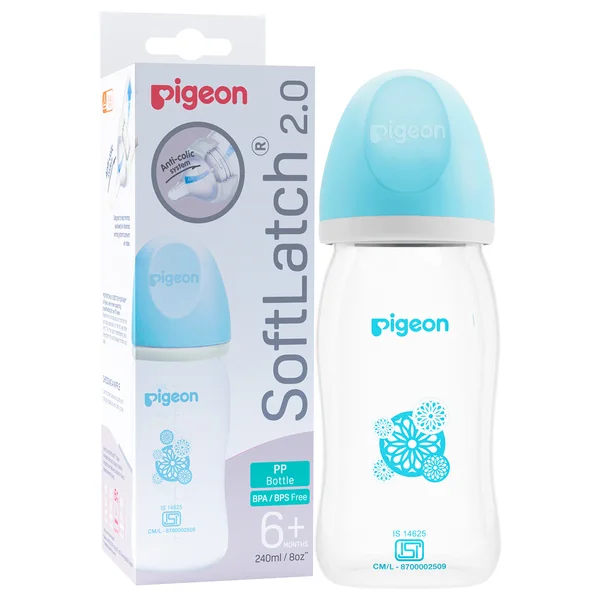
Pigeon Softlatch 2.0 Nursing Bottle Blue, 240 ml


Write a Review
MRP ₹488.5
(Inclusive of all Taxes)
Get Free delivery (₹99)


Extra 15% Off with Bank Offers
Know Your Delivery Time
Provide Delivery Location


Secure Payment

India's Most Trusted Pharmacy

Genuine Products
From the Manufacturers


Manufacturer/Marketer :
Pigeon India Pvt Ltd
Consume Type :
Non Consumable
Return Policy :
Not Returnable
Description
The Pigeon wide-neck nipple plastic feeding bottle is a healthy start to a baby's independent eating habits. The bottle allows natural movement of the baby's tongue, ensuring maximum development of the baby's facial and jaw muscles. The nipple of the bottle is stretchable and allows easy sucking and wide movement of the baby's tongue.

Have a query?
Directions for Use
- Fill the washed and sterilized bottle with the required amount of lukewarm Milk.
- Put the cap with the affixed nipple on the bottle and tighten lightly.
- Feed your baby by using this plastic bottle.
- Attach the hood to the bottle when not in use.
Key Benefits
- SoftLatch 2.0 Nipple: The nipple is made of high-quality, stretchable silicone that allows for the natural peristaltic movement of a baby's tongue.
- Anti-Colic System: Features an advanced venting system to minimize air intake, which helps reduce gas, fussiness, and colic symptoms.
- Wide Neck Design: The wider opening makes it much easier to prepare formula without spills and simplifies the cleaning process.
- Ergonomic Shape: Designed for easy gripping, allowing babies to start holding the bottle comfortably as they develop independent eating habits.
FAQs
Country of origin
India
Manufacturer/Marketer address
Unit No. 216, Suncity Business Tower, Sector 54, Golf Course Road, Gurgaon, Haryana-122002, India.
Other Info - PIG0473

Disclaimer
While we strive to provide complete, accurate, and expert-reviewed content on our 'Platform', we make no warranties or representations and disclaim all responsibility and liability for the completeness, accuracy, or reliability of the aforementioned content. The content on our platform is for informative purposes only, and may not cover all clinical/non-clinical aspects. Reliance on any information and subsequent action or inaction is solely at the user's risk, and we do not assume any responsibility for the same. The content on the Platform should not be considered or used as a substitute for professional and qualified medical advice. Please consult your doctor for any query pertaining to medicines, tests and/or diseases, as we support, and do not replace the doctor-patient relationship.

Buy Now
Add to Cart