A newborn’s heartbeat often surprises parents because it feels much faster than expected. While holding a baby against your chest, many parents notice a rapid fluttering rhythm and immediately wonder whether the heart is beating too quickly. In reality, a newborn’s heart naturally beats much faster than an adult’s because the baby’s body is growing rapidly and the heart is still very small. A faster heart rate helps circulate oxygen-rich blood efficiently to the brain, lungs, muscles, and other developing organs. Understanding what is normal can help parents feel more confident, especially during the first weeks when every movement and body sign feels important. This guide explains the normal newborn heart rate range, why it changes with activity, how to check pulse safely at home, and when a fast or slow pulse needs medical attention.
In this article
- Heart Rate and Pulse: Are They the Same?
- Normal Range by Activity Level
- Why Does a Newborn’s Heart Beat So Fast?
- Why Does Crying Increase Heart Rate?
- Best Time to Check Pulse
- Warning Signs That Need Immediate Medical Attention
- Heart Rate and Breathing Work Together
- How to Support Healthy Heart Function in a Newborn?
- Conclusion
Newborn Baby Heart Rate & Pulse: Normal Range Chart
Learn the normal newborn baby heart rate and pulse range, how to check pulse at home, activity-wise heart rate chart, and when to seek medical advice.
Dr. Mayank
Heart Rate and Pulse: Are They the Same?
Parents often hear both terms and wonder whether they mean different things.
Heart Rate
Heart rate refers to the number of times the heart beats in one minute.
Pulse Rate
Pulse refers to the wave of blood flow felt in an artery each time the heart beats. In practical newborn care, pulse rate and heart rate usually match because every heartbeat creates a pulse. This means checking the pulse gives the same useful information as checking heart rate. According to Mayo Clinic paediatric vital-sign guidance, pulse and heart rate are interchangeable in routine newborn monitoring.
Normal Newborn Heart Rate Chart
A newborn’s heart rate changes depending on activity. A sleeping baby, an awake baby, and a crying baby all have different normal ranges.


Normal Range by Activity Level
A short rise during crying is normal because crying increases oxygen demand.
Why Does a Newborn’s Heart Beat So Fast?
A newborn heart works differently from an adult heart.
Small Heart Size
A baby’s heart is very small and pumps a smaller volume of blood with each beat. To deliver enough oxygen, it must beat faster.
Rapid Growth and High Metabolism
A newborn body grows rapidly. This requires continuous oxygen delivery to:
- Brain
- Muscles
- Organs
- Developing tissues
- Faster Circulation Demand
Because newborn tissues use oxygen quickly, circulation remains fast. According to Cleveland Clinic neonatal heart guidance, fast heart rates are expected in healthy newborn circulation.
How Does Heart Rate Change During Sleep?
Parents often notice slower rhythm while the baby sleeps. This is normal. During deep sleep:
- Metabolism slows
- Breathing becomes regular
- Heart rate drops slightly
- A sleeping heart rate near 90 to 100 bpm can still be normal.
Why Does Crying Increase Heart Rate?
Crying is physically demanding for a newborn. It increases:
- Breathing effort
- Muscle activity
- Oxygen demand
This temporarily pushes the heart rate upward.
A crying baby may briefly reach 180 bpm or slightly higher.
Once soothed, the pulse should return to resting range.
How to Check Your Baby’s Pulse at Home?
Parents may sometimes wish to check pulse for reassurance. The easiest sites are the arm or chest.
1. Brachial Pulse (Inner Arm)
This is commonly used in infants.
- Steps
- Lay your baby calmly on the back
- Use two fingers
- Place them inside the upper arm between shoulder and elbow
- Press gently until the pulse is felt
- Count for 30 seconds and multiply by 2.
2. Apical Pulse (Chest)
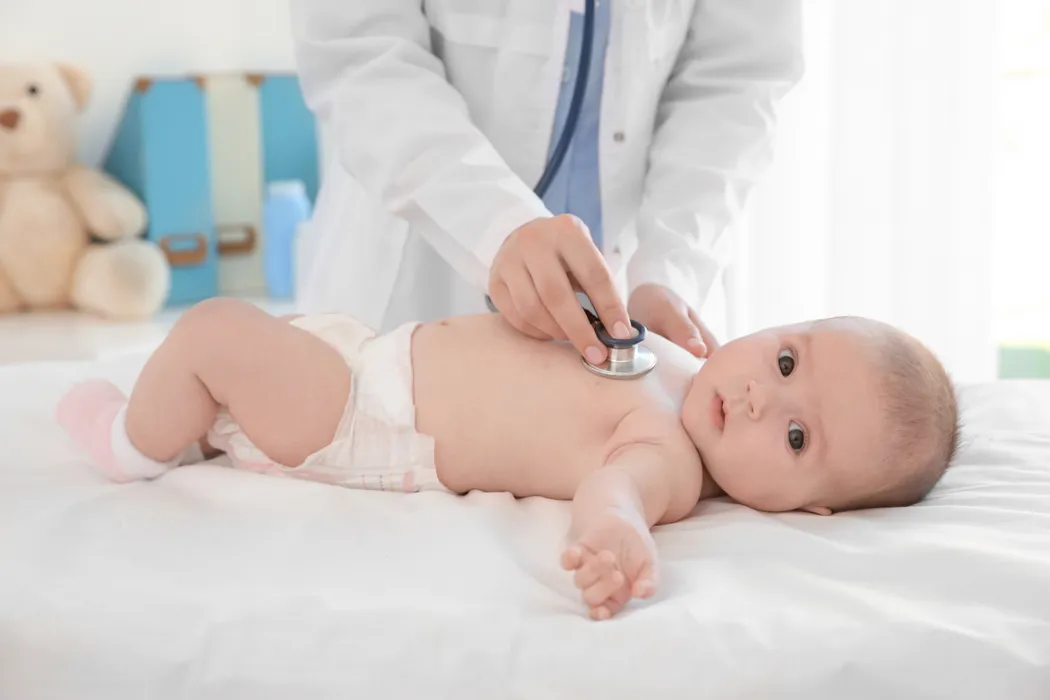
You may also feel the heartbeat directly on the chest.
- Steps
- Place your hand gently on the left side of the chest
- Count beats for one full minute
- A full minute gives the most accurate result.
Best Time to Check Pulse
Always check when the baby is:
- Calm
- Sleeping
- Quiet after feeding
A crying baby gives falsely high numbers.
When Does Heart Rate Become Too Fast (Tachycardia)?
A fast heart rate becomes concerning when it stays elevated while the baby is calm.
- Possible Causes
- Fever
- Dehydration
- Infection
- Anaemia
- Rare rhythm disorders
A calm heart rate repeatedly above 160–180 bpm may need medical review.
When Does Heart Rate Become Too Slow (Bradycardia)?
A slow heart rate during calm wakefulness may also need attention.
- Possible Causes
- Low oxygen
- Congenital heart problems
- Certain neurological issues
- A sustained heart rate below 80–90 bpm while awake should be assessed.
Warning Signs That Need Immediate Medical Attention
Seek urgent medical care if pulse changes occur with:
- Bluish lips
- Poor feeding
- Extreme sleepiness
- Fast breathin
- Chest pulling in during breathing
- Weak movement
The Centers for Disease Control and Prevention advises urgent assessment for newborn breathing changes or abnormal colour.
Heart Rate and Breathing Work Together
Heart and lungs are closely linked.
- A normal newborn breathing rate is:
- 30 to 60 breaths per minute
- If breathing rises above this while calm, pulse may also rise.
How to Support Healthy Heart Function in a Newborn?
Daily care helps support healthy circulation.
Feed Regularly
Frequent feeding prevents dehydration.
Avoid Overheating
Keep room temperature comfortable.
Attend Routine Check-ups
Doctors listen for:
- Murmurs
- Rhythm changes
- Circulation signs
- Keep Environment Smoke-Free
Second-hand smoke affects infant breathing and heart function.
When to Consult a Paediatrician?
Speak to a doctor if:
- Heart feels unusually fast repeatedly
- Pulse seems irregular
- Feeding reduces
- Baby becomes unusually sleepy
Conclusion
A newborn’s heart beats much faster than an adult’s because the body is growing rapidly and the heart must circulate oxygen efficiently through a very small body. Most heart rate changes with sleep, feeding, or crying are completely normal. The most important thing is to assess heart rate together with breathing, colour, feeding, and overall comfort rather than focusing on one number alone.


