Welcoming a new baby into the world is a joyful and life-changing experience, often accompanied by many small but important questions. In the first few moments after birth, your baby’s weight and length are measured as part of routine care. These early measurements give doctors a helpful starting point to assess your baby’s overall health and development.
It is completely natural to wonder what the normal newborn baby height in cm should be. These numbers are not about comparison or perfection. Instead, they act as a baseline that helps track how your baby grows over time. Each baby follows their own unique growth pattern, and small variations are usually completely normal.
Understanding your baby’s length at birth can bring reassurance. It helps you see how your child fits within standard ranges while also recognising that growth is influenced by several natural factors.
In this guide, you will learn about typical newborn length ranges for boys and girls, how doctors interpret these measurements, and what may influence your baby’s height at birth.
In this article
Newborn Baby Height & Length: Normal Range & Growth Chart
Learn the normal newborn baby height and length range in cm, how it’s measured, and what affects growth. Understand growth charts and when to consult a doctor.
Dr. Nallapu Siri
What is the Normal Newborn Baby Length?
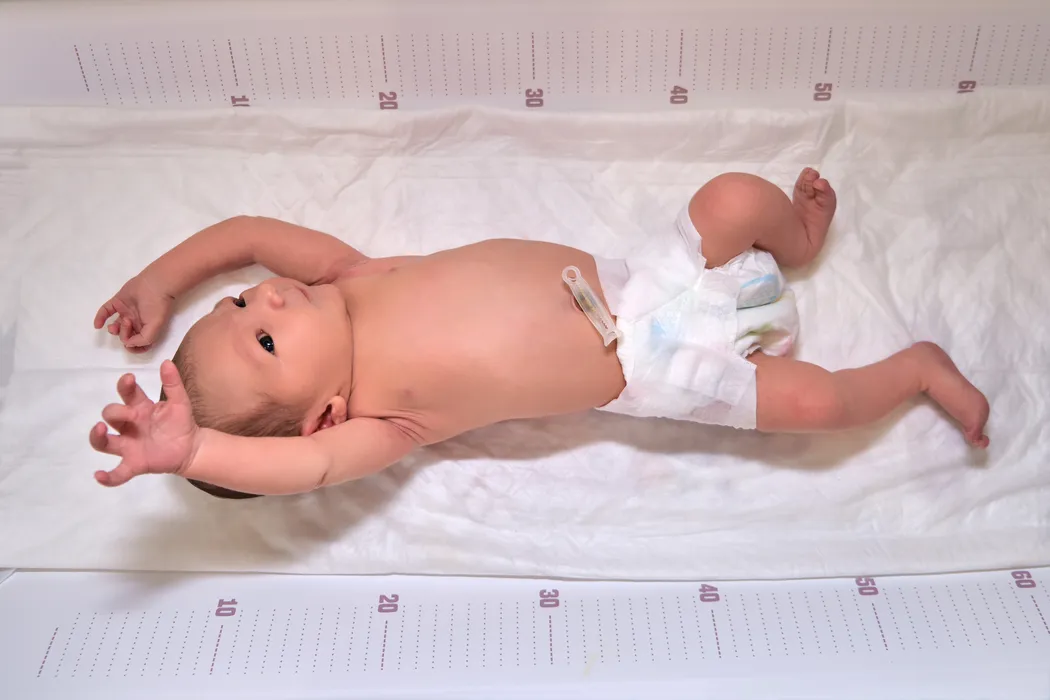
When discussing a baby’s size, doctors usually use the term “length” instead of “height.” This is because newborns are measured while lying down, not standing. In practical terms, both refer to the same measurement.
According to the World Health Organization (WHO), the normal newborn baby length for a healthy, full-term infant typically ranges between 46 cm and 53.5 cm. This range covers the majority of babies and is considered a healthy starting point.
There can be slight differences based on biological sex:
- Baby boys: The average length is around 49.9 cm. This is a general midpoint and may vary slightly from baby to baby.
- Baby girls: The average length is about 49.1 cm. Like boys, small variations within the normal range are completely expected.
Understanding these ranges can be reassuring, but it is important to remember that a single measurement does not define your baby’s health. What matters more is steady, consistent growth over time. Babies who track well along their growth curve are usually developing just as they should.


Understanding Newborn Baby Height in cm, Inches, and Feet
Different hospitals and countries use different measurement systems, which can sometimes feel confusing for new parents. Knowing how these measurements translate can make it easier to understand your baby’s size and share it with family and friends.
Newborn baby height in cm: Globally, the normal newborn length usually falls between 46 cm and 53.5 cm. Most healthy babies measure around 49 to 50 cm at birth, which is considered average.
- Newborn baby height in inches: In the imperial system, this range converts to approximately 18 to 21 inches. An average newborn is typically close to 19.5 inches long.
- Newborn baby height in feet: Although rarely used in medical settings, this can help with visualisation. The average newborn length is roughly 1.6 feet.
If you look at regional variations, such as the average height of newborn babies in India, the figures remain quite similar to global standards. Most full-term babies measure around 48 to 50 cm at birth. Small differences are normal and are usually influenced by factors such as genetics, maternal health, and overall nutrition during pregnancy.
How Do Doctors Measure New Born Length in cm?
You might wonder how healthcare providers manage to measure a newborn’s length accurately, especially since babies naturally curl up and move frequently. In clinical settings, a simple and standardised method is used to ensure precise and consistent measurements.
To measure newborn length, the following steps are followed:
- Positioning the baby: The baby is gently placed on their back on a firm, flat measuring board designed specifically for infants.
- Securing the head: One healthcare provider carefully holds the baby’s head in place against a fixed headboard to ensure alignment.
- Straightening the legs: Another provider gently straightens the baby’s legs, applying light pressure at the knees to reduce natural bending without causing discomfort.
- Measuring the length: A sliding footboard is moved until it rests against the baby’s heels, allowing an accurate measurement from head to toe.
This method provides a reliable measurement of newborn length in centimetres. It forms the baseline used by doctors to monitor your baby’s growth over time and ensure they are developing as expected.
Key Factors Influencing the Height of a Newborn Baby
Not every baby will match the exact average length at birth, and that is completely normal. A newborn’s size is influenced by several natural factors, many of which are beyond a parent’s control.
- Genetics: A baby’s length is strongly influenced by parental genetics. Taller parents are more likely to have longer babies, as growth patterns are partly inherited.
- Gestational age: The number of weeks a baby spends in the womb plays an important role. Babies born closer to or after their due date are usually longer than those born earlier.Premature babies tend to be smaller at birth but often catch up over time.
- Multiple pregnancies: In cases of twins or triplets, babies share space and nutrients in the womb. As a result, they are often slightly smaller in length compared to single births.
- Maternal health and nutrition: A mother’s overall health, diet, and any medical conditions during pregnancy can influence the baby’s growth. Good nutrition and prenatal care support healthy development.
- Biological sex: On average, baby boys tend to be slightly longer than baby girls at birth. The difference is small but consistent across populations.
These factors work together to shape each baby’s starting point. What matters most is not a single number at birth, but steady and healthy growth in the months that follow.
Tracking Newborn Height and Weight Together
Paediatricians do not assess a baby’s length in isolation. Instead, they evaluate height and weight together to build a clearer picture of overall growth, nutrition, and development.
During routine check-ups, your baby’s measurements are plotted on standardised growth charts developed by organisations such as the World Health Organization (WHO) or the Centers for Disease Control and Prevention (CDC). These charts help track how your baby is growing over time compared to other children of the same age and sex.
- Understanding percentiles: If your baby’s length falls in the 50th percentile, it means they are right in the middle compared to other babies. In simple terms, they are longer than 50% of babies and shorter than the other 50%.
- Following the growth curve: Doctors are less focused on the exact percentile and more interested in consistency. What matters most is that your baby continues to grow steadily along their own curve over time. Sudden drops or spikes are what typically need attention.
Tracking both length and weight together helps ensure your baby is receiving adequate nutrition and developing as expected. Over time, these measurements provide valuable insight into your child’s overall health and growth pattern.
When Should You Worry About Your Baby’s Growth?
Understanding average newborn length can be reassuring, but it is equally important to remember that babies grow at their own pace. Growth does not happen in a perfectly steady line. Instead, it often occurs in small spurts, especially during the first few months. On average, babies may grow around 1.5 to 2.5 cm per month in early infancy.
That said, there are certain signs where it is worth discussing your baby’s growth with a paediatrician:
- Noticeable drop in percentiles: If your baby’s height and weight percentiles fall significantly over multiple check-ups, it may indicate a need for closer evaluation.
- Weight gain without length growth: If your baby is gaining weight but not growing in length, it could suggest an imbalance that needs attention.
- Clothing patterns seem unusual: If your baby is outgrowing clothes in weight but not in length, it may be helpful to review their growth pattern.
- General concerns about development or feeding: Any persistent worries about feeding, activity levels, or physical development should be discussed, even if measurements appear normal.
It is important to remember that a single measurement rarely tells the full story. If your baby’s length is slightly outside the average range at birth, doctors usually monitor growth over time rather than treating it as a problem. Regular follow-ups help ensure your baby continues to grow in a healthy and consistent manner.
Conclusion
Understanding your newborn’s height or length can offer reassurance, but it is only one part of a much larger picture. Every baby grows at their own pace, influenced by genetics, nutrition, and overall health. Small variations from the average are common and usually nothing to worry about.
What matters most is steady, consistent growth over time rather than a single measurement at birth. Regular check-ups and growth tracking help ensure your baby is developing as expected.
If you ever feel unsure, it is always best to speak with your paediatrician. With the right guidance and a little patience, you can feel confident that your baby is growing in a healthy and natural way.
Explore Baby Care Products Here
Disclaimer: This article is for informational purposes only and does not substitute for professional medical advice. Always consult your paediatrician for any concerns about your baby’s health and medical needs.
FAQS
FAQS
What is the normal height of a newborn baby in cm?
The normal length for a healthy, full-term newborn usually falls between 46 cm and 53.5 cm. Most babies measure around 49 to 50 cm at birth. Small variations within this range are completely normal and are often influenced by factors such as genetics and gestational age.
How do medical professionals measure newborn height?
Newborns are measured while lying flat on a firm measuring board. Healthcare providers gently position the baby’s head and straighten the legs to measure from head to heel. This method ensures an accurate and consistent measurement, which becomes the baseline for tracking future growth.
Is normal newborn length different for premature babies?
Yes, premature babies are typically shorter at birth because they have had less time to grow in the womb. Instead of comparing them with full-term babies, doctors use specialised growth charts designed for preterm infants to monitor their progress more accurately over time.
What is the average newborn length in India?
In India, most full-term newborns measure between 48 cm and 50 cm. This aligns closely with global averages and is considered a healthy range. Minor differences are expected and usually depend on individual and maternal factors.
Does a newborn’s height and weight predict adult height?
Not always. While birth measurements give an initial idea of growth, they do not determine how tall a child will be as an adult. Long-term height is influenced more by genetics, nutrition, overall health, and growth during childhood and adolescence.


