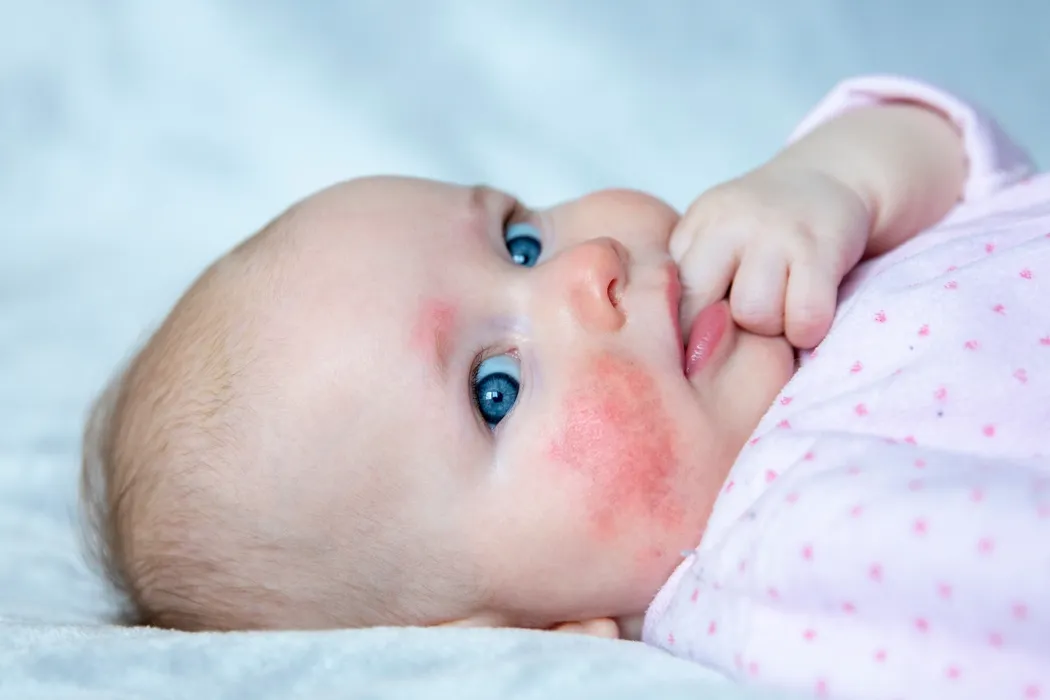
If you are examining your little one and spot lighter areas on their skin, there are a few common pediatric conditions to consider. Most of these are benign (harmless) and resolve on their own.
1. Milia (The Most Common Culprit)
If the white areas look like tiny, raised, pearly bumps rather than flat patches, your baby likely has milia. These occur when dead skin flakes become trapped in tiny pockets near the surface of the skin. They are incredibly common; in fact, nearly half of all healthy babies develop them. You will often see these white spots on newborn babies' noses, cheeks, and chins. They are not painful, they do not itch, and they are not contagious.
2. Post-Inflammatory Hypopigmentation
Babies are prone to minor skin irritations like baby acne, drool rash, or mild eczema. When a red, inflamed rash heals, it can sometimes leave a lighter patch of skin behind. This flat white patch on a newborn baby's skin is known as post-inflammatory hypopigmentation. It simply means the skin temporarily lost some of its pigment during the healing process. Over a few weeks or months, the normal skin colour will naturally return.
3. Pityriasis Alba
This condition is more common in older infants and toddlers, but can occasionally start early. Pityriasis alba initially presents as a mildly red, scaly patch that eventually fades into a flat, light-colored patch. It is considered a mild form of eczema. If you notice these dry white patches in newborn baby skin areas, keeping the skin well-moisturised is the best line of defense.
4. Nevus Depigmentosus
Sometimes, a white spot in a newborn baby's skin is simply a birthmark. Nevus depigmentosus is a localised area of skin that has less melanin than the surrounding skin. It is usually present at birth or appears shortly after. These birthmarks are flat, have irregular borders, and grow proportionately as the baby grows. They are entirely harmless and require no medical treatment.
5. Tinea Versicolor
Though rare in very young infants, tinea versicolor is a mild fungal infection that can cause discoloured patches of skin. The yeast that causes it lives naturally on everyone's skin, but in warm, humid environments, it can overgrow. A doctor can easily diagnose this and prescribe a safe, mild anti-fungal cream if necessary.