
0
Welcome User
Login/Sign Up

Login/Sign Up
₹535
(Inclusive of all Taxes)
Get Free delivery (₹99) with
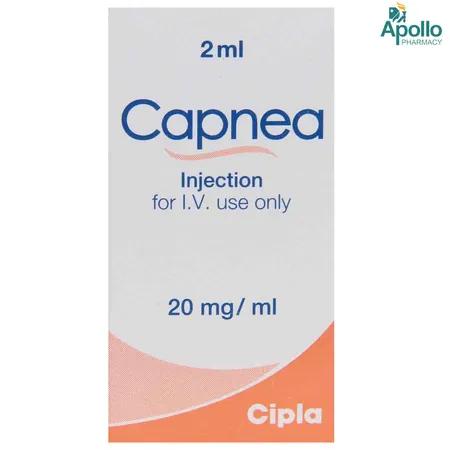
CAPNEA INJECTION 2ML belongs to a group of medicines known as methylxanthines. It is used to treat apnea of premature newborns. Apnea is a condition in which breathing is interrupted, causing abnormal heart rate and oxygen saturation changes. It is a common occurrence, particularly in premature infants.
CAPNEA INJECTION 2ML contains 'Caffeine Citrate', which belongs to the central nervous system (CNS) stimulants class. This medicine stimulates the respiratory centre, sensitising it to hypercapnia. Thereby, CAPNEA INJECTION 2ML effectively regulates the mean respiratory rate and tidal volume, improves pulmonary blood flow, and enhances the breathing pattern.
A paediatrician or healthcare professional will administer CAPNEA INJECTION 2ML in a hospital setting. CAPNEA INJECTION 2ML can cause side effects like a fast heartbeat, irregular heartbeat, and increased blood sugar levels. These side effects are not prevalent and vary from person to person. Consult your doctor if these symptoms continue or worsen.
Inform your doctor about the complete medical history of your infant. If you are nursing your infant and are being treated with this medication, avoid drinking coffee or using any other caffeine-containing products since caffeine passes into breast milk. This medication should be used with caution in infants with impaired hepatic or renal function. Before adjusting the dose, your doctor may assess your child's baseline serum caffeine levels if they were born to a mother who consumes caffeine.
CAPNEA INJECTION 2ML is commonly used to treat apnea.
CAPNEA INJECTION 2ML contains Caffeine Citrate as an active ingredient, which belongs to the central nervous system (CNS) stimulants class. By activating the respiratory centre and making it more sensitive to hypercapnia, this medication helps control the mean respiratory rate and tidal volume and enhances pulmonary blood flow.
Not applicable
-
Not applicable
-
Caution
CAPNEA INJECTION 2ML is intended for use in newborns/neonates only. If your infant is being treated with this medication, avoid drinking coffee or using any other caffeine-containing products since caffeine passes into breast milk.
Not applicable
-
Caution
CAPNEA INJECTION 2ML should be used with caution in infants with impaired liver function.
Caution
CAPNEA INJECTION 2ML should be used with caution in infants with impaired kidney function.
Consult your doctor
CAPNEA INJECTION 2ML is intended for use in premature newborns and neonates. Consult your doctor for more information.
Caution
CAPNEA INJECTION 2ML should be used with caution in patients with heart problems. Therefore, please inform your doctor if your child has any heart problems.
Consult your doctor
Limited information is available on the use of CAPNEA INJECTION 2ML in elderly patients. Please consult a doctor if you have any concerns about its use in elderly patients.
Have a query?
Inform your doctor about your infant's medical history. If you are breastfeeding and your infant is being treated with this medication, avoid drinking coffee or using any other caffeine-containing products since caffeine passes into breast milk. CAPNEA INJECTION 2ML should only be used in a neonatal intensive care unit where adequate patient surveillance and monitoring facilities are available. Treatment should begin under the supervision of a neonatologist with experience in neonatal intensive care. This medication should be used with caution in infants with impaired liver or kidney function.
Drug-Drug Interaction: No interactions were found or established.
Drug-Food Interaction: No interactions were found or established.
Drug-Disease Interaction: No interactions were found or established.
Login/Sign Up
Login/Sign Up
Gufic Biosciences Ltd
₹262.5
(₹262.5/ 1ml)
Abbott India Ltd
₹263
(₹263.0 per unit)
Neon Laboratories Ltd
₹267
(₹267.0/ 1ml)
Disclaimer


