MRP ₹399
(Inclusive of all Taxes)
₹59.9 Cashback (15%)
Provide Delivery Location
About Pamoria Cream
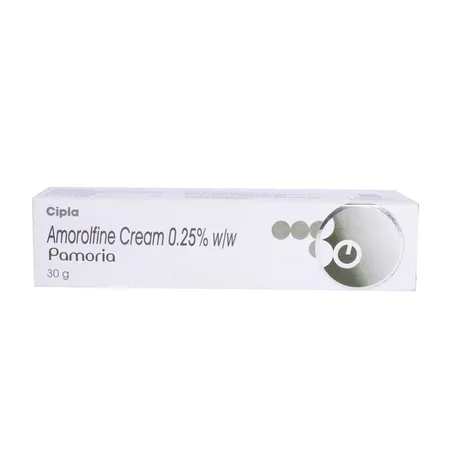
Pamoria Cream belongs to a class of drugs called 'antifungal' primarily used to treat fungal nail infections. Fungal infection occurs when a fungus invades and affects the tissue on the skin. Symptoms of a fungal infection include skin rash, irritation, redness, and scaling of the skin.
Pamoria Cream contains 'Amorolfine' that works by stopping producing a chemical called 'ergosterol' in fungi that causes nail infection. Without ergosterol, the fungus cannot survive. As a result, infection-causing fungi die.
Use Pamoria Cream as suggested by your doctor. Common side effects of Pamoria Cream may include dry skin, itching, redness, or burning sensation of the skin. Most of these side effects of Pamoria Cream do not require medical attention and typically resolve on their own over time. However, if the side effects persist or worsen, please consult your doctor.
If you are pregnant or breastfeeding, it is recommended to consult a doctor before using Pamoria Cream. If you use Pamoria Cream in topical form, avoid smoking or going near naked flames as Pamoria Cream catches fire and burns easily. If you are using any steroidal cream, lotion or ointment, inform your doctor before taking Pamoria Cream to adjust the dose.
Uses of Pamoria Cream
Pamoria Cream is used in the treatment of Fungal nail and skin infections. The detailed uses of Pamoria Cream are as follows:

Have a query?
Directions for Use
Key Benefits
Pamoria Cream is an antifungal that is primarily used to treat fungal infections of nails and skin such as ringworm, jock itch and athlete’s foot, seborrheic dermatitis (dry, flaky skin on face, scalp, chest, upper back, or ears) and pityriasis (a type of skin rash that causes scaly, discoloured patches on chest, back, legs and arms). The fungal cell membranes are essential for their survival, as they prevent unwanted substances from entering the cells and stop the leakage of cell contents. Pamoria Cream causes holes in the fungal cell membranes and kills fungi. Therefore, it clears fungal infections and provides relief from the symptoms of skin irritation, including cracking, burning, scaling, and itching, caused by these infections.
How Pamoria Cream Works
Storage
What if I have taken an overdose of Pamoria Cream
Drug Warnings
Before using Pamoria Cream, let your doctor know if you have a history of liver diseases, adrenal gland problems, cataracts, glaucoma, diabetes or allergic reactions to any medicine ingredient. Let your doctor know if you plan to become pregnant or already pregnant and a lactating mother. Studies show that there may be harmful effects on the baby; hence Pamoria Cream should be used with caution in pregnancy under your doctor's supervision. If you apply Pamoria Cream to breasts or nipple for treatment, wash it off while nursing your baby.
Pamoria Cream is for external use only, so avoid contact with the eyes, the mouth, or intravaginally. Notify the doctor if there is no improvement after one week of treatment for tinea cruris or tinea corporis or two weeks for tinea pedis. When using Pamoria Cream in the groin area, patients should use the medication for two weeks only. Prolonged use of Pamoria Cream may cause hormonal suppression, Cushing's syndrome, hyperglycemia (increased blood sugar level), and glucosuria (high sugar in urine) in some patients. Apply sunscreen (SPF 30 or higher) whenever you go outdoor in the sunlight.
Drug-Drug Interactions
Login/Sign Up
Drug-Food Interactions
Login/Sign Up
Diet & Lifestyle Advise
Habit Forming
Therapeutic Class
RXLivia Healthcare Llp
₹271.5
(₹4.89/ 1gm)
RXCanixa Life Sciences Pvt Ltd
₹384
(₹6.91/ 1gm)
RXSystopic Laboratories Pvt Ltd
₹265
(₹7.95/ 1gm)
Alcohol
Safe if prescribed
No interactions were found. Please consult your doctor before using Pamoria Cream.
Pregnancy
Consult your doctor
Pamoria Cream is a Category C pregnancy drug and is given to a pregnant woman only if the doctor thinks the benefits outweigh the risks.
Breast Feeding
Consult your doctor
There is limited data on how Pamoria Cream affects breastfeeding. Please consult your doctor before starting Pamoria Cream. However, if nursing mothers apply Pamoria Cream to their breasts for treatment, it is advised to wash the affected area thoroughly before breastfeeding the baby.
Driving
Safe if prescribed
Pamoria Cream does not influence on the ability to drive or use machines.
Liver
Consult your doctor
If you have any concerns regarding the use of Pamoria Cream in patients with Liver problems, please consult a doctor.
Kidney
Consult your doctor
Pamoria Cream is safe for patients with kidney disease if prescribed by a doctor.
Children
Safe if prescribed
Pamoria Cream is to be used only on children below 12 years of age when prescribed by a doctor.
Heart
Please inform your doctor if you have any pre-existing heart problems
Geriatrics
Consult your doctor
Limited information available for use of Pamoria Cream in elderly patients. Please consult your doctor.
Pamoria Cream is used to treat fungal nail infections.
Pamoria Cream is safe to use with doctor's advice and over a limited period (1-2 weeks). Let your doctor know if your symptoms are not relieved by then or if you experience any side effects.
Pamoria Cream consists of Amorolfine that should be used after consulting with a doctor if a person has raised blood sugar levels (diabetes mellitus).
You are required to maintain a three-hour gap after applying Pamoria Cream if you are using more than one topical medication.
No, do not stop taking Pamoria Cream on your own, even if the symptoms are relieved, until your course, as advised by the doctor, is finished.
There is limited data on how Pamoria Cream affects breastfeeding. Please consult your doctor before starting Pamoria Cream. However, if nursing mothers apply Pamoria Cream to their breasts for treatment, it is advised to wash the affected area thoroughly before breastfeeding the baby.
Pamoria Cream contains Amorolfine, which works by stopping the production of a chemical called ergosterol in fungi that causes nail infection. Without ergosterol, the fungus cannot survive. As a result, infection-causing fungi die.
Pamoria Cream is for topical (for skin) use only. Do not put a bandage or dressing on the affected area while treating with Pamoria Cream unless the doctor advises. If the medicine gets into your eyes, nose, mouth or vagina, rinse with cold water. Do not apply Pamoria Cream on open wounds, lesions and blisters.
Pamoria Cream, when used for longer periods, can cause thinning and weakening of the skin. Please stop using Pamoria Cream and consult your doctor immediately if you experience these symptoms.
Yes, fungal infection is a contagious skin condition that spreads from one person to another through direct skin-to-skin contact, contact with contaminated soil or surfaces, or contact with infected animals. Therefore, it is recommended to avoid close direct contact until the infection is cleared and to avoid sharing items with the infected person, as this can also spread the infection.
You are recommended to apply makeup or sunscreen to the treated area of skin after a minimum of 20 minutes have passed since using Pamoria Cream.
You are recommended to use Pamoria Cream for as long as your doctor has prescribed it. However, if the condition worsens or persists after 2 to 4 weeks of treatment with Pamoria Cream, please consult a doctor.
You should use Pamoria Cream as prescribed. Your doctor will recommend the dose and duration based on the type of fungal infection. It is usually applied once a week to the affected finger or toenails. Sometimes, your doctor may ask you to use it twice a week.
No, Pamoria Cream is not a steroid. Pamoria Cream is an antifungal drug.
No, do not apply Pamoria Cream on other parts of the body like the oral cavity, eyes or intravaginally. It should only be restricted to nails and skin. Follow your doctor’s instructions carefully.
Yes, Pamoria Cream may cause allergic reactions in some people. Although, it is not very common and is likely to occur in only sensitive or susceptible people. If you experience such reactions, contact your doctor immediately.
Pamoria Cream should not be used in children unless advised by a doctor.
Pamoria Cream may cause skin redness as a common side effect. However, if the condition persists or worsens, consult your doctor.
Apply Pamoria Cream as a thin layer evenly on the entire surface of the dry skin or nail. Always wash your hands after applying Pamoria Cream. Avoid contact of Pamoria Cream with the eyes, ears, and mucous membranes.
Pamoria Cream may cause side effects such as itching, dry skin, redness, and a burning sensation in the skin. If these side effects persist or worsen, please consult your doctor.
Store Pamoria Cream at room temperature. Protect from light. Do not freeze. Keep it out of reach of children.
If you forget to use Pamoria Cream, apply it as soon as you remember. If you have concerns, discuss with your doctor.
Country of origin
Manufacturer/Marketer address
We provide you with authentic, trustworthy and relevant information