
0
Welcome User
Login/Sign Up

Login/Sign Up
₹409.5
(Inclusive of all Taxes)
₹302 with coupons & bank offers*
Get Free delivery (₹99) with
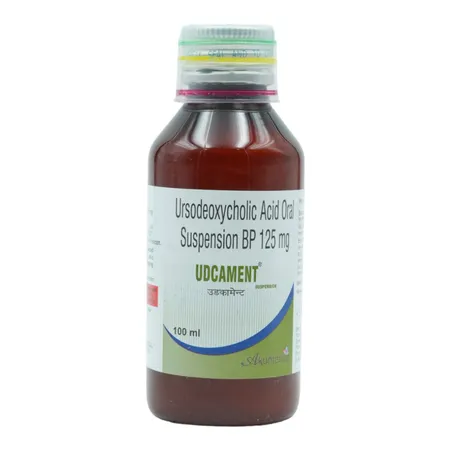
Udcament Oral Suspension is used to treat gallstones, primary biliary cholangitis (an autoimmune disease of the liver), excess cholesterol in the bile, and children above 6 years old with biliary and liver diseases caused by cystic fibrosis.
Udcament Oral Suspension contains ursodeoxycholic acid, which helps decrease the production of cholesterol in the blood, thereby dissolving gallbladder stones composed mainly of cholesterol.
Not everyone who is taking Udcament Oral Suspension will get these side effects. In some cases, you may experience certain common side effects such as abdominal discomfort, abdominal pain, diarrhoea, nausea, rash, dizziness, indigestion and weakness. Most of these side effects do not require medical attention and will resolve gradually over time. However, you are advised to talk to your doctor if you experience these side effects persistently.
Take Udcament Oral Suspension as advised. Your physician will decide the dosage based on your medical condition. You can take Udcament Oral Suspension with food to avoid any stomach upset. It is advised not to take more than the recommended dose of Udcament Oral Suspension . Do not chew, crush, or break the medicine.
Inform your doctor before taking Udcament Oral Suspension if you are allergic to it, or have variceal bleeding (high blood pressure in portal veins), ascites (excess abdominal fluid), or liver disease. Do not take Udcament Oral Suspension if you are pregnant or breastfeeding unless prescribed. Udcament Oral Suspension can be given to children above 6 years if prescribed by the doctor. Avoid consuming alcohol along with Udcament Oral Suspension as it could lead to increased drowsiness and liver damage.
Udcament Oral Suspension is used in the treatment of gallstones, primary biliary cholangitis and biliary and liver diseases caused by cystic fibrosis. The detailed uses of Udcament Oral Suspension are as follows:
Unsafe
Avoid consumption of alcohol while taking Udcament Oral Suspension as it may cause increased dizziness and liver damage.
Consult your doctor
Udcament Oral Suspension belongs to pregnancy category B. Please consult your doctor if you have any concerns regarding this. Your doctor will prescribe only if the benefits outweigh the risks.
Consult your doctor
Consult your doctor before taking Udcament Oral Suspension ; your doctor will decide whether breastfeeding mothers can take Udcament Oral Suspension or not.
Consult your doctor
Udcament Oral Suspension does not affect your ability to drive. However, you are advised to be cautious while driving if you experience dizziness.
Caution
Dose adjustment may be needed in patients with liver impairment. Please consult your doctor if you have a liver impairment or any concerns regarding this.
Caution
Dose adjustment may be needed in patients with kidney impairment. Please consult your doctor if you have kidney impairment or any concerns regarding this.
Caution
Udcament Oral Suspension can be given to children with caution above 6 years and only if prescribed by the doctor.
Consult your doctor
Please consult your physician if you have any heart-related problems before taking Udcament Oral Suspension .
Consult your doctor
Limited information available for use of Udcament Oral Suspension in elderly patients. Please consult your doctor.
Have a query?
The time required for Udcament Oral Suspension to start to work: The time required for Udcament Oral Suspension to show its action is unknown. The time for which the effects of Udcament Oral Suspension last: The duration of action for Udcament Oral Suspension is unknown.
Drug-Drug Interactions: Udcament Oral Suspension may interact with antibiotics (ciprofloxacin and dapsone), antihypertensive agents (nitrendipine), immunosuppressants (cyclosporine), hormones (oestrogen), and antacids (aluminium hydroxide, aluminium carbonate, magaldrate).
Drug-Food Interactions: No interactions found/established.
Drug-Disease Interactions: Inform your doctor if you have biliary obstruction and liver impairment, variceal bleeding (high blood pressure in portal veins), ascites (excess abdominal fluid), or liver encephalopathy.
Login/Sign Up
Login/Sign Up
Disclaimer


