
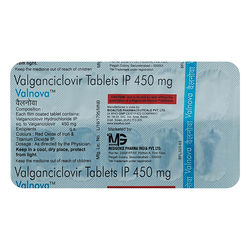
Valnova Tablet 10's




₹3573.5
 ₹536.0Cashback (15%)
(Inclusive of all Taxes)
₹2637 with coupons & bank offers*
 Offers & Discounts
Get Free delivery (₹99) with


Delivery Information
More about the Product
Composition :
Manufacturer/Marketer :
Consume Type :
Expires on or after :
Return Policy :
NPPA :
About Valnova Tablet
Valnova Tablet is a prescription medicine used to treat cytomegalovirus (CMV) infection of the retina in people with acquired immunodeficiency syndrome (AIDS). It is also used to help prevent CMV disease in patients who have received an organ transplant, such as a kidney, heart, or pancreas, and are at high risk of getting this infection. This medicine helps manage viral growth to protect vital organs and preserve vision.
You should take Valnova Tablet exactly as prescribed by your doctor, keeping a consistent daily schedule to maintain steady levels of the medication in your body. It is highly recommended to take this oral medicine with food, as eating a meal significantly helps your body absorb the drug. Adopting a diet rich in nutrients and getting sufficient rest can also support your immune system during treatment.
Common side effects of Valnova Tablet include diarrhoea, fever, nausea, and low blood cell counts, which can leave you feeling tired or more vulnerable to new infections. If you experience severe side effects such as unusual bruising, pale skin, unexplained fever, or sudden changes in your vision, you must contact your doctor immediately.
Before starting this medication, talk to your doctor if you have kidney problems, a history of blood cell disorders, or are receiving bone marrow treatments. Do not take this if you are allergic to this medication or other similar antiviral drugs. Individuals with severe kidney impairment or severely low blood cell counts may not be able to take this medicine.
Valnova Tablet can interact with other medicines that affect your kidneys or bone marrow, and drinking alcohol while on this medication can increase your risk of severe side effects. Pregnant women, breastfeeding mothers, and elderly individuals must consult their healthcare provider before using this medicine, as it can carry serious risks for these specific groups.
Uses of Valnova Tablet
Valnova Tablet is used to treat and prevent cytomegalovirus (CMV) infections in specific high-risk patients. It is mainly used for:
- Cytomegalovirus (CMV) retinitis in AIDS patients: Valnova Tablet helps control the virus in the eye, preventing the infection from spreading and protecting your vision from permanent damage.
- Prevention of CMV disease in organ transplant recipients: Valnova Tablet prevents the virus from active replication in high-risk kidney, heart, liver, or kidney-pancreas transplant patients, reducing the risk of CMV disease after transplantation.
Key Benefits
Valnova Tablet helps control CMV infection and reduces the risk of serious complications. Key benefits of using Valnova Tablet include:
- Protects your vision: Valnova Tablet helps stabilise your sight and reduces the risk of blindness by controlling CMV infection in the eye. This allows you to maintain your daily activities and independence.
- Supports recovery after organ transplantation: This medicine provides critical protection for your immune system and organs by keeping cytomegalovirus under control. This helps you recover more safely after a major transplant.
- Helps prevent the return of severe viral symptoms: Taking this medicine consistently helps prevent the return of severe viral symptoms. This gives you peace of mind and supports your overall physical recovery.
- Inform Your Doctor: Notify your doctor immediately about your diarrhoea symptoms. This allows them to adjust your medication or provide guidance on managing side effects.
- Stay Hydrated: Drink plenty of fluids to replace lost water and electrolytes. Choose water, clear broth, and electrolyte-rich drinks. Avoid carbonated or caffeinated beverages to effectively rehydrate your body.
- Follow a Bland Diet: Eat easy-to-digest foods to help firm up your stool and settle your stomach. Try incorporating bananas, rice, applesauce, toast, plain crackers, and boiled vegetables into your diet.
- Avoid Trigger Foods: Steer clear of foods that can worsen diarrhoea, such as spicy, fatty, or greasy foods, high-fibre foods, and dairy products (especially if you're lactose intolerant).
- Practice Good Hygiene: Maintain good hygiene to prevent the spread of infection. To stay healthy, wash your hands frequently, clean and disinfect surfaces regularly, and avoid exchanging personal belongings with others.
- Take Anti-Diarrheal Medications: If your doctor advises, anti-diarrheal medications such as loperamide might help manage diarrhoea symptoms. Always follow your doctor's directions.
- Keep track of your diarrhoea symptoms. If they don't get better or worse or are accompanied by severe stomach pain, blood, or dehydration signs (like extreme thirst or dark urine), seek medical help.
- Include iron-rich foods like dark leafy vegetables, lean red meat, legumes and fish in your diet.
- Consume vitamin C-rich foods as they aid iron absorption.
- Limit tea, cocoa, and coffee as these can slow iron absorption.
- Exercise regularly; however, do not overdo it.
- Notify your doctor immediately if you experience tremors or involuntary shaking after taking medication or adjusting your medication regimen.
- Your doctor may adjust your medication regimen or recommend alternative techniques like relaxation, meditation, or journaling to alleviate tremor symptoms.
- Your doctor may direct you to practice stress-reducing techniques, such as deep breathing exercises, yoga, or journaling.
- Regular physical activity, such as walking or jogging, can help reduce anxiety and alleviate tremor symptoms.
- Your doctor may recommend lifestyle changes, such as avoiding caffeine, getting enough sleep, and staying hydrated, to help manage tremors.
- Maintain regular follow-up appointments with your doctor to monitor tremor symptoms and adjust treatment plans as needed.
- Prepare for a restful night's sleep: Develop a calming pre-sleep routine, like reading or meditation, to help your body relax and prepare for sleep.
- Create a sleep-conducive Environment: Make bedroom a sleep haven by ensuring it is quiet, dark and calm.
- Follow a Sleep Schedule: Go to bed and get up at the same time every day to help regulate your body's internal clock and increase sleep quality.
- Try relaxing techniques like deep breathing, mindfulness meditation and any others.
- Limit stimulating activities before bedtime: Avoid stimulating activities before bedtime to improve sleep quality.
- Monitor Progress: Keep track of your sleep patterns to identify areas for improvement.
- Consult a doctor if needed: If these steps don't improve your sleep, consult a doctor for further guidance and therapy.
- Inform your doctor about the nausea and discuss possible alternatives to the medication or adjustments to the dosage.
- Divide your daily food intake into smaller, more frequent meals to reduce nausea.
- Opt for bland, easily digestible foods like crackers, toast, plain rice, bananas, and applesauce.
- Avoid certain foods that can trigger nausea, such as fatty, greasy, spicy, and smelly foods.
- Drink plenty of fluids, such as water, clear broth, or electrolyte-rich beverages like coconut water or sports drinks.
- Use ginger (tea, ale, or candies) to help relieve nausea.
- Get adequate rest and also avoid strenuous activities that can worsen nausea.
- Talk to your doctor about taking anti-nausea medication if your nausea is severe.
- Record when your nausea occurs, what triggers it, and what provides relief to help you identify patterns and manage your symptoms more effectively.
- Preventing Vomiting (Before it Happens)
- Take medication exactly as prescribed by your doctor. This can help minimize side effects, including vomiting.
- Having a small meal before taking your medication can help reduce nausea and vomiting.
- Talk to your doctor about taking anti-nausea medication along with your prescribed medication.
- Managing Vomiting (If it Happens)
- Try taking ginger in the form of tea, ale, or candy to help alleviate nausea and vomiting.
- What to Do if Vomiting Persists
- Consult your doctor if vomiting continues or worsens, consult the doctor for guidance on adjusting your medication or additional treatment.
- Limit sugary drinks and foods to reduce yeast growth.
- Avoid yeast-rich foods like beer, wine, and sourdough bread.
- Include probiotic-rich foods like yogurt, kefir, kimchi, and sauerkraut.
- Eat antifungal foods like garlic, onions, cinnamon, and coconut oil.
- Focus on nutrient-rich foods high in vitamins C and E.
- Use a warm saltwater rinse in your mouth several times daily.
- Practice excellent oral hygiene through regular brushing, flossing, and denture cleaning.
- Stay hydrated by drinking plenty of water.
- To manage stress, try relaxation methods like deep breathing exercises, meditation, or yoga to help calm your mind and body.
- Avoid smoking and tobacco to prevent immune function impairment.
- Consult a doctor for proper diagnosis and treatment.
Directions for Use
- Valnova Tablet can be taken with food to minimise stomach discomfort or as advised by your doctor.
- Follow your doctor's instructions on the dosage and timing of this medication to ensure safety.
- Swallow Valnova Tablet as a whole with a glass of water.
- Do not chew, crush, or break it.
How Valnova Tablet Works

Alcohol
Consult your doctor
The interaction of alcohol with Valnova Tablet is unknown. Please consult a doctor before consuming alcohol while using Valnova Tablet .

Pregnancy
Unsafe
Valnova Tablet is not recommended for pregnant women as it may cause birth defects. Please consult a doctor if you are pregnant.

Breast Feeding
Unsafe
Avoid breastfeeding while taking Valnova Tablet as it may pass into breast milk. Therefore, please consult a doctor if you are breastfeeding.

Driving
Unsafe
Valnova Tablet may cause dizziness, tiredness, drowsiness, shakiness or confusion in some people. Therefore, avoid driving or operating heavy machinery if you experience any of these symptoms after taking Valnova Tablet .

Liver
Caution
Take Valnova Tablet with caution, especially if you have a history of liver disease. The dose may be adjusted by your doctor as required.

Kidney
Caution
Take Valnova Tablet with caution, especially if you have a history of kidney disease. The dose may be adjusted by your doctor as required.

Children
Consult your doctor
Valnova Tablet should be used in children only if recommended by a doctor.

Heart
Caution
Valnova Tablet should be used with caution in patients with heart problems. Inform your doctor about any heart-related conditions before taking Valnova Tablet .

Geriatrics
Caution
Limited data is available regarding the use of Valnova Tablet in elderly patients. If you have any concerns about the usage of Valnova Tablet in geriatrics, please consult your doctor.
What if I have taken an overdose of Valnova Tablet
Diet & Lifestyle Advise
- Stay well-hydrated: Drink plenty of fluids throughout the day to help protect your kidneys, as this medicine is cleared from your body through your urine.
- Practice strict food safety: Since your immune system may be weakened, avoid raw or undercooked meats, unpasteurised dairy products, and unwashed produce to prevent foodborne infections.
- Protect yourself from germs: Wash your hands frequently with soap and water, and avoid close contact with people who have active infections like colds or flu.

Have a query?
How Soon It Starts Working
- The time required for Valnova Tablet to start to work: Valnova Tablet ideally shows its action within 2 hours after administration.
- The time for which the effects of Valnova Tablet last: The effect of Valnova Tablet lasts for 4 hours.
What if you forget to take Valnova Tablet
Storage
- Store Valnova Tablet tablets at room temperature, between 20°C and 25°C (68°F to 77°F), in a dry place away from direct heat and moisture. Do not store them in the bathroom cabinet.
- If you are using the oral solution, store the liquid in the refrigerator betw.
Drug Warnings
- Avoid handling broken or crushed tablets: Especially if you are pregnant or planning to become pregnant, as the active substance can be absorbed through the skin and may cause birth defects.
- Wash exposed areas immediately: If the powder from a broken tablet or the liquid medicine touches your skin or eyes, wash the area immediately and thoroughly with soap and water.
- Get regular blood tests: This medicine can lower your white blood cells, red blood cells, and platelets, which must be monitored closely as directed by your doctor.
- Use effective birth control: During treatment and for at least 90 days after your last dose (for men) or 30 days (for women) to prevent pregnancy, as this medicine can cause birth defects and affect fertility.
Drug-Drug Interactions


Drug-Drug Interaction Summary:
- Medicines that can damage the kidneys: Taking Valnova Tablet with other medicines that can damage the kidneys (such as certain antibiotics or pain relievers) can increase the risk of kidney damage.
- Bone marrow-suppressing medicines: Combining this medicine with drugs that suppress your bone marrow (such as certain cancer therapies or other antivirals) can severely lower your blood cell counts.
- Medicines used for gout (such as probenecid): Taking it alongside medications used for gout (like probenecid) can increase the levels of Valnova Tablet in your blood, raising the risk of side effects.
- Imipenem-cilastatin: Avoid using this medicine with Valnova Tablet , as the combination may increase the risk of seizures.
Drug-Drug Interactions
Login/Sign Up
Taking cidofovir with Valnova Tablet can increase the risk of kidney problems.
How to manage the interaction:
Taking Valnova Tablet with Cidofovir is not recommended as it can possibly result in an interaction, but can be taken together if prescribed by a doctor. However, if you experience nausea, vomiting, loss of hunger, increased or decreased urination, sudden weight gain or loss, swelling, shortness of breath, muscle cramps, tiredness, weakness, dizziness, confusion, or an irregular heart rhythm, consult a doctor. Do not discontinue any medications without consulting a doctor.
Taking Valnova Tablet and Deferiprone may increase the risk of severe infections.
How to manage the interaction:
There may be a possibility of interaction between Valnova Tablet and Deferiprone, but it can be taken if prescribed by a doctor. If you're having any of these symptoms - like infection, fever, chills, diarrhea, sore throat, trouble breathing, losing weight, or pain while peeing - contact your doctor right away. Do not stop using any medications without a doctor's advice.
Taking Clozapine and Valnova Tablet may increase the risk of severe infections.
How to manage the interaction:
Taking Clozapine with Valnova Tablet together can possibly result in an interaction, but it can be taken if your doctor has advised it. If you're having any of these symptoms - like fever, chills, diarrhea, sore throat, muscle aches, shortness of breath, weight loss, pain or burning during urination - contact your doctor right away. Do not stop using any medications without a doctor's advice.
The combined use of cladribine and Valnova Tablet can increase the risk of infections.
How to manage the interaction:
Taking Cladribine with Valnova Tablet together can possibly result in an interaction, but it can be taken if your doctor has advised it. If you have any of these symptoms - infection, fever, chills, diarrhea, sore throat, muscle aches, difficulty breathing, weight loss, pain, or burning while urinating - contact your doctor right away. Do not discontinue any medications without consulting your doctor.
The combined use of golimumab and Valnova Tablet can increase the risk of infections.
How to manage the interaction:
Although taking Valnova Tablet and Golimumab together can cause an interaction, it can be taken if your doctor has suggested it. If you notice any of the following symptoms - fever, chills, diarrhea, sore throat, muscle aches, difficulty breathing, weight loss, pain or burning while peeing - contact your doctor right away. Do not stop using any medications without talking to your doctor.
The combined use of etanercept and Valnova Tablet can increase the risk of serious infections.
How to manage the interaction:
Although there is a possible interaction between Valnova Tablet and Etanercept, you can take these medicines together if prescribed by a doctor. However, if you experience fever, chills, diarrhea, sore throat, muscle pains, breathing difficulty, blood in your coughing fluid, weight loss, red or irritated skin, body sores, and discomfort or burning when you urinate, consult a doctor. Do not stop using any medications without talking to a doctor.
The combined use of infliximumab and Valnova Tablet can increase the risk of infections.
How to manage the interaction:
Co-administration of Valnova Tablet with Infliximab can result in an interaction, but it can be taken if your doctor has advised it. However, if you experience fever, chills, diarrhea, sore throat, muscle pains, breathing difficulty, blood in your coughing fluid, weight loss, red or irritated skin, body sores, and discomfort or burning sensation when you urinate, consult a doctor. Do not stop using any medications without a doctor's advice.
When Valnova Tablet is used with Maribavir, it may make Valnova Tablet less effective in treating your condition
How to manage the interaction:
Although there is a possible interaction between Valnova Tablet and Maribavir, you can take these medicines together if prescribed by your doctor. If you're having any unusual symptoms, contact a doctor right away. Do not stop using any medications without talking to your doctor.
Combining Valnova Tablet with Zidovudine can increase the risk of side effects.
How to manage the interaction:
Although taking Valnova Tablet and Zidovudine together can cause an interaction, it can be taken if your doctor has suggested it. If you experience any complications or symptoms, make sure to contact your doctor right away. Do not stop using any medications without a doctor's advice.
The combined use of adalimumab and Valnova Tablet can increase the risk of serious infections.
How to manage the interaction:
There may be a possibility of interaction between Valnova Tablet and Adalimumab, but it can be taken if prescribed by a doctor. If you notice any of the following symptoms - fever, chills, diarrhea, sore throat, muscle aches, difficulty breathing, weight loss, pain or burning while peeing - reach out to your doctor right away. Do not stop using any medications without talking to your doctor.
Drug-Food Interactions
Drug-Food Interaction Summary:
- Food: Taking this medicine with food increases its absorption into your body, making it more effective. Do not take it on an empty stomach unless directed by your doctor.
Drug-Food Interactions
Login/Sign Up

All Substitutes & Brand Comparisons


FAQs
Disclaimer
Author Details


Reference
- Electronic Medicines Compendium (EMC). Pil.8177 Patient Information Leaflet (PIL). Cheshire, UK: Datapharm; 2025. [Accessed on 02 Jun. 2026]Check here
- Electronic Medicines Compendium (EMC). Pil.6508 Patient Information Leaflet (PIL). Cheshire, UK: Datapharm; 2025. [Accessed on 02 Jun. 2026]Check here
- Alganciclovir [Prescribing Information]. 2010. [Accessed on 01 Apr. 2019]Check here
- Valgaciclovir [Prescribing Information]. 2025. [Accessed on 09 Mar. 2025]Check here
- Fda.gov. 2020. VALCYTE (valganciclovir hydrochloride tablets) [Accessed on 19 March 2025]Check here
- Valganciclovir 450 mg Film-coated Tablets - Summary of Product Characteristics (SmPC) - (emc) [Internet]. [Accessed on 19 March 2025]Check here
- Valganciclovir 450 mg Film-coated Tablets -PIL-Electronic Medicines Compendium (EMC). Electronic Medicines Compendium (eMC) [Internet]. Medicines.org.uk. 2019. [Accessed on 2025 Mar 19]Check here
Country of origin
Manufacturer/Marketer address
Therapeutic Class
Habit Forming

