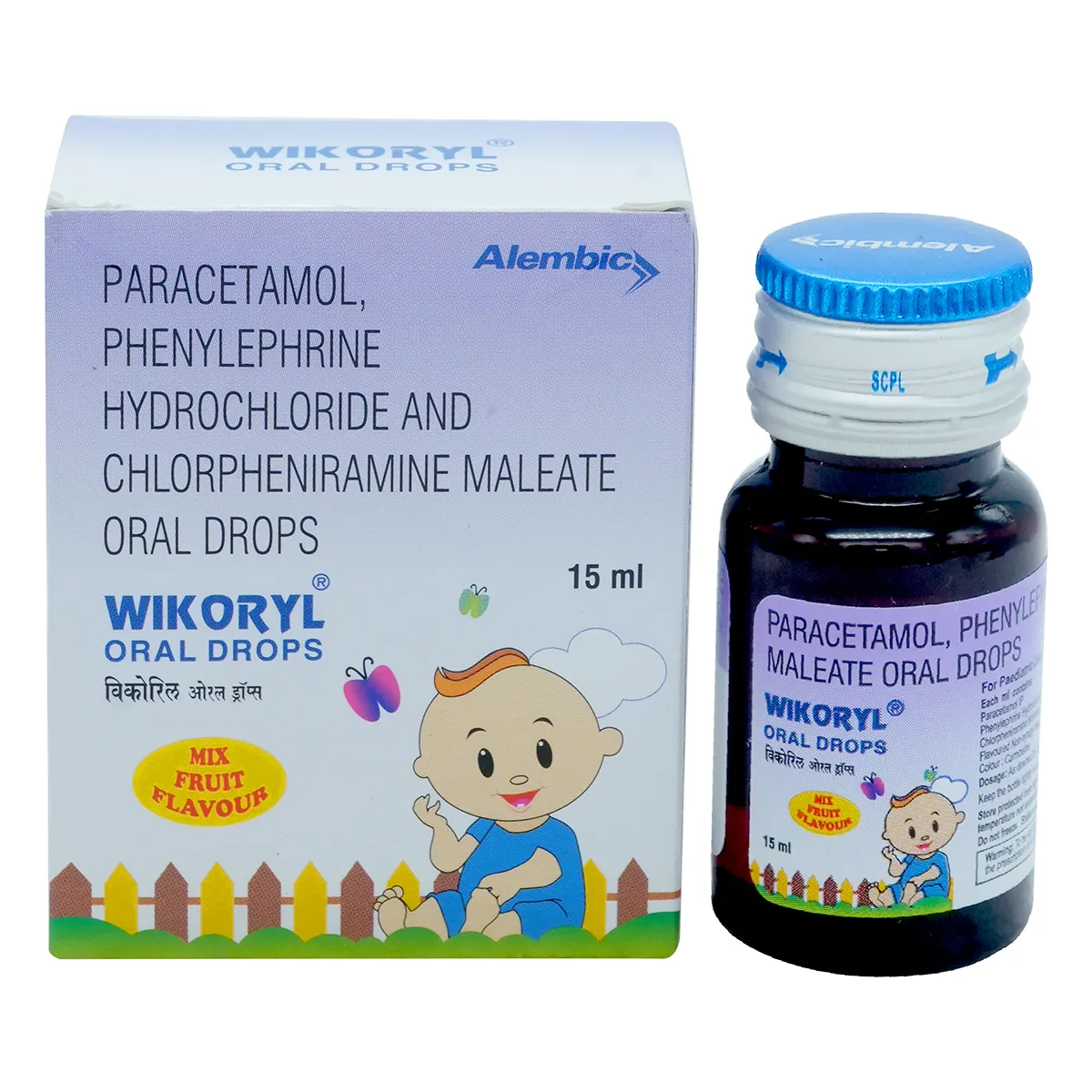
Selected Pack Size:15 ml
(₹7.11 per ml)
In Stock
(₹10.67 per ml)
In Stock
MRP ₹118.5
(Inclusive of all Taxes)
₹17.8 Cashback (15%)
Provide Delivery Location
About Wikoryl Oral Drops
Wikoryl Oral Drops is primarily used to treat common cold symptoms and allergies like sneezing, runny/stuffy nose, fever, headache, body pains, congestion, or watery eyes. The common cold is a respiratory illness affecting the nose and throat. It is mostly caused by viruses known as rhinovirus.
Wikoryl Oral Drops is a combination of Paracetamol, Phenylephrine and Chlorpheniramine. Paracetamol works by inhibiting the production of prostaglandins, which are responsible for pain and fever. Phenylephrine works by shrinking the blood vessels in the nasal passage. Chlorpheniramine blocks the action of histamine, which is responsible for causing allergic reactions.
Some people may experience drowsiness, nervousness, headache, dizziness, insomnia (difficulty falling or staying asleep), blurred vision, constipation, and dry mouth. Most of these side effects of Wikoryl Oral Drops do not require medical attention and gradually resolve over time. However, if the side effects persist or worsen, please consult your doctor.
Take Wikoryl Oral Drops as prescribed. Your doctor will recommend how often you must take Wikoryl Oral Drops based on your medical condition. Swallow the medicine as the whole with a glass of water. Do not chew, break or crush the medicine.
Please tell your doctor if you are allergic to Wikoryl Oral Drops or any other medicines. If you are pregnant, it is advised to inform your doctor before using Wikoryl Oral Drops. Do not use Wikoryl Oral Drops if you are breastfeeding without a doctor’s advice, as it may be excreted in breast milk and cause harm to the baby.
Uses of Wikoryl Oral Drops
Wikoryl Oral Drops is used in the treatment of Common cold and Allergies. The detailed uses of Wikoryl Oral Drops are as follows:

Have a query?
Directions for Use
Key Benefits
How Wikoryl Oral Drops Works
Storage
What if I have taken an overdose of Wikoryl Oral Drops
Drug Warnings
Drug-Drug Interactions
Login/Sign Up
Drug-Food Interactions
Login/Sign Up
Diet & Lifestyle Advise
Habit Forming
Therapeutic Class
RXNippon Healthcare Llp
₹65
(₹3.9/ 1ml)
RXBaxium Healthcare
₹67.5
(₹4.05/ 1ml)
RXComed Chemicals Ltd
₹75.5
(₹4.53/ 1ml)
Alcohol
Safe if prescribed
Avoid consumption of alcohol with Wikoryl Oral Drops as it may increase the risk of liver damage and cause increased drowsiness, dizziness or difficulty in concentrating. Please consult a doctor before consuming alcohol with Wikoryl Oral Drops.
Pregnancy
Consult your doctor
The safety of Wikoryl Oral Drops in pregnant women is unknown. Therefore, it is given to pregnant women only if the doctor thinks the benefits outweigh the risks.
Breast Feeding
Consult your doctor
Wikoryl Oral Drops may be excreted in breast milk and harm the baby. It may also slow milk production, so it is better to contact a doctor before a lactating mother takes it.
Driving
Safe if prescribed
Wikoryl Oral Drops may cause blurred vision or impair thinking in some people. Therefore, drive only if you are alert after taking Wikoryl Oral Drops.
Liver
Consult your doctor
Take Wikoryl Oral Drops with caution, especially if you have a history of liver disease. Your doctor may adjust the dose as required.
Kidney
Consult your doctor
Take Wikoryl Oral Drops with caution, especially if you have a history of kidney disease. Your doctor may adjust the dose as needed.
Children
Safe if prescribed
Wikoryl Oral Drops is not recommended for children below four years of age. However, please consult a doctor before giving Wikoryl Oral Drops to children.
Heart
Wikoryl Oral Drops should be taken with caution in patients with heart problems. Please inform your doctor if you have any pre-existing heart problems before using Wikoryl Oral Drops.
Geriatrics
Consult your doctor
Wikoryl Oral Drops should be given with caution in elderly patients due to an increased risk of side effects. Seek medical advice if you have any concerns.
Wikoryl Oral Drops is used to treat symptoms of the common cold and allergies like sneezing, runny/stuffy nose, fever, headache, body pains, congestion, or watery eyes.
Wikoryl Oral Drops contains Paracetamol, Phenylephrine hydrochloride, and Chlorpheniramine maleate. Paracetamol works by inhibiting the production of certain chemical messengers in the brain known as prostaglandins that are responsible for pain and fever. Phenylephrine hydrochloride works by contracting and narrowing the blood vessels. Thereby providing relief from congestion and decreasing mucus production. Chlorpheniramine maleate works by blocking the action of histamine, a substance responsible for causing allergic reactions.
Wikoryl Oral Drops contains paracetamol, which acts as a mild pain killer (analgesic) and fever reducer (antipyretic). It works by inhibiting the production of certain chemical messengers in the brain known as prostaglandins, which are responsible for pain and fever.
Wikoryl Oral Drops may cause drowsiness. It is not necessary for everyone taking Wikoryl Oral Drops to experience this side effect. Therefore, avoid driving or operating heavy machinery if you feel drowsy after taking Wikoryl Oral Drops.
It is not recommended to take Wikoryl Oral Drops with Cetirizine, as co-administration of these two medicines may increase sedation and can cause drowsiness, dizziness, and difficulty concentrating. However, please consult a doctor before taking Wikoryl Oral Drops with other medicines.
You are not recommended to stop taking Wikoryl Oral Drops without consulting your doctor as it may worsen the condition or cause recurring symptoms. Therefore, take Wikoryl Oral Drops for as long as your doctor has prescribed it, and if you experience any difficulty while taking Wikoryl Oral Drops, please consult your doctor.
Do not use Wikoryl Oral Drops if you have used an MAO inhibitor in the past 14 days, like isocarboxazid, linezolid, phenelzine, rasagiline, selegiline, or tranylcypromine. Tell your doctor before taking Wikoryl Oral Drops if you have nausea, stomach pain, itchy skin, loss of appetite, dark urine, clay-coloured stools, or jaundice (yellowing of your skin or eyes). In rare cases, paracetamol present in Wikoryl Oral Drops may cause a severe skin allergic reaction. So, if you observe any skin blisters or redness or rash, stop taking Wikoryl Oral Drops and contact your doctor.
No, Wikoryl Oral Drops contains a decongestant ingredient called Phenylephrine hydrochloride, which may raise blood pressure, especially in people who already have high blood pressure (hypertension). If your blood pressure stays high after taking Wikoryl Oral Drops, please consult your doctor.
You should take Wikoryl Oral Drops at the recommended dose and duration or as prescribed by your doctor.
No, Wikoryl Oral Drops may be excreted in breast milk and could harm the baby. It may also reduce milk production. Therefore, it is best to consult a doctor before a lactating mother takes it.
Yes, Wikoryl Oral Drops contains a decongestant and an antihistamine, which can help relieve the symptoms of a blocked nose. The decongestant works to reduce nasal congestion, and the antihistamine helps with any allergy symptoms you may have. However, please consult your doctor before using Wikoryl Oral Drops to ensure it is right for you.
No, do not take Wikoryl Oral Drops for more than seven days in a row (for adults) or five days (for children over 4) without consulting your doctor. Using Wikoryl Oral Drops for a longer time may cause side effects.
Wikoryl Oral Drops is a medication commonly used to relieve symptoms of a cough and cold. However, it does not directly target the cough itself. It may help with some associated symptoms, such as sneezing, runny or stuffy nose, fever, headache, body pains, congestion, or watery eyes. Please consult your doctor for the medications effective for managing a cough.
Wikoryl Oral Drops is composed of Chlorpheniramine maleate, Paracetamol, and Phenylephrine hydrochloride, which are primarily used to treat common cold symptoms, allergies, and fever.
Wikoryl Oral Drops is not an antibiotic. It contains a combination of a decongestant, antihistamine, and antipyretic. It does not target bacterial infections like an antibiotic would.
Wikoryl Oral Drops is generally safe when used as directed by your doctor, especially for short-term use in people with common cold symptoms and allergies. However, you should inform your doctor if you have high blood pressure, diabetes, glaucoma, overactive thyroid (hyperthyroidism), chronic bronchitis, asthma, chronic obstructive pulmonary disease (COPD), an enlarged prostate, or any kidney, liver, heart, or urinary problems, before using Wikoryl Oral Drops.
Wikoryl Oral Drops may potentially harm your liver if taken in excessive doses or for a long time, especially if you have pre-existing liver problems. Please consult your doctor before using Wikoryl Oral Drops, as your doctor may adjust the dosage if necessary.
Wikoryl Oral Drops should be stored in a cool and dry place, away from direct sunlight and moisture. Keep it out of reach of children.
Country of origin
Manufacturer/Marketer address
We provide you with authentic, trustworthy and relevant information