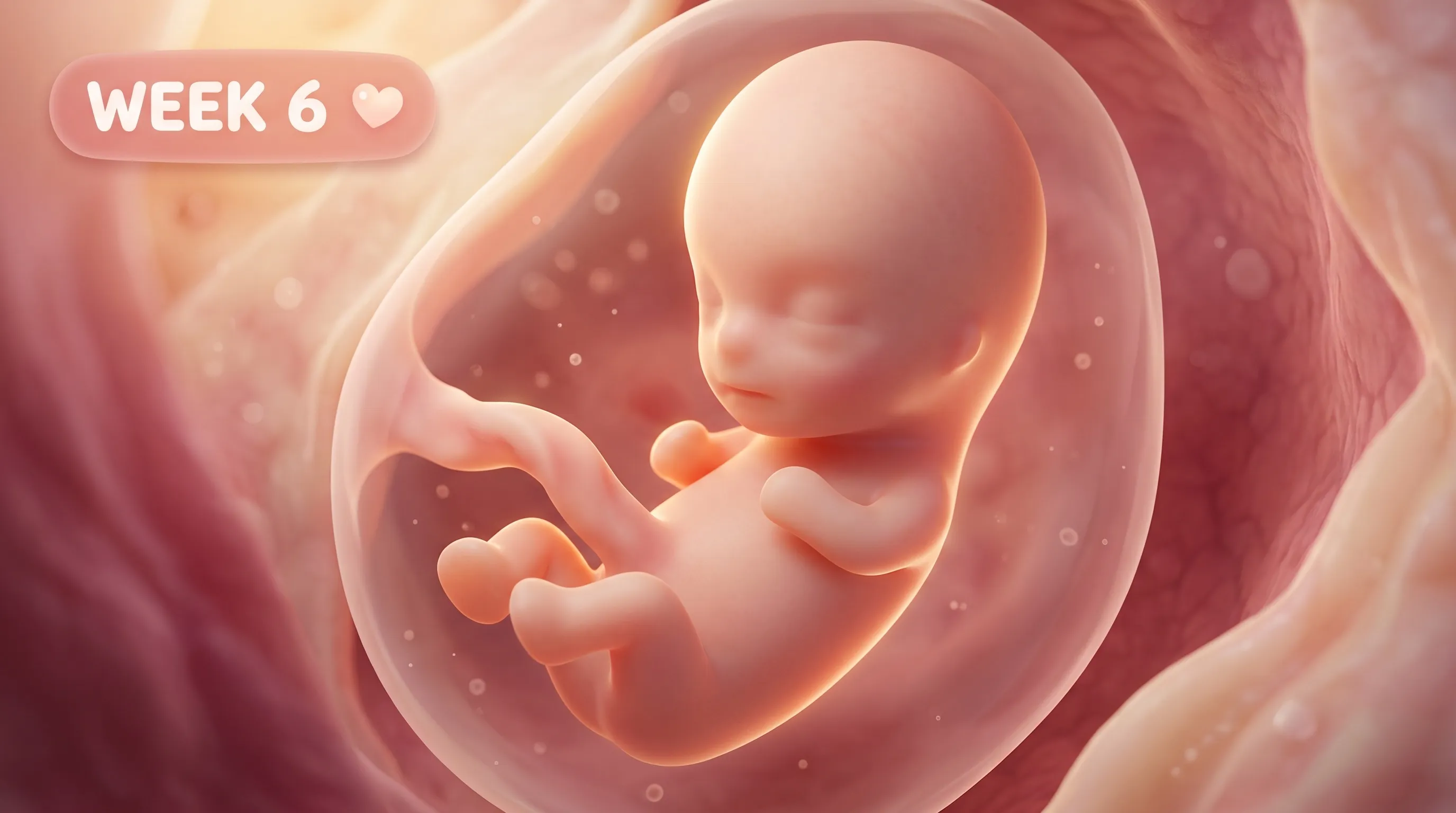
Foetal Development at 6 Weeks
How Big Is the Embryo?
At 6 weeks, the embryo measures roughly 4 to 6 mm in crown-rump length, about the size of a small lentil. Despite that tiny size, rapid changes are already underway.
The neural tube, which will eventually form the brain and spinal cord, is closing this week. The embryo has a distinctly curved C-shape, with a large head relative to the rest of the body. Tiny limb buds are forming, though no recognisable arms or legs are visible yet. The primitive gut and liver are beginning to develop, and facial features are taking shape at a microscopic level.
Heart Formation and Heartbeat
Foetal development at 6 weeks includes one of its most significant milestones: the start of cardiac activity. The heart at this point is not yet a four-chambered structure. It begins as a simple tube that folds and starts to beat, typically at 90 to 110 beats per minute, a rate that rises steadily over the following weeks.
On ultrasound, this appears as a rapid flicker. Reports often describe it as "cardiac activity detected" rather than a full heartbeat, which is accurate and normal. The fetal pole and heartbeat at 6 weeks are the two key markers your doctor uses to confirm a viable pregnancy.