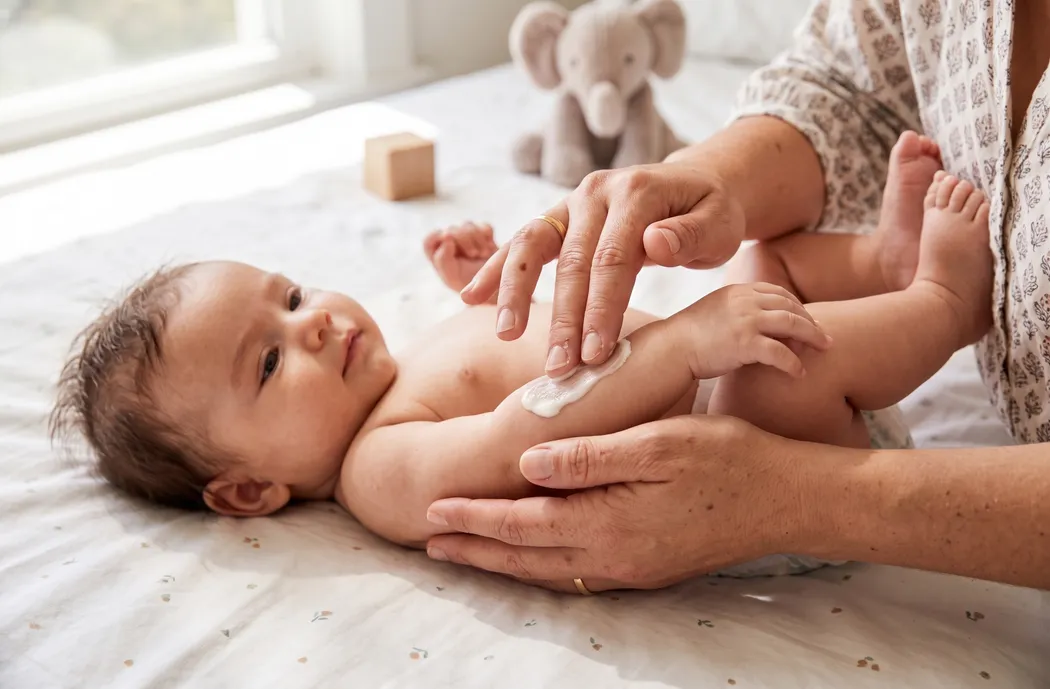
Learn how to choose the best baby lotion for newborn and sensitive skin, including safe ingredients, fragrance-free options, application tips, and precautions.
Choosing the best baby lotion feels daunting when every product claims to be "gentle" or "pure." But newborn skin is genuinely different from adult skin, and the wrong moisturiser can cause more harm than good. This guide walks you through what to look for, what to avoid, and when to call your doctor, so you can make a confident choice for your baby.
When caring for newborn skin, a simple routine is usually best because their skin barrier is still developing:
Newborn skin is delicate: A newborn's skin is thinner and has a less mature protective barrier than adult skin. This can allow moisture to escape more easily and make the skin more susceptible to irritation from fragrances and other ingredients.
Vernix and early peeling: The vernix caseosa provides protection at birth and gradually disappears during the first few days. Mild dryness or peeling during the early weeks can be normal as the skin adjusts to its environment.
Higher moisture loss: Newborn skin can lose moisture more readily, so simple skincare routines using products specifically formulated for babies may help maintain the skin barrier.
Keep skincare simple: Short, warm baths, gentle patting rather than rubbing, and applying a suitable moisturiser to dry skin soon after bathing can help maintain hydration.
What Makes a Baby Lotion Hypoallergenic?
"Hypoallergenic" is a marketing term with no single legal definition, so it helps to know what genuinely matters when you see it on a label.
A reliable hypoallergenic baby lotion generally meets these criteria:
Free from added fragrance, including "natural" fragrances, which can still trigger reactions
Free from parabens and preservatives linked to skin sensitisation
Formulated at a pH close to newborn skin (roughly 4.5 to 5.5)
Tested under dermatological or pediatric supervision, with patch-test data
Free from dyes and colourants
No product can guarantee zero reactions in every baby, because any ingredient can theoretically cause sensitivity in someone. The fewer the ingredients and the simpler the formula, the lower the overall risk.
How to Choose the Best Baby Lotion: Ingredients to Look For and Avoid
Reading a baby product label takes practice. The table below gives you a quick reference for what helps and what to skip.
Category
Look For
Avoid
Moisturizers
Glycerin, ceramides, hyaluronic acid
Ethanol (drying alcohol), propylene glycol in high concentrations
Emollients
Shea butter, sunflower seed oil, squalane
Low-grade mineral oil, pore-blocking petroleum derivatives
Cetyl alcohol (a fatty alcohol, not a drying one), beeswax
Benzyl alcohol in higher concentrations
One important note on "natural" products: natural does not automatically mean safe. Lavender oil, tea tree oil, and many botanical extracts are common allergens. A fragrance-free baby lotion with a short, recognisable ingredient list is generally a safer choice than a "natural" formula packed with plant extracts. Baby lotion ingredients to avoid are not always the synthetic-sounding ones.
These newborn skin care tips apply beyond lotion too. Keep bath products, laundry detergents, and fabric softeners fragrance-free wherever possible, since irritants reach the skin from multiple sources.
Expert-Recommended Baby Lotion Picks
Rather than recommending specific brands, pharmacists assess baby lotions by formulation type. Here are the categories that tend to work best for newborn skin:
Ceramide-based formulas: Ceramides are lipids that naturally form part of the skin barrier. Ingredients such as ceramide NP, ceramide AP, and ceramide EOP can help support the skin barrier and are useful options for babies with dry skin.
Glycerin-forward formulas: Glycerin is a humectant that helps attract and retain moisture in the skin. It can be a suitable ingredient for babies with mild dryness and is generally well tolerated.
Colloidal oatmeal formulas: Colloidal oatmeal can help soothe dry or irritated skin and may be useful for babies with eczema-prone skin. If your baby has persistent or worsening eczema, seek advice from a paediatrician.
Plain emollient creams or ointments: Products with short ingredient lists, including those containing white soft paraffin, can provide effective moisturisation for very dry skin. If a paediatrician has recommended a specific emollient, follow that advice rather than switching to another product.
When comparing products, aim for fewer than 10 ingredients where possible. The best baby lotion is not always the most expensive or the most heavily marketed one on the shelf.
When to Consult a Doctor About Baby Skin Issues
Mild dryness and light peeling in the first two to three weeks are completely normal. A healthy newborn does not always need lotion at all during this early period.
See your paediatrician promptly if you notice:
A rash that spreads, weeps, or looks infected
Persistent redness or swelling after applying any product
Red, itchy, scaly patches, especially in skin folds, which may suggest eczema
Hives, facial swelling, or breathing difficulty after skin contact with any product (call emergency services immediately)
Skin that does not improve after two to three weeks of simple moisturising ac
Eczema (atopic dermatitis) in infants often needs a treatment plan that goes beyond over-the-counter lotion. A dermatologist may recommend prescription emollients or other therapies. Do not delay seeking help if the skin looks inflamed rather than simply dry.
While you are building your newborn skin care routine, our newborn belly button care guide covers another area of delicate newborn skin that deserves careful attention. And if any skin product causes a small cut or abrasion during application, refer to our advice on treating minor skin cuts and wounds to handle it safely. Report adverse events to your healthcare provider or the relevant regulatory authority.
Contraindications and Precautions
There are situations where applying any baby lotion is not appropriate, even a mild, hypoallergenic one.
Do not apply lotion to:
Broken, open, or bleeding skin: Avoid applying baby lotion to broken, open, or bleeding skin, as even gentle ingredients may cause irritation or interfere with healing.
Signs of infection: Do not apply lotion to skin showing redness, warmth, pus, or crusting unless advised by a doctor, as these signs may indicate an infection.
Known allergies: Avoid any product containing an ingredient that your baby is known to be allergic or sensitive to.
Face and sensitive areas: Use caution when applying lotion to the face, particularly around the eyes and mouth. Choose a product specifically labelled for facial use when appropriate.
If you are trying a new product for the first time, do a patch test. Apply a small amount to the inner arm or behind the knee and wait 24 hours before using it more widely. Stop use immediately if redness, itching, or swelling appears and consult your paediatrician.
Conclusion
Choosing the best baby lotion for newborn and sensitive skin is less about finding the most expensive product and more about selecting a simple, gentle formulation that supports the skin barrier. Look for fragrance-free products with ingredients such as ceramides, glycerin, colloidal oatmeal, or suitable emollients, and avoid unnecessary fragrances and potential irritants. Apply moisturiser gently to dry, intact skin and monitor your baby's response after introducing a new product. If your baby's skin becomes persistently red, swollen, weepy, infected-looking, or does not improve with simple moisturising, consult a paediatrician for appropriate guidance.
FAQS
Is baby lotion necessary for newborns?
Not always. Healthy newborns often experience some natural peeling in the first weeks without needing a moisturiser. If the skin looks noticeably dry or your baby has eczema-prone skin, a simple fragrance-free lotion can help.
Can I use adult lotion on my baby?
Adult lotions are formulated for thicker, more resilient skin and often contain fragrances, active ingredients, or preservatives that are too harsh for newborn skin. Stick to products specifically designed for infants.
How often should I apply baby lotion?
Once a day after a bath is a good starting point for most babies. If your baby has very dry or eczema-prone skin, your paediatrician may suggest applying it twice daily.
What is the difference between baby lotion and baby oil?
Baby lotion contains water and forms a light layer that absorbs into the skin. Baby oil is purely an emollient that sits on the surface and helps seal in moisture. Lotions are generally easier to spread and suit everyday use; oils are sometimes used for massage or very dry patches.
Is coconut oil safe for newborn skin?
Coconut oil is used by many parents, but research on its safety for newborn skin is mixed. Some studies suggest it may disrupt the skin barrier in babies prone to eczema. Until your paediatrician advises otherwise, a fragrance-free baby lotion with ceramides or glycerin is a more evidence-supported choice.