logo
0

Beta hCG Test: Ranges, Interpretation & Timing Guide

Learn about the beta hCG test, normal ranges, when to take the test, how to interpret results, accuracy, and what high or low levels may mean.
 

article image

Dr.Rohini priyanaka

Confirming a pregnancy or tracking its early progress can be an anxious time, and the beta hCG test is often the first concrete answer you get. This blood test measures human chorionic gonadotropin, a hormone produced by the placenta shortly after a fertilised egg implants in the uterus. Understanding what the numbers mean, when to test, and how to read your report can turn a confusing lab slip into genuine reassurance.

What Is a Beta hCG Test?

Human chorionic gonadotropin (hCG) is a hormone made up of two subunits: alpha and beta. The beta subunit is unique to hCG, which is why labs measure it specifically to confirm pregnancy rather than confusing it with other hormones that share the alpha subunit.

There are two types of hCG tests:

  • Qualitative test: A qualitative beta hCG test gives a simple positive or negative result. It detects whether hCG is present above a specific threshold. Most home urine pregnancy tests use this method.
  • Quantitative test: A quantitative hCG blood test measures the exact concentration of hCG in the blood. The result is usually reported in milli-international units per millilitre (mIU/mL) and can help doctors monitor changes in hCG levels over time.

Doctors order the quantitative version to confirm early pregnancy, track a potentially failing pregnancy, investigate a suspected ectopic pregnancy, monitor recovery after a miscarriage, or screen for certain hormone-producing tumours.

When to Take the Test for Accurate Results?

The best time to take a beta hCG test is around the time of a missed period, roughly 14 days after ovulation. At this point, hCG levels are usually high enough to give a clear positive in most pregnancies.

That said, a blood test can detect hCG as early as 8 to 10 days after ovulation, before a period is even due. If your doctor suspects an ectopic pregnancy or you have had fertility treatment, they may order the test earlier than you might expect.

Unlike a urine test, you do not need your first morning sample. Blood hCG levels remain stable throughout the day, so the draw can happen at any time. Fasting is not required.

If you test very early and get a negative result but your period still does not arrive, repeat the test 48 to 72 hours later. A single early negative does not always rule out pregnancy.

Beta hCG Levels Chart by Week

hCG levels vary enormously between individuals, and a single value is rarely diagnostic on its own. The ranges below are approximate reference values for gestational age counted from the last menstrual period (LMP).

Gestational Age (from LMP) Typical hCG Range (mIU/mL)
3 weeks5 to 50
4 weeks 10 to 425
5 weeks 200 to 7,200
6 weeks  200 to 32,000
7 to 8 weeks3,500 to 160,000
9 to 12 weeks25,700 to 288,000
13 to 16 weeks13,300 to 254,000
17 to 24 weeks4,060 to 165,400
25 to 40 weeks 3,640 to 117,000

These ranges are wide on purpose. Your personal number may sit at the low or high end and still represent a healthy pregnancy. What matters more than a single reading is the trend over serial measurements. Always interpret your beta hCG levels chart result alongside your doctor's clinical assessment.

How to Read Your Beta hCG Report?

Your report states a value in mIU/mL alongside a lab-specific reference range. Here is how to make sense of it.

Doubling time is the key concept. In a healthy early pregnancy, hCG typically doubles every 48 to 72 hours up to about 8 to 10 weeks, then levels off and gradually declines through the second trimester. A level that doubles appropriately is generally reassuring.

Contact your doctor if you notice:

  • Levels rising by less than 50 to 60 percent over 48 hours in early pregnancy, which can indicate a non-viable or ectopic pregnancy.
  • Levels that plateau or fall before 8 to 10 weeks.
  • A value that seems very high relative to your expected gestational age, which occasionally points to a molar pregnancy or twins.

What rising or falling hCG actually means in practice:

  • A rising hCG confirms ongoing placental activity.
  • A falling hCG after a confirmed pregnancy suggests miscarriage or a resolving ectopic pregnancy.
  • After a miscarriage, doctors monitor hCG until it drops below 5 mIU/mL to confirm complete resolution.

A single "low" number does not automatically mean something is wrong, especially if you are unsure of your ovulation date. Context and serial testing matter far more than any one result.

Blood Test vs Urine Test: Which Is More Accurate?

The quantitative hCG blood test is more sensitive than a home urine strip. Blood tests can detect hCG at concentrations as low as 1 to 2 mIU/mL, while most urine tests require at least 20 to 25 mIU/mL before they show a positive line. This difference in hCG blood test vs urine test accuracy means blood testing can confirm pregnancy several days earlier.

In practical terms:

  • The blood test is better for early detection, monitoring trends over time, and ruling out ectopic pregnancy.
  • The urine test is convenient and private, and it is a reasonable first step once a period is missed.

Neither test is infallible, but a quantitative blood result gives far more clinical information than a line on a strip.

Contraindications and Situations Affecting Results

The beta hCG test itself is a routine blood draw with no medical contraindications in the usual sense. However, certain conditions and medications can affect the result and must be disclosed to your doctor.

Causes of a falsely high hCG:

  • Fertility medications containing hCG, used to trigger ovulation, can artificially raise levels for up to two weeks after the injection.
  • Certain tumours of the ovary, testis, or placenta (gestational trophoblastic disease) produce hCG independent of pregnancy.
  • Heterophilic antibodies in the blood can occasionally interfere with the lab assay and produce a phantom positive. If your result does not match your clinical picture, ask about repeat testing with a different assay method.

Causes of a falsely low hCG:

  • Testing too early, before implantation has raised levels to a detectable concentration.
  • Diluted blood samples or certain rare biochemical variants of hCG that some assays do not detect well.

Report adverse events or unexpected reactions related to any diagnostic procedure or treatment to your healthcare provider or the relevant regulatory authority.

Conclusion

The beta hCG test is a useful way to confirm pregnancy and monitor hCG levels during early pregnancy. A quantitative blood test provides an exact hCG value, but a single result cannot always determine whether a pregnancy is developing normally. Doctors may assess repeat beta hCG measurements, gestational age, ultrasound findings, and symptoms together to interpret the result accurately. If your beta hCG level is higher or lower than expected, discuss the report with your healthcare provider rather than relying on the number alone.

FAQS

How soon can beta hCG detect pregnancy?

A quantitative blood test can detect hCG as early as 8 to 10 days after ovulation, which is typically a few days before a missed period. Urine tests usually need a few more days for levels to build high enough to register.

What is a good beta hCG level at 4 weeks?

At 4 weeks from the last menstrual period, hCG commonly falls somewhere in the range of 10 to 425 mIU/mL, though individual variation is wide. A single number matters less than whether the level is rising appropriately on repeat testing.

Can beta hCG be high but not pregnant?

Yes. Certain ovarian or placental tumours, gestational trophoblastic disease, and some fertility injections can all raise hCG without an ongoing pregnancy. Rarely, a lab interference called a heterophilic antibody reaction produces a false positive; your doctor can investigate this with a different assay.

Does fasting affect beta hCG test results?

No. hCG is a hormone measured from your blood serum, and eating or drinking before the test does not affect the result. You can have the blood drawn at any time of day without any special preparation.
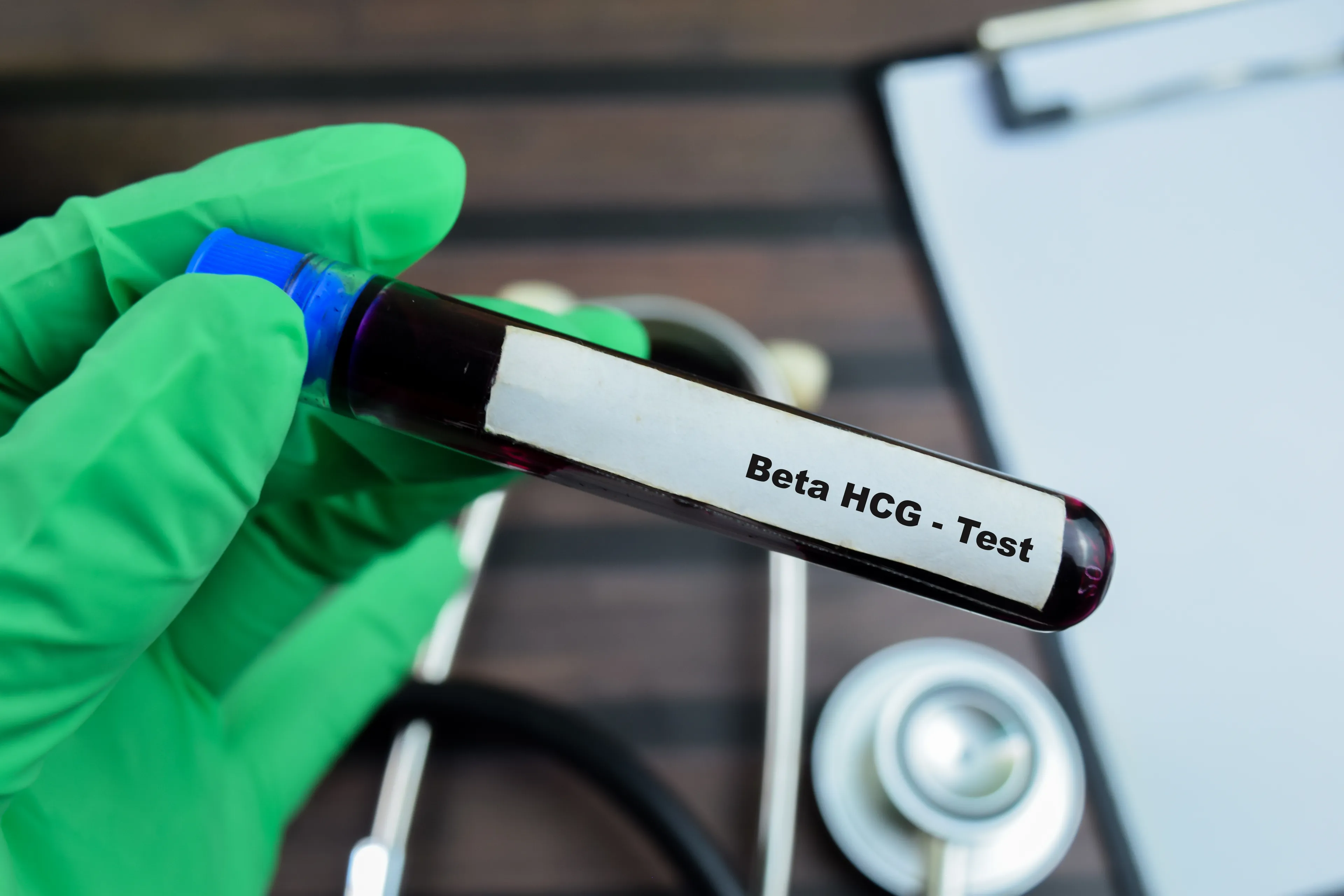
How is beta hCG test done?

A healthcare professional draws a small sample of blood, usually from a vein in your forearm. The sample is sent to a laboratory where it is analysed using an immunoassay. Results are typically available within a few hours to one business day, depending on the facility.

Apollo 247 Floating Action Button