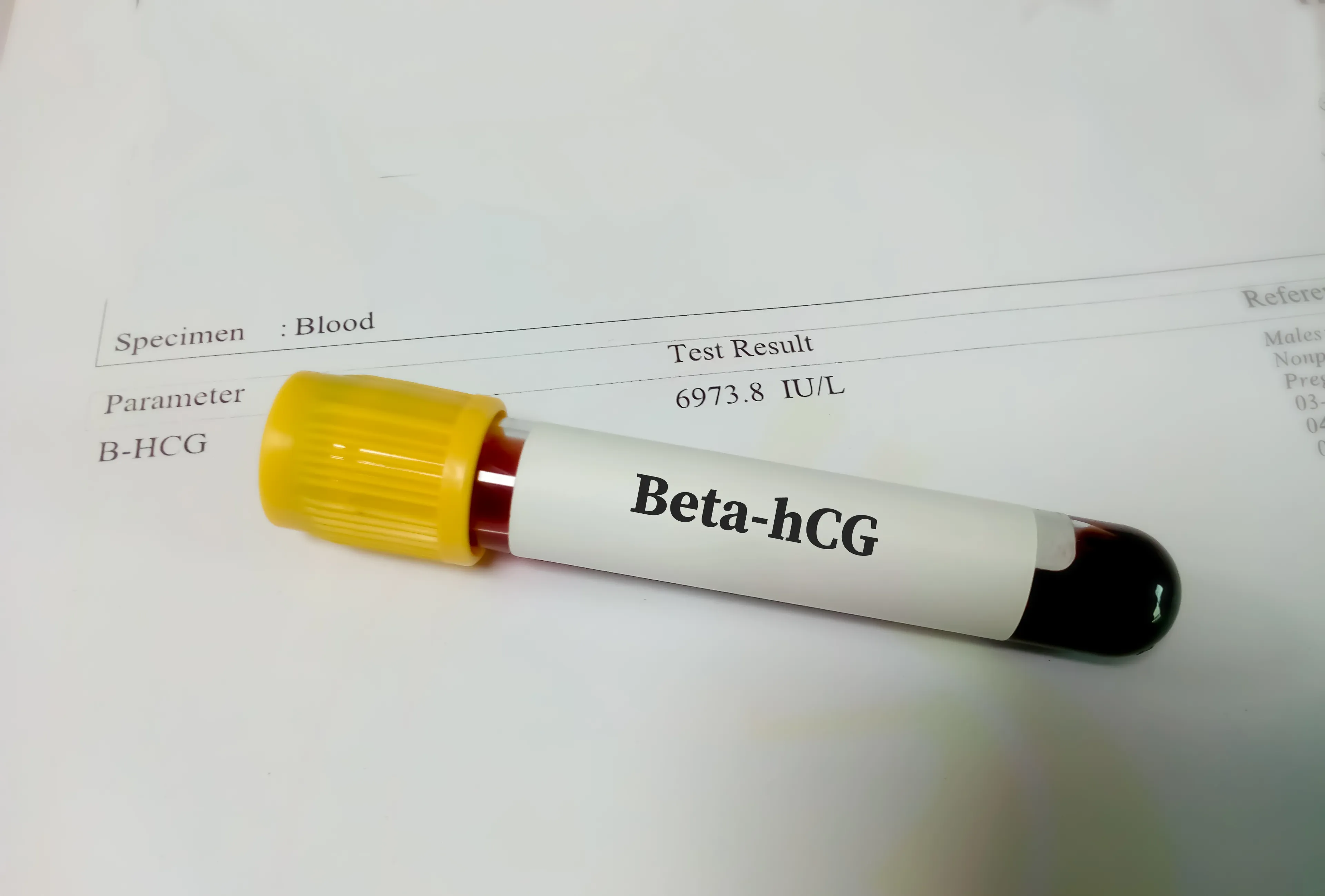
HCG Beta Test: Weekly Ranges and Results Explained
Understand the hCG beta test — normal ranges by week of pregnancy, what rising or falling levels indicate, and when to consult your doctor.
Dr. Kamran
Few numbers carry as much emotional weight during early pregnancy as those from an hCG beta test. Whether you are tracking a first positive home test or monitoring a pregnancy after fertility treatment, understanding what your beta-hCG values mean and what the trend over time is telling you can make an uncertain wait a little more manageable.
Human chorionic gonadotropin, commonly called hCG, is a hormone produced by the placenta shortly after a fertilised egg implants in the uterus. The "beta" refers to the beta subunit of the hormone, which is what laboratory tests measure to distinguish hCG from other similar hormones in the body.
There are two kinds of hCG tests:
A qualitative test gives a yes or no answer, confirming whether hCG is present above a detection threshold. Most home pregnancy tests and urine dipstick tests at clinics work this way.
A quantitative hCG blood test, often called a beta-hCG or serum hCG test, measures the exact concentration in milli-international units per millilitre (mIU/mL). Doctors order this when they need to track how a pregnancy is progressing over time.
The test itself is straightforward. A small blood sample is drawn from a vein in the arm and sent to a laboratory. Results are typically available within a few hours to a day, and no fasting is required.
Normal HCG Levels by Week of Pregnancy
One of the most important things to know about beta hCG levels by week is that the ranges are very wide. Two healthy pregnancies at the same gestational age can have values differing by a factor of ten or more and both be completely normal. A single result rarely tells the whole story; the trend over time matters far more.
The table below shows approximate reference ranges. Gestational age is counted from the first day of the last menstrual period (LMP), which is the standard clinical convention.
Gestational Week (from LMP)
Approximate hCG Range (mIU/mL)
3 weeks
5 to 50
4 weeks
10 to 750
5 weeks
200 to 7,000
6 weeks
200 to 32,000
7 to 8 weeks
3,500 to 160,000
9 to 12 weeks
11,000 to 250,000
13 to 16 weeks
9,000 to 210,000
17 to 24 weeks
1,400 to 53,000
25 weeks to term
Approx. 940 to 60,000
These values are drawn from widely cited obstetric references, but your own laboratory report may show slightly different intervals because reference ranges vary between testing platforms and facilities. Always interpret your result alongside the reference range printed on your specific report.
Levels rise steeply through the first trimester, peak around weeks 10 to 12, then gradually decline and plateau for the remainder of pregnancy. An hCG levels chart from your lab printout is the most relevant guide for your result.
What Rising HCG Levels Indicate?
In a healthy early pregnancy, hCG roughly doubles every 48 to 72 hours during the first eight weeks. This doubling time is what doctors watch most closely when the hcg beta test is repeated, usually two to three days apart in the first trimester.
Rising hCG levels generally indicate that the pregnancy is progressing and the placenta is developing. A few nuances are worth knowing:
A rise slower than expected (less than approximately 53% over 48 hours) does not automatically signal a problem, but it warrants a follow-up test and possibly an ultrasound.
Very high values for gestational age can suggest a multiple pregnancy. Carrying twins or more tends to produce hCG concentrations that run higher than a singleton at the same stage, though ranges overlap considerably.
After fertility treatments such as IVF, clinics often start monitoring hCG from as early as 9 to 11 days after embryo transfer. Both the initial value and subsequent doubling pattern are assessed together.
What Falling or Low HCG Levels Indicate?
Low hCG levels in early pregnancy, or a pattern of falling values, is something doctors take seriously, though context is everything.
A significant drop in hCG, or a value that fails to rise appropriately, can signal:
A miscarriage or pregnancy loss. When a pregnancy is not viable, hCG stops rising and begins to fall. After a confirmed miscarriage, levels typically return to below 5 mIU/mL within a few weeks.
An ectopic pregnancy, where the fertilised egg has implanted outside the uterus, usually in a fallopian tube. hCG may still rise in an ectopic pregnancy but often does so more slowly, or the value plateaus. This is a medical emergency requiring urgent ultrasound and clinical evaluation.
A blighted ovum, where a gestational sac forms but an embryo does not develop.
A single low number is not diagnostic on its own. The hcg beta test normal range at 4 weeks spans roughly 10 to 750 mIU/mL. A value of 20 could be perfectly normal for someone who is 3.5 weeks pregnant. Clinical correlation, including repeat testing and ultrasound, is always required before drawing any conclusion.
Contraindications and Precautions
The blood draw for a quantitative hCG blood test carries no meaningful contraindications for most people. However, several factors can affect accuracy or interpretation:
Certain rare tumours, including gestational trophoblastic disease (molar pregnancy) and some germ cell tumours, produce hCG. A positive result does not always mean an intrauterine pregnancy.
Fertility medications containing hCG, used as a trigger shot in IVF cycles, can cause a false-positive result if tested too soon after injection.
Very high hCG levels can occasionally cause a "hook effect" in some assays, where the result is falsely reported as low. If clinical suspicion remains high despite a surprisingly low result, ask whether a diluted sample should be retested.
Laboratory results vary between facilities. Always compare your value against the reference range on your own report, not a generic online chart.
The blood draw itself is low-risk, but minor side effects can occur: bruising or tenderness at the puncture site, light-headedness, or, rarely, a vasovagal response (brief fainting). These usually resolve quickly. Report adverse events, including any unexpected reaction to the blood draw procedure, to your healthcare provider or the relevant regulatory authority.
When to Consult Your Doctor?
Contact your doctor promptly if:
Your hCG level is not rising as expected on repeat testing
You have pain, heavy bleeding, or shoulder-tip pain alongside any abnormal result (possible signs of ectopic pregnancy)
Your result falls well outside the reference range for your gestational week
You feel uncertain about how to interpret a result from a home test or clinic visit
Do not attempt to self-diagnose or adjust any treatment based on a single hCG number. Interpretation of beta-hCG results always requires clinical correlation with your symptoms, ultrasound findings, and medical history.
Conclusion
The beta-hCG test is an important tool for monitoring early pregnancy and understanding how hCG levels change over time. While reference ranges provide a general guide, a single result cannot confirm whether a pregnancy is progressing normally. Doctors usually assess repeat hCG measurements alongside symptoms and ultrasound findings to evaluate pregnancy development and identify possible complications. If you experience unusual bleeding, abdominal pain or shoulder-tip pain, seek prompt medical attention, as these may indicate an ectopic pregnancy. Always discuss your test results with your healthcare provider rather than relying on online charts alone.
FAQs
What is a good hCG level at 4 weeks?
At 4 weeks of pregnancy (counted from the last menstrual period), hCG levels typically range from about 10 to 750 mIU/mL. Because the range is so wide, a single number means very little without a follow-up measurement to confirm the level is rising appropriately.
Can hCG levels rise but still result in a miscarriage?
Yes. In some cases, hCG rises initially but more slowly than expected, then peaks and falls as the pregnancy fails. Rising levels are reassuring but not a guarantee of a viable pregnancy, which is why ultrasound confirmation is important.
How often should hCG be tested?
In early pregnancy with a concern about viability, doctors typically repeat the test every 48 to 72 hours to assess the doubling pattern. Once a heartbeat is confirmed on ultrasound, serial hCG monitoring is usually no longer necessary.
Does a high hCG level mean twins?
Higher-than-average hCG for gestational age can suggest a multiple pregnancy, but the ranges for singleton and twin pregnancies overlap significantly. An ultrasound, not an hCG value alone, is the reliable way to confirm twins.
What hCG level confirms a pregnancy?
A serum hCG level of 5 mIU/mL or above is generally considered detectable, but most clinicians look for a value of at least 10 to 25 mIU/mL before confirming pregnancy, along with a rising trend on repeat testing.