


Few things in early pregnancy feel as nerve-wracking as waiting for hCG results. Understanding hCG levels and pregnancy can help you read those numbers with more confidence and know when to call your doctor.
Learn about hCG levels in pregnancy week by week, including typical ranges, testing methods, rising patterns, result interpretation, and when follow-up may be needed.
Dr. Mayank
Few things in early pregnancy feel as nerve-wracking as waiting for hCG results. Understanding hCG levels and pregnancy can help you read those numbers with more confidence and know when to call your doctor.
Human chorionic gonadotropin, commonly called hCG, is a hormone produced by the cells that will eventually form the placenta. It appears in the blood within days of a fertilised egg implanting in the uterus, usually around 6 to 12 days after conception.
hCG does two critical things early in pregnancy. It signals the corpus luteum (a temporary gland in the ovary) to keep producing progesterone, preventing the uterine lining from shedding. It also serves as the chemical marker that home pregnancy tests and clinical labs detect to confirm pregnancy. Without rising hCG, the uterus cannot maintain the early pregnancy environment.
hCG levels vary enormously between individuals, so a single reading rarely tells the full story. What matters most is the trend over time.
In a healthy early pregnancy, hCG typically doubles roughly every 48 to 72 hours up to about week 8 to 10. After that, levels plateau and then gradually decline through the second trimester.
The table below shows approximate ranges based on gestational age counted from the first day of the last menstrual period. These are broad reference ranges; your laboratory may use slightly different values.
| Gestational Week | Typical hCG Range (mIU/mL) |
| 3 weeks | 5 to 50 |
| 4 weeks | 10 to 750 |
| 5 weeks | 200 to 7,200 |
| 6 weeks | 160 to 32,000 |
| 7 to 8 weeks | 3,500 to 160,000 |
| 9 to 12 weeks | 32,000 to 210,000 |
| 13 to 16 weeks | 9,000 to 210,000 |
| 17 to 24 weeks | 1,400 to 53,000 |
| 25 to 40 weeks | 940 to 60,000 |
A level that looks "low" in isolation may still be perfectly normal if it is rising consistently. Always interpret results with your doctor rather than comparing numbers alone.
Both tests detect hCG, but they work differently and serve different purposes.
A qualitative urine test simply answers "pregnant or not." Most home pregnancy tests fall into this category. They can detect hCG above roughly 20 to 25 mIU/mL, which is why testing too early before a missed period can produce a false negative.
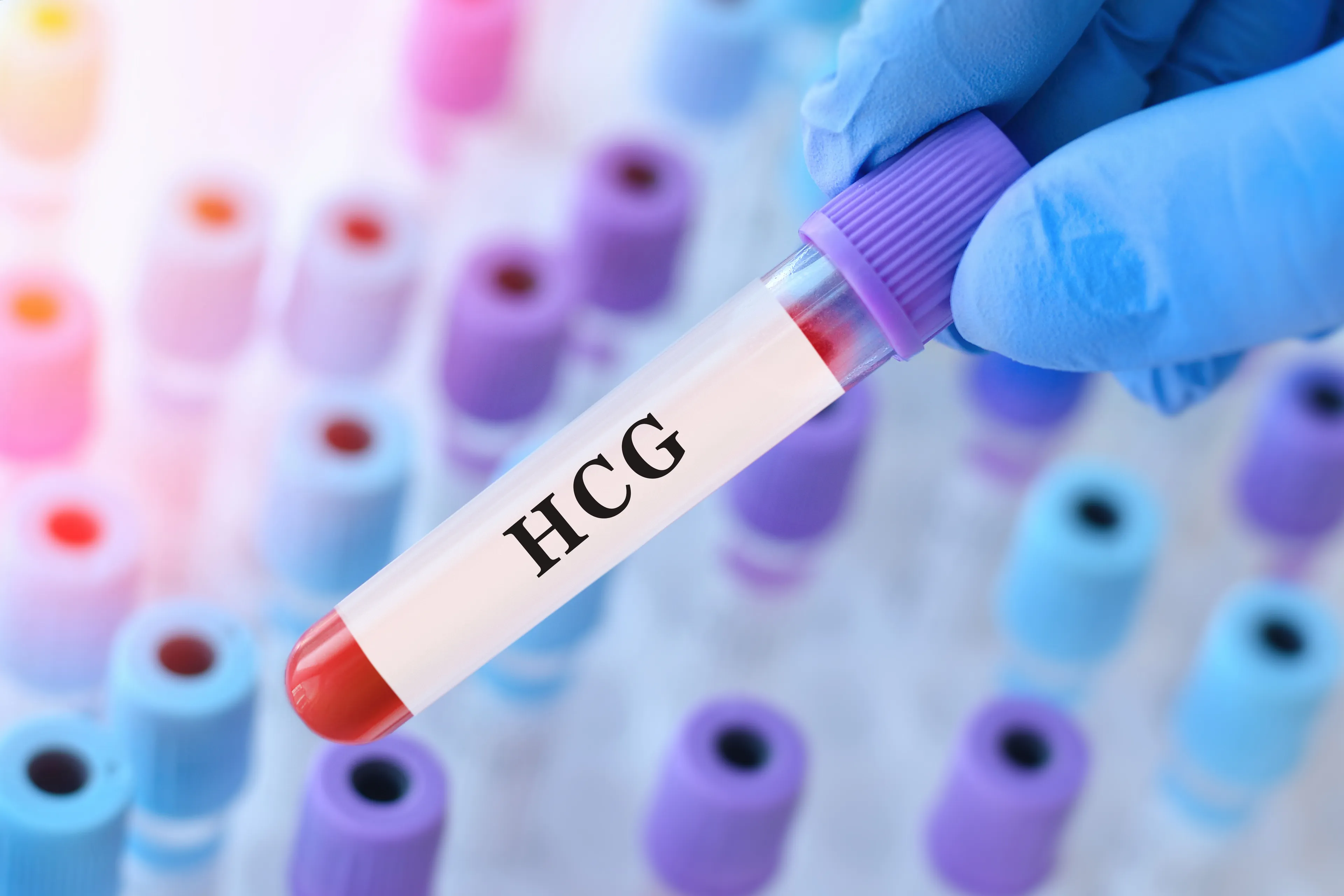
The hCG blood test pregnancy option that your doctor orders, known as a quantitative beta hCG test, measures the exact concentration of hCG in your blood. This test is far more sensitive, detecting levels as low as 1 to 2 mIU/mL. It is the standard tool for:
Beta hCG test interpretation from a blood sample also guides decisions in fertility treatment, where precise hormone tracking directly affects protocol timing.
A single value matters far less than the pattern over time. That said, levels consistently outside the expected range for gestational age are worth investigating.
Low hCG levels causes include:
Slow-rising or falling levels are more concerning than a single low reading. Your doctor will usually repeat the test in 48 hours to assess the trend before drawing any conclusions.
Levels significantly above the expected range may suggest:
Very high hCG can intensify symptoms like nausea and vomiting. A high reading alone is not automatically a problem, but it warrants further investigation with ultrasound.
In fertility care, an hCG injection is used as an ovulation trigger. When follicles in the ovary reach a mature size during a stimulated cycle, a physician administers human chorionic gonadotropin by injection to mimic the natural LH surge and trigger egg release. This is standard practice in intrauterine insemination (IUI) and in vitro fertilisation (IVF) protocols.
The timing of the hCG injection in pregnancy preparation cycles is precise, typically given 34 to 36 hours before egg retrieval or planned insemination. Dose and timing must be calculated and supervised by a fertility specialist. Self-administering or using it outside a supervised protocol is unsafe and strongly discouraged.
A common concern is whether the hCG injection will cause a false positive on a pregnancy test. It can, for up to 10 to 14 days after the shot depending on the dose. Your fertility team will advise on the right time to test.
Like any hormone treatment, hCG injections can cause side effects. Most are mild, but some require prompt attention.
Report adverse events to your healthcare provider or the relevant regulatory authority. If you experience severe abdominal pain, sudden weight gain, or difficulty breathing after an hCG injection, seek medical attention immediately.
hCG injections are not appropriate for everyone. A prescribing physician will screen for contraindications before recommending this treatment.
hCG injections should generally not be used in people who have:
This prescribing information is a general guide only. Your doctor will review your full medical history before recommending any hormone treatment.
Tracking hCG levels and pregnancy progress is best done with a doctor, not with a calculator. Certain signs should prompt you to call your provider sooner rather than later.
Seek prompt medical attention if you notice:
A plateauing or falling hCG trend in early pregnancy is not something to watch and wait on. An ultrasound alongside beta hCG test interpretation gives your doctor the clearest picture of what is happening.
Once your pregnancy progresses into the third trimester and you are preparing for the newborn stage, you may find it helpful to read up on newborn care essentials after delivery to feel ready for what comes next.
hCG levels change throughout pregnancy and can vary considerably between individuals, so there is no single number that defines a normal pregnancy at each week. Levels generally rise during early pregnancy, often increasing rapidly before reaching a peak and changing later in pregnancy. A quantitative beta-hCG result should be interpreted according to gestational age, the laboratory's reference range, symptoms, and how the level changes over time. A single hCG measurement cannot confirm pregnancy viability or determine the exact gestational age, and it cannot reliably diagnose twins. When appropriate, repeat hCG testing and ultrasound can provide more information. Heavy bleeding, severe or one-sided abdominal pain, dizziness, fainting, or shoulder pain during early pregnancy requires prompt medical evaluation.
At 4 weeks of pregnancy, a typical range is around 10 to 750 mIU/mL. A wide range is normal at this stage, and what matters more is whether levels are rising consistently over serial tests.
No. hCG levels do not reliably predict the sex of the baby. While some studies suggest slightly higher average levels in pregnancies with female fetuses, the overlap between groups is too large to draw any conclusions from an individual result.
In early pregnancy with a concern such as possible miscarriage or ectopic pregnancy, doctors typically repeat the test every 48 hours to assess the doubling pattern. In routine pregnancies without complications, serial hCG testing is usually not necessary.
There is no strong evidence that psychological stress directly lowers or raises hCG levels. hCG is produced by the developing placenta in response to biological signals, not emotional ones. If your levels are abnormal, a physical cause is far more likely.
Slow-rising or falling levels in early pregnancy can indicate a miscarriage, ectopic pregnancy, or other complication. Your doctor will usually order a repeat blood test and an ultrasound to understand the cause and decide on next steps.


