HCG Levels in Pregnancy: Normal Ranges & What They Mean
Learn about normal HCG levels in pregnancy by week, what high or low levels may indicate, how HCG testing works, and when to consult a doctor.
Dr.Yusuf
Understanding pregnancy HCG levels can feel overwhelming, especially when you are staring at a number on a lab report and wondering whether it is good or bad. HCG, or human chorionic gonadotrophin, is the hormone that confirms a pregnancy exists, and its pattern of rise or fall in early weeks carries important information about how the pregnancy is progressing. This guide explains what the numbers mean, what is considered normal, and when to loop in your doctor.
What Is HCG and Why It's Tested in Pregnancy
HCG is a hormone produced by the cells that eventually form the placenta, starting shortly after a fertilised egg implants in the uterine wall. Its main job in early pregnancy is to signal the ovaries to keep producing progesterone, which maintains the uterine lining and supports the growing embryo.
Testing for HCG serves two broad purposes. A qualitative test simply confirms whether HCG is present, the basis of every home pregnancy test. A quantitative test, known as the beta HCG test, measures the exact amount in your blood and is used to track how a pregnancy is developing, particularly in the first trimester.
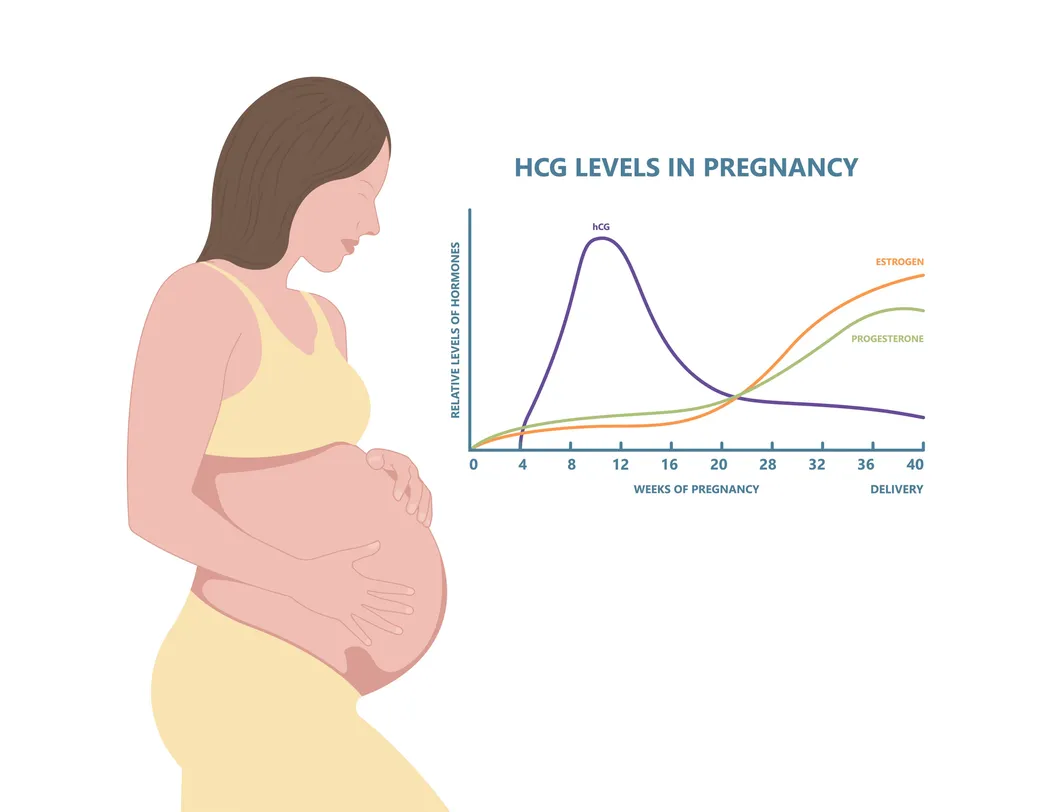
HCG rises sharply in early pregnancy, typically doubling every 48 to 72 hours until around weeks 8 to 10, and then gradually declining toward a stable plateau for the rest of the pregnancy.
The table below shows general reference ranges. These are approximate figures that vary widely between labs and between individuals. A single result is rarely as informative as the trend across two or more tests taken 48 hours apart.
HCG Levels Chart by Gestational Week
Weeks Since Last Menstrual Period
Approximate HCG Range (mIU/mL)
Typical Clinical Milestone
3 weeks
5 to 50
Implantation occurs
4 weeks
10 to 425
Expected period missed; home test positive
5 weeks
19 to 7,340
Gestational sac visible on TVUS ($\\ge 1,500\\text{ mIU/mL}$)
6 weeks
1,080 to 56,500
Yolk sac and fetal pole visible
7 to 8 weeks
7,650 to 229,000
Fetal cardiac activity routinely detectable
9 to 12 weeks
25,700 to 288,000
Peak HCG concentration reached
13 to 16 weeks
13,300 to 254,000
Placenta fully established; levels stabilise
17 to 24 weeks
4,060 to 165,400
Second trimester plateau
25 to 40 weeks
3,640 to 117,000
Third trimester maintenance
The HCG levels chart above uses values from general clinical practice. Your lab may use slightly different reference intervals, so always compare your result against the range printed on your own report.
The key takeaway: wide variability is completely normal. A level of 50 mIU/mL at four weeks is just as valid as 400 mIU/mL at four weeks, as long as the trend is upward.
What High HCG Levels Indicate
A result significantly above the expected range for the gestational week is called an elevated HCG. Common reasons include:
Carrying twins or multiples: HCG levels in a twin pregnancy are often higher than in a singleton, sometimes nearly double. This is why HCG levels in twins can be a clue before an ultrasound is performed, though ultrasound remains the definitive method for confirming multiples.
A molar pregnancy: A rare condition where abnormal tissue grows in place of a normal embryo. This is rare but requires prompt medical attention.
A dating discrepancy: The pregnancy may simply be further along than initially estimated.
High HCG alone is not a diagnosis. Your doctor will usually request an ultrasound to understand the cause before drawing any conclusions.
What Low HCG Levels Indicate
Low HCG levels meaning is a topic that understandably causes anxiety. A level lower than expected for gestational age can point to:
A threatened or early miscarriage: Falling or plateauing HCG levels, rather than a low level in isolation, are the stronger warning sign.
An ectopic pregnancy: where the embryo has implanted outside the uterus, usually in a fallopian tube. This is a medical emergency requiring immediate evaluation.
A dating error: if the last menstrual period date is uncertain or ovulation happened later than expected.
A single low reading without a clear trend is rarely enough to draw conclusions. Your doctor will typically retest within 48 hours to see how the number is changing. If you experience severe pelvic pain, shoulder-tip pain, or heavy bleeding alongside a low HCG result, seek emergency care immediately.
HCG Testing: Blood vs Urine Tests
Home pregnancy tests detect HCG in urine qualitatively: they give a positive or negative result, usually reliable from the day of a missed period.
The beta HCG test pregnancy test run at a laboratory is a blood test that measures HCG quantitatively. It can detect pregnancy earlier than a urine test (sometimes as early as 10 to 12 days after conception) and gives an exact number, making it possible to track the rate of rise over time.
There are two types of blood HCG tests:
Qualitative beta-HCG: confirms presence or absence of HCG, similar to a urine test but more sensitive.
Quantitative beta-HCG (also called serum beta-HCG): gives the precise concentration in mIU/mL and is the standard tool for monitoring early pregnancy and investigating complications.
When to Consult Your Doctor About HCG Results
Numbers on a report are a starting point, not a final answer. Contact your doctor promptly if:
Your HCG is not rising as expected over 48 to 72 hours in early pregnancy.
You have HCG levels consistent with pregnancy, but no gestational sac is visible on ultrasound by the expected week.
You experience vaginal bleeding, cramping, dizziness, or one-sided pelvic pain.
You have a history of ectopic pregnancy or recurrent pregnancy loss.
Only a clinician who knows your full history can interpret HCG results in context. Please do not rely on a single number or an online chart to self-diagnose.
Contraindications and Precautions
Certain factors can affect the accuracy of HCG test results and should always be disclosed to your doctor before testing:
Fertility medications: Fertility medications that contain HCG (used in some IVF protocols) can cause a false-positive result or artificially elevated levels.
Non-pregnancy conditions: Some rare non-pregnancy conditions, such as certain germ cell tumours, can produce HCG in both women and men.
Testing too early: Testing too early, before a missed period, can produce false-negative results because HCG may not yet be detectable.
Dilute urine: Dilute urine (from drinking large amounts of fluid) affects urine-based tests and can lead to a weaker positive or a false negative; blood tests are not affected.
Report adverse events, including unexpected symptoms after any diagnostic or fertility procedure, to your healthcare provider or the relevant regulatory authority.
A Note on Safe Pregnancy Care Beyond HCG
Once your pregnancy is confirmed and progressing, attention shifts to ongoing antenatal care. Planning ahead for all stages, including newborn care after delivery, is a healthy part of the journey from early on.
Conclusion
HCG is an essential early marker of pregnancy development, but its true clinical value lies in its rate of rise rather than an isolated snapshot number. As long as your serial levels are trending appropriately and aligning with ultrasound milestones, wide numerical variations are normal. Always consult your obstetrician to interpret your specific lab results safely.
FAQS
What is a good HCG level at 4 weeks?
At four weeks of pregnancy (counted from the last menstrual period), HCG levels anywhere from about 10 to 425 mIU/mL can be considered within the normal range. What matters more than a single number is whether the level is rising appropriately when retested after 48 hours.
Can HCG levels predict twins?
Higher-than-average HCG levels can suggest a twin pregnancy, since more placental tissue produces more hormone. However, levels overlap significantly between singleton and twin pregnancies, so an ultrasound scan is the only reliable way to confirm multiples.
How fast should HCG levels rise in early pregnancy?
In early pregnancy, HCG typically doubles every 48 to 72 hours up until around weeks 8 to 10. After that, levels plateau and then slowly decline for the remainder of the pregnancy.
Does HCG level indicate baby's gender?
No. HCG does not reliably predict the sex of the baby. Some older studies suggested a weak association, but this has not held up in clinical practice, and HCG testing is not used for gender determination.
Can HCG levels be normal and still miscarry?
Yes. A normal HCG level at a point in time does not guarantee the pregnancy will continue. Some pregnancies with initially appropriate HCG levels do not progress, which is why ultrasound and clinical assessment together provide a fuller picture than HCG alone.