logo
0

hCG Pregnancy Hormone Levels: Blood & Urine Tests Guide

Understand hCG pregnancy hormone levels across trimesters. Learn normal ranges, compare blood and urine tests, and interpret serial beta-hCG results.
 

article image

Dr. Vasantha Sree

Finding out you might be pregnant brings a rush of questions, and understanding hCG pregnancy hormone levels is usually the first place those questions land. Human chorionic gonadotropin, or hCG, is the hormone that pregnancy tests detect, and knowing what its numbers mean can help you make sense of your results before your first doctor's visit.

What Is hCG and Why It Matters in Pregnancy

hCG is a hormone produced by the cells that eventually form the placenta, beginning very shortly after a fertilised egg implants in the uterine lining. Its primary job in early pregnancy is to signal the ovaries to keep producing progesterone, which maintains the uterine lining and supports the developing embryo until the placenta is mature enough to take over that role.

Because hCG appears in the blood and urine only when an embryo has implanted, it is the most reliable early marker of pregnancy. Levels typically rise steeply through the first trimester, which is why both blood and urine tests can confirm a pregnancy within days of a missed period.

Blood Test vs Urine Test: Key Differences

Both tests detect hCG, but they work differently and suit different situations.

Urine tests (home pregnancy tests)

An hCG urine test gives a qualitative result, meaning it tells you whether hCG is present above a certain threshold, not how much. Most strips sold in India can detect hCG at concentrations around 20 to 25 mIU/mL. Testing with first-morning urine, when hCG is most concentrated, improves accuracy. Results are available in minutes.

hCG blood test for pregnancy

A blood draw at a lab can be done in two ways:

  • Qualitative blood test: like a urine test, gives a yes-or-no answer, but can detect hCG at lower concentrations, sometimes as low as 5 mIU/mL.
  • Quantitative blood test (beta-hCG): measures the exact amount of hCG in the blood. This is used to confirm pregnancy, monitor how levels are rising, and investigate concerns such as possible miscarriage or ectopic pregnancy.

The hCG blood test for pregnancy can detect the hormone slightly earlier than most home urine strips, often 10 to 14 days after conception. When your doctor needs to track the pattern of hCG rise rather than just confirm pregnancy, the quantitative blood test is the right choice.

Normal hCG Levels by Week of Pregnancy

hCG levels by week vary enormously between individuals, which is one reason doctors caution against reading too much into a single number. The table below shows approximate reference ranges; your own lab may use slightly different values.

Gestational Week (from last menstrual period)Typical hCG Range (mIU/mL)
3 weeks 5 to 50
4 weeks 10 to 426
5 weeks217 to 7,138
6 weeks  152 to 32,177
7 to 8 weeks 4,059 to 153,767
9 to 12 weeks   25,700 to 288,000
13 to 16 weeks 13,300 to 254,000
17 to 24 weeks  4,060 to 165,400
25 to 40 weeks3,640 to 117,000

    
A few important points about these ranges:

  • Wide week-to-week overlap: The overlap between weeks is wide, so a single result is rarely diagnostic on its own.
  • Normal 48 to 72-hour doubling pattern: In early pregnancy, hCG levels typically double roughly every 48 to 72 hours.
  • First-trimester peak and plateau: Levels usually peak around 8 to 10 weeks, then gradually fall and plateau for the rest of pregnancy.
  • Laboratory-specific reference intervals: Different laboratories may use different reference intervals, so always read your result alongside your lab's own reference range.

Understanding the beta hCG normal range for your gestational week is less about hitting an exact number and more about confirming that levels are rising consistently in the right direction.
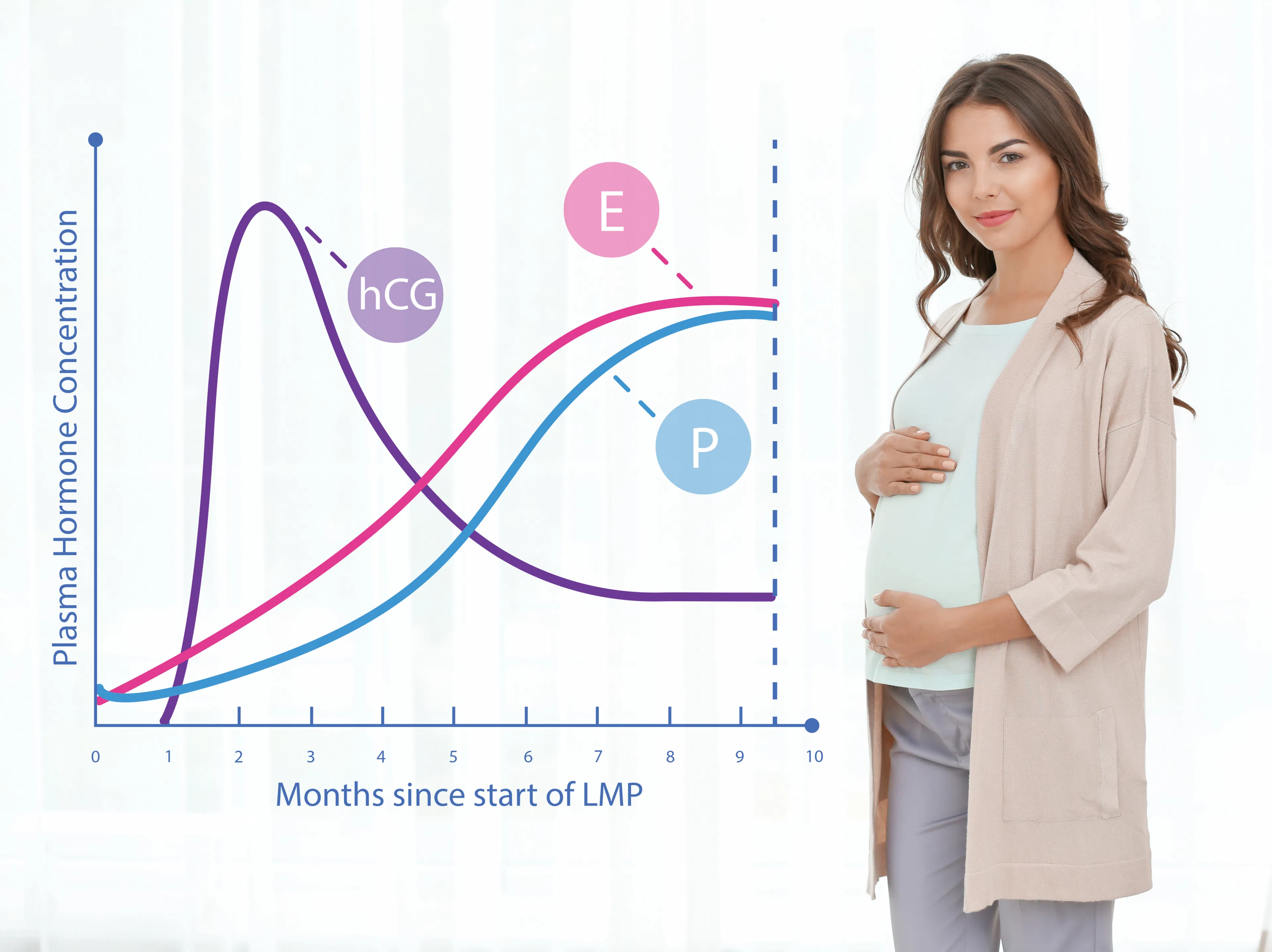
Interpreting Your hCG Test Results

A single hCG value tells you less than a series of values taken over time. Doctors usually request two or more tests, drawn 48 hours apart, to assess the pattern. This is where hCG test result interpretation becomes genuinely useful.

  • Rising hCG levels: In a healthy early pregnancy, hCG approximately doubles every 48 to 72 hours. A consistent rise is reassuring, though some healthy pregnancies rise a little more slowly and still proceed normally.
  • Levels not doubling appropriately: If hCG rises more slowly than expected, it can indicate a pregnancy that is not developing as expected, a possible early miscarriage, or an ectopic pregnancy, where the embryo has implanted outside the uterus. A slow rise alone is not conclusive. Your doctor will combine hCG trends with ultrasound findings and your symptoms before drawing any conclusions.
  • Plateauing or falling levels: hCG that stops rising or begins to fall in the first trimester generally signals that the pregnancy is not continuing. After a confirmed miscarriage, levels decline but may take several weeks to return to undetectable levels.
  • Significantly elevated levels: Levels significantly above the beta hCG normal range for gestational age can occasionally point to a multiple pregnancy (twins or more) or, rarely, a molar pregnancy, where abnormal tissue grows in the uterus. Both situations need medical evaluation.

A low early pregnancy hCG level is not automatically alarming; timing uncertainty and laboratory variation explain many single low readings. Bring your numbers to your doctor rather than interpreting them alone.

Contraindications and When Testing May Mislead

Certain situations can produce misleading hCG results. Tell your doctor about any relevant factors before or after testing.

  • Recent fertility treatments: hCG is used as an injectable medication in fertility treatments to trigger ovulation or support the luteal phase. Residual hCG from that injection can produce a positive test result that does not reflect a natural pregnancy. Your fertility specialist will advise the correct window for testing.
  • Underlying medical conditions: Some rare conditions, including germ cell tumours and gestational trophoblastic disease, can produce hCG in the absence of a normal pregnancy. A positive test in someone who is certain they are not pregnant, or who is postmenopausal, warrants further evaluation.
  • Evaporation lines and test timing: On home urine strips, leaving a test too long before reading it can produce a faint "evaporation line" that mimics a positive result. Always read results within the time window stated on the packaging.
  • Dilute urine samples: Testing with very dilute urine, for example after drinking large amounts of fluid, can lower hCG concentration enough to produce a false-negative early in pregnancy. First-morning urine reduces this risk.

Report any unexpected symptoms or test reactions to your healthcare provider or the relevant regulatory authority.

After Pregnancy: Planning Ahead

Once you have a confirmed pregnancy, the focus shifts from detection to care. If you are preparing for what comes after delivery, Apollo's newborn care guide for after delivery covers practical steps including umbilical cord care for your baby's first weeks.

Conclusion

Human chorionic gonadotropin (hCG) is an essential early pregnancy marker that supports the uterine lining and embryonic development from the moment implantation occurs. Because normal reference ranges vary widely between individuals, a single hCG blood or urine test reading rarely provides the full clinical picture. Obstetricians rely primarily on serial quantitative blood tests drawn 48 to 72 hours apart alongside diagnostic ultrasound scans to accurately track pregnancy progression and confirm foetal wellbeing. Expectant mothers should strictly avoid self-interpreting lab sheets or becoming anxious over isolated values, as wide variations between trimesters and laboratories are completely normal. Consulting a qualified obstetrician or gynaecologist ensures you receive clear, reassuring, and evidence-based guidance tailored to your individual pregnancy journey.

FAQS

How soon can hCG detect pregnancy?

A quantitative blood test can detect hCG as early as 10 to 14 days after conception. Most home urine tests are reliable from the first day of a missed period.

What is a normal hCG level for pregnancy?

There is no single "normal" number. At 4 weeks of pregnancy (from the last menstrual period), the beta hCG normal range runs roughly from 10 to 426 mIU/mL. Levels rise steeply through the first trimester, so the week of pregnancy matters as much as the number itself.

Can hCG levels indicate twins?

Higher-than-average hCG for gestational age can sometimes suggest a multiple pregnancy, but levels overlap considerably with singleton pregnancies. Ultrasound is the reliable way to confirm twins.

Do hCG levels drop after miscarriage?

Yes. After a miscarriage, hCG levels fall, but the rate varies. It can take anywhere from a few days to several weeks for levels to return to undetectable, depending on how far the pregnancy had progressed.

How accurate are home urine pregnancy tests?

When used correctly on or after a missed period, most home urine pregnancy tests are accurate in the large majority of cases. Testing too early or with dilute urine increases the chance of a false-negative result.

Apollo 247 Floating Action Button