logo
0

HCG Test Price in India: Cost & Normal Levels Guide

Check the beta hCG test price in India, understand blood and urine pregnancy tests, explore normal hCG levels by pregnancy week and learn what your results may mean.

article image

Dr.Rohini priyanaka

Waiting to find out whether you are pregnant can bring a mixture of excitement, hope and uncertainty. If your doctor has recommended an hCG test, you may also want to understand its cost, what it measures and how to interpret the result.

Human chorionic gonadotropin (hCG) is a hormone produced by cells that develop into the placenta after a fertilised egg implants in the uterus. Measuring this hormone in your blood or urine can help detect pregnancy. A quantitative blood test also measures the amount of hCG present, which may help your doctor assess an early pregnancy or investigate certain complications.

Understanding the different types of hCG tests, their costs and what your results may indicate can help you feel better prepared for your appointment.

What Is an HCG Test and Why Is It Done?

An hCG test measures human chorionic gonadotropin, a hormone that becomes detectable after implantation and increases during early pregnancy. It can be detected in both blood and urine.

Depending on the type of test, the result may indicate whether hCG is present or show its exact concentration in your blood.

Your doctor may recommend an hCG test for several reasons:

  • To detect pregnancy: Identifies hCG in your blood or urine, sometimes before a pregnancy can be seen on an ultrasound scan.
  • To assess an early pregnancy: Helps evaluate hormone levels when the timing or development of a pregnancy is uncertain.
  • To investigate a pregnancy of unknown location: Serial blood tests may help guide further assessment when an ultrasound has not yet established where the pregnancy is located.
  • To investigate possible pregnancy complications: Changes in hCG levels, considered alongside symptoms and ultrasound findings, may help assess a suspected ectopic pregnancy or pregnancy loss.
  • To monitor certain medical conditions: hCG measurements may be used after treatment for a molar pregnancy or certain hCG-producing tumours.

An hCG result alone cannot confirm that a pregnancy is developing normally or establish where it is located. Your doctor considers the result alongside your symptoms, medical history and ultrasound findings when appropriate.

HCG Test Price: Blood vs Urine Test Cost

The hCG test price in India depends on the type of test, laboratory, location and available discounts. A home urine pregnancy test is generally less expensive than a laboratory blood test.

The main options include:

  • Urine hCG test (qualitative): A home pregnancy test kit or urine test performed at a clinic detects whether hCG is present above the test's detection threshold. It generally provides a positive or negative result rather than an exact hormone level. Home pregnancy test kit prices vary by brand and product type.
  • Blood hCG test (qualitative): This test checks whether hCG is present in your blood and gives a positive or negative result. Its cost varies between diagnostic laboratories.
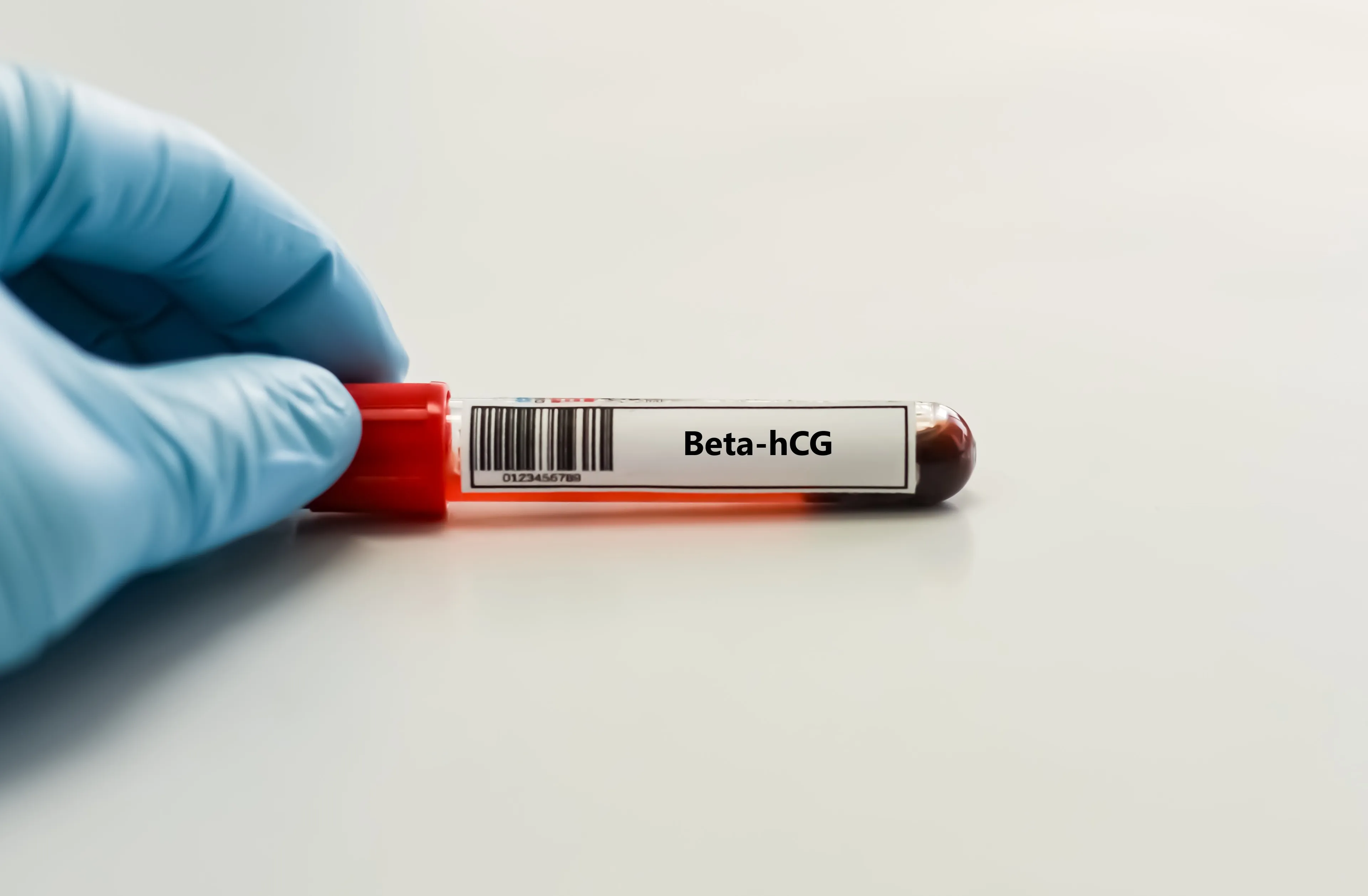
  • Blood hCG test (quantitative or beta-hCG): This test measures the exact concentration of hCG in your blood, usually reported in milli-international units per millilitre (mIU/mL). It provides more detailed information than a qualitative test and may be recommended when your doctor needs to monitor changes in hormone levels.

What Is the Apollo Beta HCG Test Price?

The Apollo Beta HCG Test is available for ₹1,099 for one blood test. The listed maximum retail price is ₹2,747. You can check the current price, available offers and home sample collection options through Apollo 24|7 Beta HCG Test.

The test does not require fasting or any special preparation. You can usually have your blood sample collected at a convenient time, unless your doctor gives you different instructions.

Types of HCG Tests: Qualitative vs Quantitative

The right hCG test depends on the information your doctor needs.

Qualitative HCG Test

A qualitative hCG test checks whether the hormone is present above a particular detection threshold. It gives a positive or negative result rather than measuring the exact amount.

It may be used for initial pregnancy detection through a urine or blood sample. A negative result does not always exclude pregnancy, particularly if testing takes place very early.

Quantitative HCG Test

A quantitative hCG test, commonly called a beta-hCG blood test, measures the exact concentration of the hormone in your blood.

Your doctor may recommend it to:

  • Assess a suspected very early pregnancy.
  • Monitor changes in hCG levels over time.
  • Investigate bleeding or abdominal pain during early pregnancy.
  • Help assess a pregnancy when its location has not been confirmed by ultrasound.
  • Monitor hCG levels after treatment for a molar pregnancy or certain tumours.

If serial testing is needed, your doctor may recommend two blood samples taken approximately 48 hours apart. The timing and need for further tests depend on your symptoms and clinical findings. Not everyone with a positive pregnancy test needs repeated blood tests.

Normal HCG Levels by Week of Pregnancy

hCG levels usually rise rapidly during early pregnancy, reaching their highest levels around 8 to 10 weeks. They then gradually decrease and remain at lower levels during the rest of pregnancy.

The following table provides general reference ranges for blood hCG levels by gestational week, calculated from the first day of your last menstrual period (LMP).

Gestational ageTypical hCG range (mIU/mL)
3 weeks5–50
4 weeks5–426
5 weeks18–7,340
6 weeks1,080–56,500
7–8 weeks7,650–229,000
9–12 weeks25,700–288,000
13–16 weeks13,300–254,000
17–24 weeks4,060–165,400
25–40 weeks3,640–117,000

These are general reference ranges, not fixed targets for every pregnancy. hCG levels vary considerably between individuals, and reference ranges may differ between laboratories and testing methods. Your report's reference values should take priority.

For many laboratories, an hCG level below 5 mIU/mL is considered negative in non-pregnant adults. Results between 5 and 25 mIU/mL may be considered borderline or indeterminate and may require repeat testing. However, the cut-offs vary between laboratories, so check the reference range on your report.

How to Read and Interpret Your HCG Results

Your hCG result needs to be interpreted in the context of your pregnancy stage, symptoms and medical history. A single measurement provides information about the hormone level at that time, but it cannot establish whether a pregnancy is developing normally.

What Do Low HCG Levels Mean?

A lower-than-expected hCG result may have several explanations:

  • Earlier pregnancy than estimated: Ovulation or implantation may have occurred later than expected, meaning your pregnancy may be at an earlier stage.
  • Possible pregnancy loss: Falling hCG levels may indicate that a pregnancy is not continuing.
  • Possible ectopic pregnancy: An ectopic pregnancy may produce hCG levels that rise more slowly or follow an unusual pattern.

A low result does not automatically mean that you are experiencing a pregnancy complication. Your doctor may recommend repeat testing and an ultrasound, depending on your result and symptoms.

What Do High HCG Levels Mean?

Higher-than-expected hCG levels may be associated with:

  • Multiple pregnancy: Twins or higher-order pregnancies may produce higher hCG levels, although a blood test cannot confirm the number of babies.
  • Incorrect pregnancy dating: Your pregnancy may be further along than estimated from your last menstrual period.
  • Molar pregnancy: This is a rare condition involving abnormal growth of placental tissue and may cause unusually high hCG levels.

A high result does not confirm any of these conditions. Further assessment is needed to understand the reason.

Does HCG Double Every 48 Hours?

You may have heard that hCG levels should double every 48 hours during early pregnancy. However, this is not a rule that applies to every pregnancy.

hCG usually rises rapidly during early pregnancy, but the rate of increase varies according to the starting level and stage of pregnancy. A healthy pregnancy may show a slower rise than an exact doubling over 48 hours.

When your doctor recommends serial hCG testing, the change between results is considered alongside ultrasound findings and symptoms. A rising hCG level alone cannot rule out an ectopic pregnancy.

If you experience vaginal bleeding, one-sided abdominal pain, shoulder-tip pain, dizziness or fainting, seek urgent medical assessment rather than waiting for another test.

Contraindications and Precautions

An hCG test is generally safe. A blood test involves a needle inserted into a vein and may cause brief discomfort, minor bruising or occasional light-headedness. A urine test is non-invasive.

Certain factors can affect how your result is interpreted:

  • Fertility medicines containing hCG: Some fertility treatments use hCG injections to trigger ovulation. The injected hormone can remain detectable and produce a positive result even before pregnancy is established. Follow your fertility specialist's instructions about when to test.
  • Recent pregnancy loss or termination: hCG may remain detectable for several weeks after a pregnancy ends. A positive result during this period does not necessarily indicate a new pregnancy.
  • Certain medical conditions: Gestational trophoblastic disease and some ovarian or testicular tumours can produce hCG without an ongoing pregnancy.
  • Very early testing: If hCG levels are still below the test's detection threshold, the result may be negative even when pregnancy has begun.
  • Diluted urine: Drinking excessive amounts of fluid before a urine test can reduce the concentration of hCG in the sample and affect the result.

Tell your doctor about any fertility treatment, recent pregnancy loss or relevant medical condition before interpreting your result. If the result is unexpected, your doctor can decide whether repeat testing or further investigation is appropriate.

Prescribing and Safety Information

An hCG test is a diagnostic investigation, not a medicine. A prescription may not be required for routine testing, but a doctor's advice is important when the result is being used to assess an early pregnancy or investigate a possible complication.

You generally do not need to fast before a blood beta-hCG test. You can eat and drink normally unless your doctor or laboratory gives you different instructions.

Do not use an hCG result alone to make decisions about pregnancy care or treatment. If you receive an unexpected result, discuss it with your doctor, who can explain what it means in your circumstances.

Conclusion

The hCG test helps detect pregnancy and, when measured quantitatively, provides information about the concentration of pregnancy hormone in your blood. The cost depends on whether you choose a urine or blood test, the type of investigation and the laboratory. The Apollo Beta HCG Test is available for ₹1,099, with home sample collection in eligible locations.

Your hCG level can provide useful information, particularly during early pregnancy, but one result cannot confirm pregnancy viability or location. If your doctor recommends repeat testing, an ultrasound or further assessment, these investigations can help build a clearer picture of your pregnancy and guide appropriate care.

FAQs

How many days after a missed period should I take an HCG test?

You can take a home urine pregnancy test from the first day of your missed period. A blood hCG test may detect pregnancy earlier, sometimes around 7 to 10 days after conception, although testing this early may still produce a negative result. If your result is negative but your period does not arrive, your doctor may recommend repeating the test.

Can an HCG test give a false result?

Yes. A false-negative result may occur if you test too early or if your urine is very dilute. False-positive results are less common but may occur after fertility treatment involving hCG injections, a recent pregnancy loss or certain medical conditions. If the result does not match your symptoms or circumstances, consult your doctor.

Is fasting required before an HCG blood test?

No. Fasting is generally not required before a blood beta-hCG test. You can usually eat and drink normally before sample collection. Follow any specific instructions provided by your doctor or laboratory.

How soon can an HCG blood test detect pregnancy after conception?

A blood hCG test may detect pregnancy approximately 7 to 10 days after conception, depending on when implantation occurs and the sensitivity of the test. Testing very early may still give a negative result. For a more reliable result, your doctor may recommend testing around the time of your expected period or repeating the test if needed.
Does Apollo offer home sample collection for an HCG test?

Yes. You can choose home sample collection for the Apollo Beta HCG blood test in eligible locations. Visit the Apollo 24|7 Beta HCG Test page to check availability, current pricing and booking options for your area.

Apollo 247 Floating Action Button