logo
0

How to Choose the Right Baby Soap and Shampoo

Learn how to choose the right baby soap and shampoo based on your baby's skin type, safe ingredients, fragrance, pH, cleansing needs, and age.

article image

Dr. Mayank

Bringing a newborn home is one of life's most joyful moments, and also one of its most anxious ones. Something as simple as choosing the right baby soap can feel overwhelming when you are staring at a shelf of products making nearly identical claims. Newborn skin is genuinely different from adult skin, and what you put on it matters. This guide covers everything you need to know, from reading ingredient labels to bathing safely in those early weeks.

How to Choose a Safe Baby Soap and Shampoo

Not all "baby" labels mean the same thing. A product marketed for babies can still contain ingredients that irritate delicate skin. Here is what to look for and what to avoid.

Key criteria to check

  • pH-balanced formulas (ideally around pH 5.5) preserve the skin's natural acid mantle, which protects against bacteria and moisture loss.
  • Sulphate-free baby soap avoids harsh cleansing agents like sodium lauryl sulphate (SLS) and sodium laureth sulphate (SLES), which strip natural oils.
  • Fragrance-free products reduce the risk of contact dermatitis. Synthetic fragrances are among the most common triggers of skin reactions in infants.
  • Look for "dermatologically tested" on the label, and check whether testing was done specifically on infant skin.
  • Parabens, formaldehyde-releasing preservatives, and artificial dyes are worth avoiding in a first-year product.

Is pH-balanced soap important for babies?

Yes, and more so than most parents realise. A newborn's skin pH is higher at birth and gradually settles into an acidic range over the first few weeks. Using an alkaline soap during this window can disrupt that process, leaving skin more vulnerable to dryness and infection. A gentle, pH-balanced baby soap supports healthy barrier development rather than working against it.

Newborn-Safe Formulations: What Makes Them Different

Newborn skin is thinner, absorbs substances more readily, and loses moisture faster than adult skin. At birth, many babies are also covered in vernix, a waxy coating that acts as a natural moisturiser and antimicrobial layer. Delaying the first bath by at least 24 hours is widely recommended, partly to preserve this coating.

Regular baby soap, even a mild one designed for older infants, can still be too harsh for the first few weeks. The best soap for newborn baby use is one formulated with:

  • Mild, plant-derived surfactants instead of sulphates
  • No synthetic dyes, which add irritation risk without any benefit
  • Minimal preservatives, using only those that are well-studied and low-irritant
  • A tear-free formula for anything used near the face

A tear-free baby shampoo for newborns achieves its gentle quality not by numbing the eyes, as older formulations sometimes did, but by using surfactant systems that are genuinely less irritating to mucous membranes. Look for this distinction on the label.

Can I use regular baby soap on a newborn?

It is better not to, at least in the first month. Products labelled for "newborns" or ages 0 to 3 months are formulated with extra caution in mind. For very young babies, plain warm water with a soft cloth is often enough for daily cleaning, with a gentle soap for baby skin used only on areas that actually need it.

Step-by-Step Safe Bathing Technique for Babies

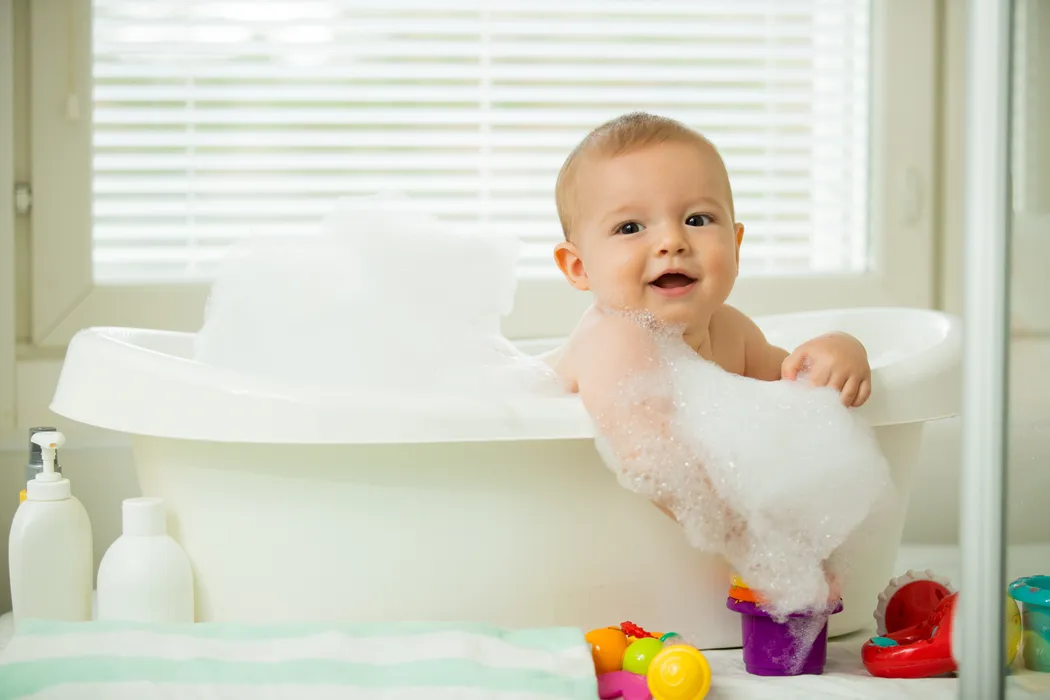
Knowing how to bathe a newborn safely is just as important as choosing the right products. Good technique protects both skin integrity and your baby's safety.

Before you start

  • Gather everything before undressing the baby: a basin or infant tub, two soft cloths, a towel, clean clothes, and your chosen products.
  • Water temperature should feel comfortably warm on your inner wrist or elbow.
  • Around 37 to 38 degrees Celsius is appropriate.
  • Bathe in a warm room to prevent heat loss.

Sponge bath vs tub bath

Until the umbilical cord stump falls off (usually within 1 to 3 weeks), stick to sponge baths. Submerging the navel area can slow healing and raise infection risk. For detailed guidance on caring for the umbilical cord during baths, see our related article.

Once the stump has gone, you can move to a shallow tub bath with just enough water to cover the lower body.

The bathing sequence

  1. Clean the face first with a damp cloth and plain water, no soap.
  2. Wash the scalp gently with a small amount of tear-free baby shampoo, rinsing carefully.
  3. Clean the body with a soft cloth and a small amount of gentle soap for baby skin, working from neck to feet.
  4. Clean the nappy area last.
  5. Rinse thoroughly; soap residue is a common cause of dryness and rash.
  6. Pat dry immediately, paying close attention to skin folds.
  7. Apply a fragrance-free baby moisturiser while skin is still slightly damp.

When to Avoid Certain Soaps: Contraindications and Skin Sensitivities

Babies who need extra caution

Some infants should not use standard baby soaps without medical guidance:

  • Babies with eczema (atopic dermatitis) often react to even mildly fragranced or preservative-containing products. A paediatrician or dermatologist may recommend a soap substitute or emollient wash instead.
  • Broken or inflamed skin should not come into contact with any soap until it has healed. For guidance on treating minor skin cuts or irritation, see our related article.
  • Premature babies have even more fragile skin and may need specific products recommended by their neonatal care team.
  • Babies with a known allergy to a specific plant extract (for example, coconut or aloe) should avoid products containing that ingredient, even if it is marketed as "natural."

Patch testing

Before using any new product on your baby's skin, apply a small amount to the inner forearm or behind the knee. Wait 24 hours and check for redness, swelling, or a rash. If any reaction appears, discontinue use immediately.

Conclusion

Choosing the right baby soap and shampoo is mainly about protecting your baby's delicate skin rather than using more cleansing products. Look for gentle, pH-balanced, fragrance-free formulations with mild cleansing ingredients, and avoid unnecessary irritants. For newborns, plain warm water may be sufficient for routine cleaning, while a gentle baby cleanser can be used when needed. Keep baths short, use comfortably warm water, rinse products thoroughly, and moisturise the skin after bathing if needed. If your baby has eczema, premature skin, persistent irritation, or a known sensitivity to an ingredient, consult your paediatrician before introducing new skincare products.

FAQS

Is baby soap necessary, or is water enough?

For very young newborns, plain warm water is sufficient for daily face and body wipes. A gentle baby soap is useful two to three times a week, mainly for the nappy area and skin folds where bacteria and moisture accumulate.

Can adults use baby soap?

Adults can use baby soap without harm, particularly those with sensitive or dry skin. It is simply formulated to be milder, so it may not remove heavy dirt or oil as effectively as products designed for adult skin.

How do I choose a shampoo for a baby with cradle cap?

Look for a fragrance-free, sulphate-free baby shampoo for newborn scalps. Gently massaging it in and using a soft brush to loosen flakes before rinsing is often effective. If cradle cap is thick, persistent, or inflamed, ask your paediatrician before trying any medicated option.

Are herbal baby soaps safer than synthetic ones?

Not automatically. "Herbal" or "natural" products can still contain allergens, such as plant extracts or essential oils, that trigger reactions in sensitive infants. The safety of a baby soap depends on its specific ingredients and formulation, not on whether it is labelled natural or synthetic.

What is the right age to start using baby shampoo?

You can use a tear-free baby shampoo from birth, applying it to the scalp two to three times a week during baths. There is no need to wait for visible hair growth; even bare scalps benefit from a gentle cleanse to manage oil and flaking.

Apollo 247 Floating Action Button