logo
0

Infant Crawling Toys: A Guide to Age-Appropriate Picks

Discover age-appropriate crawling toys for infants, including safe toy features, developmental benefits, selection tips and precautions for active babies.

article image

Dr.Nallapu Siri

Choosing the right infant crawling toys can make a real difference in how your baby builds strength, coordination, and confidence during those early months. Crawling is one of the first major physical milestones, and the right playthings can motivate your baby to reach, stretch, and push forward. This guide covers what to buy at each stage, how to keep playtime safe, and when to talk to your paediatrician.

When Do Babies Start Crawling?

Understanding when babies start crawling helps parents set realistic expectations and plan play accordingly. Most babies begin crawling somewhere between 6 and 10 months of age, though this range varies widely and that variation is completely normal. Some babies go straight to pulling themselves up and cruising along furniture, skipping traditional hands-and-knees crawling altogether.

Signs that your baby may be getting ready to crawl include:

  • Holding their head steady and pushing up on both arms during tummy time
  • Rocking back and forth on hands and knees
  • Pivoting on their belly to reach objects just out of reach
  • Pulling their knees under their hips when lying on their stomach

Pediatric guidelines generally suggest watching for crawling attempts in the 6-to-10-month window, but not seeing crawling by 10 months does not automatically signal a problem. Each baby follows their own timeline.

How Toys Support Crawling and Motor Development?

Play is one of the most powerful motivators for movement. When a bright toy sits just beyond a baby's reach, curiosity does the work. The baby stretches, shifts weight, and eventually figures out how to propel themselves forward to get it.

This motivation-through-play mechanism supports gross motor development in several ways:

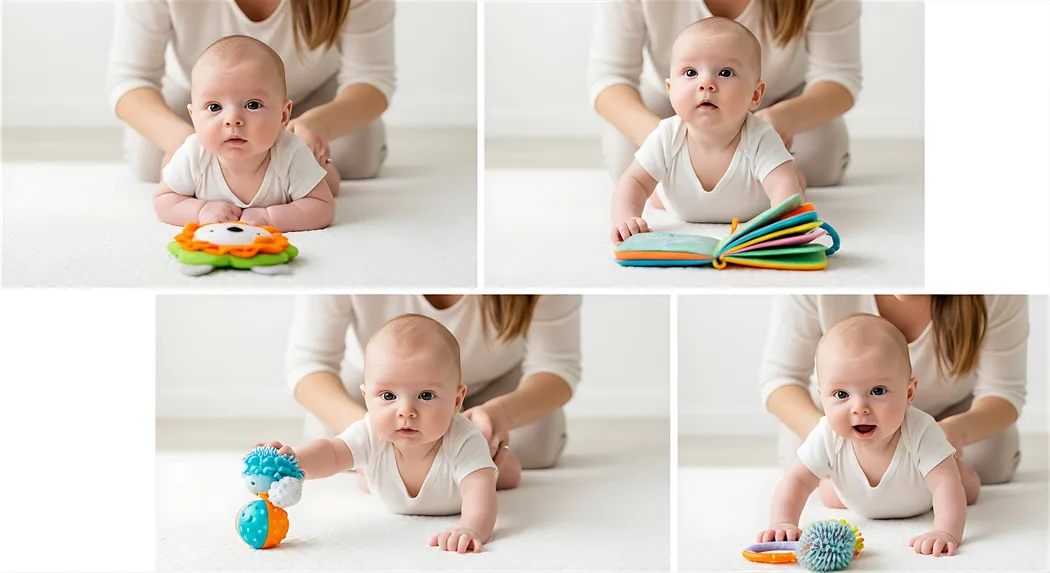
  • Tummy time with interesting objects in front builds the shoulder, arm, and core strength babies need before they can crawl
  • Reaching and tracking a moving toy develops bilateral coordination, the ability to use both sides of the body together
  • Cause-and-effect toys that light up or make sounds when touched reward effort and keep babies engaged long enough to practice

Think of gross motor development toys for infants less as training equipment and more as reasons to move. The toy sets the goal; the baby figures out how to get there.

Age-Appropriate Toy Categories

5 to 6 Months: Building the Foundation

At this stage, babies are strengthening their neck, back, and arms through tummy time. They are not yet crawling, but the right toys set the groundwork. Choosing safe toys for 6-month-olds means looking for soft, oversized pieces with no detachable parts and materials that can be safely mouthed, since everything goes in the mouth at this age.

Good options at this stage include:

  • A soft, high-contrast play mat with attached crinkle toys or dangling rings, which gives babies something to bat at and reach toward during floor time
  • A simple sensory ball with varied textures, easy for small hands to grip, and slow enough to roll just ahead during tummy time to spark the urge to move forward
  • Lightweight rattles in bright colours that encourage weight-shifting while reaching, exactly the core engagement babies need before they can crawl

7 to 9 Months: Encouraging Forward Movement

This is the prime window for most babies to start crawling. Toys to encourage crawling at this stage should reward movement with something worth chasing.

Good picks here include:

  • Rolling or crawl-along toys that move slowly when pushed, such as soft balls or push-along animals on wheels, giving babies a moving target that is not too fast to follow
  • Musical cause-and-effect cubes placed a short distance ahead, which play a sound when the baby finally reaches them, making arrival feel like a small victory
  • Pop-up toys with buttons or levers, because they encourage the baby to shift from sitting to kneeling and to transition between positions

The best toys for crawling babies in this age band are ones that can be safely mouthed, because oral exploration is still very much part of how babies interact with the world.

10 to 12 Months: Refining Skills and Exploring Space

Babies crawling confidently at this stage are often also pulling up, cruising along furniture, and exploring at speed. Toys can now introduce a bit more challenge.

  • Low soft-play tunnels encourage babies to crawl through a defined space, building body awareness and spatial understanding
  • Stacking rings or large-piece shape sorters placed across the room give a destination worth crawling toward
  • Large push-along walkers, used only when a baby is already pulling to stand and well-supported, can help with the transition toward walking, though they should not replace floor crawling time.

Safety Checklist for Crawling Toys

Safety is non-negotiable when choosing infant crawling toys. Run through this list before buying or introducing any toy.

  • Any toy or detachable part small enough to pass through a standard 45-mm circle is a choking hazard for babies under 3 years
  • Look for BIS (Bureau of Indian Standards) certification on packaging. Indian toy safety standards under IS 9873 cover mechanical, physical, and chemical requirements
  • Avoid toys with sharp edges, loose threads, or paint that chips or peels
  • Choose non-toxic, baby-safe materials, particularly for toys that will be mouthed regularly
  • Always supervise floor play, even with certified toys
  • Inspect toys regularly for cracks, broken parts, or wear, and discard damaged items promptly

Who should not use certain toys: Avoid toys with small magnetic pieces for babies under 36 months. Babies with a known latex sensitivity should not use rubber toys containing natural latex. If your baby has a diagnosed motor or neurological condition, consult your occupational therapist or paediatrician before introducing new play equipment.

For broader guidance on caring for your baby in those early months, see our newborn care basics for new parents.

When to Consult a Paediatrician About Delayed Crawling?

Most babies who are not yet crawling by 10 months are simply taking a little longer and will get there on their own. That said, certain signs are worth raising with a paediatrician sooner rather than later.

Contact your baby's doctor if you notice:

  • No attempt to bear weight on legs by around 9 to 10 months
  • Consistent use of only one side of the body when reaching or moving
  • No sitting without support by 9 months
  • A complete absence of crawling or alternative mobility (bottom-shuffling, rolling) by 12 months
  • Loss of a motor skill the baby previously had

These are not diagnoses. They are prompts for a conversation with a professional who can assess your baby in person. Early support, if needed, is always more effective than a wait-and-see approach that stretches too long.

Report adverse events to your healthcare provider or the relevant regulatory authority.

Conclusion

Crawling toys can encourage infants to move, explore and develop coordination while making floor play more engaging. Choose toys that match your baby’s developmental stage, are sturdy and free from small detachable parts or other choking hazards. Always supervise your baby during play and check toys regularly for damage or loose components.

FAQS

What toys encourage a baby to crawl?

Toys that move away from a baby, like slowly rolling balls or crawl-along animals, are among the most effective because they give babies a reason to chase. Cause-and-effect toys placed just out of reach during tummy time work in the same way.
Is it normal for a baby to skip crawling?

Yes, it is. Some babies go directly from sitting to pulling up and walking without ever crawling on hands and knees. Pediatric guidance generally considers this a normal variation as long as other motor milestones are being met.

How can I help my baby start crawling faster?

Give your baby plenty of daily tummy time on a firm, flat surface, and place interesting toys just beyond their reach to motivate forward movement. Reducing time spent in bouncers or car seats outside of travel also frees up the floor time babies need to practice.

What age should a baby crawl by?

Most babies crawl between 6 and 10 months, but some reach this milestone a little later. If your baby is not showing any signs of independent mobility by 12 months, speak to your paediatrician.

Do walkers help babies learn to crawl?

No. Baby walkers actually reduce the floor time babies need to develop the core and arm strength required for crawling, and several pediatric bodies advise against their use for this reason. Push-along toys used while a baby is already standing are a safer option for supporting the transition to walking.

Apollo 247 Floating Action Button