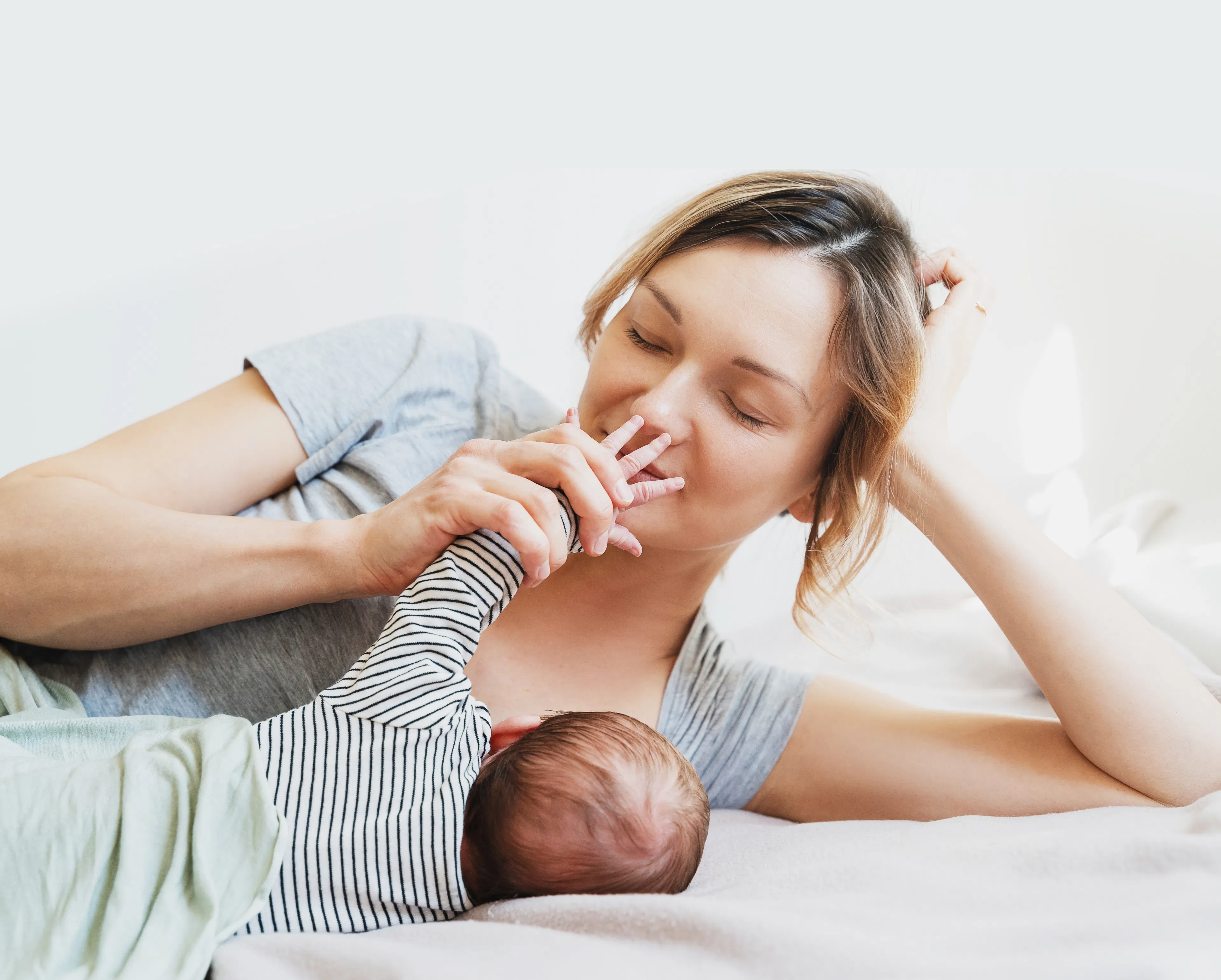
The following overview describes skills many babies develop during the first year. Your baby may acquire them earlier or later, and not every baby will show every skill at the same time.
Newborn Development: Birth to 1 Month
Newborns spend much of their time sleeping, feeding and adjusting to life outside the womb. Their movements are largely reflexive, and they need support when being held.
You may notice that your newborn:
- Turns towards a touch near the cheek as part of the rooting reflex.
- Sucks when feeding and grasps a finger placed in the palm.
- Briefly focuses on a face or object held close.
- Reacts to loud sounds or sudden movements.
- Recognises familiar voices and may settle when held or spoken to gently.
How you can support development: Hold your baby securely, speak softly and respond to feeding and comfort cues. When your baby is awake and supervised, short periods of tummy time can help develop neck and shoulder strength. Always place your baby on their back to sleep.
2 Months Newborn Development
By around two months, babies often become more responsive to the people around them. Parents may notice more eye contact, facial expressions and early vocal sounds.
Common milestones include:
- Smiling in response to interaction.
- Looking at your face and briefly watching a moving person or object.
- Making sounds other than crying, such as cooing.
- Reacting to loud sounds.
- Beginning to hold the head up briefly during supervised tummy time.
How you can support development: Talk, sing and smile at your baby. Give them time to look at your face and respond to their sounds. Continue supervised tummy time for short, comfortable periods while your baby is awake.
If your baby does not respond to loud sounds, rarely looks at faces or is not showing expected social responses, discuss your observations with your paediatrician.
3 Months: Improving Head Control and Interaction
During the third month, your baby may become more alert and increasingly interested in faces and sounds. Head control and upper-body strength continue to develop.
You may notice that your baby:
- Holds the head more steadily when supported.
- Watches faces and moving objects.
- Smiles and vocalises during interaction.
- Moves the arms and legs more actively.
- Enjoys familiar voices and playful communication.
How you can support development: Continue talking, singing and playing face-to-face. Offer safe opportunities to look at age-appropriate toys and move the arms and legs freely while supervised.
4 Months: Reaching, Rolling and Babbling
At around four months, many babies become more active and begin exploring their surroundings with their hands.
Common developments include:
- Holding the head steady when supported upright.
- Bringing the hands to the mouth.
- Reaching for toys and holding objects placed in the hand.
- Making sounds such as cooing and beginning to respond with sounds.
- Smiling to gain attention and showing enjoyment during interaction.
- Beginning to roll, although the timing varies.
How you can support development: Offer safe, easy-to-grasp toys and let your baby explore them under supervision. Continue talking and responding to sounds. Stop swaddling as soon as your baby shows signs of attempting to roll, and maintain a clear, safe sleep space.
5 Months: Exploring with Hands and Eyes
Many babies become increasingly interested in objects, movement and familiar people at around five months. Some may roll in one direction or begin rolling both ways.
You may observe that your baby:
- Reaches more deliberately for toys.
- Brings objects to the mouth to explore them.
- Turns towards familiar voices.
- Laughs, squeals or makes a wider range of sounds.
- Pushes up on the arms during tummy time.
- Shows greater control of the head and upper body.
How you can support development: Offer supervised floor play and safe toys of different textures. Keep small objects, loose parts and other choking hazards away from your baby.
6 Months: Sitting with Support and Early Babbling
Six months is an important stage in infant development. Many babies can roll in at least one direction, reach for objects and make a wider variety of sounds. Some begin sitting with support or briefly lean forward on their hands when sitting.
Your baby may also:
- Recognise familiar people.
- Laugh, squeal and take turns making sounds with you.
- Reach for a toy they want.
- Explore objects by looking at, touching and mouthing them.
- Show curiosity about food when others are eating.
Complementary foods are generally introduced at around six months when your baby shows the necessary developmental readiness. Breast milk or infant formula remains important during this transition. Seek guidance from your paediatrician if you are unsure whether your baby is ready.
How you can support development: Play simple games, respond to babbling and offer safe objects to explore. During meals, ensure your baby is sitting upright and supervised, and offer foods prepared in an age-appropriate texture.
7 Months: More Confident Movement
By seven months, some babies can sit without support, while others still need help maintaining their balance. Reaching, turning and shifting body weight may become easier as strength and coordination improve.
You may notice that your baby:
- Sits independently for periods of time.
- Reaches for toys while sitting or lying down.
- Transfers objects between hands.
- Makes repeated sounds and enjoys vocal interaction.
- Shows stronger preferences for familiar people.
How you can support development: Provide a safe floor area for movement and exploration. Sit nearby, talk to your baby and offer toys that encourage reaching without placing them too far away.
8 Months: Object Exploration and Familiarity
Around eight months, babies may become more aware of familiar routines and people. Some begin showing anxiety around strangers or become upset when a caregiver leaves the room.
Possible developments include:
- Reaching for an object partly hidden from view.
- Exploring toys by turning, banging or transferring them between hands.
- Sitting more steadily.
- Beginning to move by rolling, pivoting, crawling or scooting.
- Making varied babbling sounds.
How you can support development: Play simple hiding games with safe toys, respond warmly when your baby seeks reassurance and encourage movement in a supervised, child-safe area.
9 Months: Sitting, Babbling and Exploring
By around nine months, many babies sit without support and use their hands to explore objects. Some begin moving around by crawling or scooting, while others use different movement patterns.
Your baby may:
- Respond to their name.
- Make repeated sounds such as “mamama” or “bababa”.
- Look for a toy that has fallen out of sight.
- Reach for objects and transfer them between hands.
- Show different reactions to familiar people and strangers.
- Use fingers to rake small objects towards themselves.
Babbling does not necessarily mean your baby is saying meaningful words. Communication develops gradually through sounds, facial expressions, gestures and shared attention.
How you can support development: Read picture books, name familiar objects and respond to your baby's sounds. Keep floors and reachable surfaces free of small items that could cause choking.
10 Months: Pulling Up and Using Gestures
Some babies begin pulling themselves to stand using furniture during this period. Others focus on crawling, sitting or practising movements that prepare them for standing.
You may notice that your baby:
- Moves between sitting and other positions.
- Pulls up to stand with support.
- Cruises sideways while holding furniture.
- Copies gestures or sounds.
- Looks for familiar objects and people.
- Uses fingers to pick up small pieces of suitable food.
How you can support development: Secure heavy furniture to the wall, block access to stairs and supervise your baby around furniture. Avoid baby walkers that allow a child to move around while supported in a suspended seat, as they can increase injury risk.
11 Months: More Communication and Independence
As the first birthday approaches, babies often become more purposeful in how they move and communicate. Some may stand briefly without support or take steps while holding an adult's hands or furniture.
Your baby may:
- Use gestures such as reaching, waving or lifting the arms to be picked up.
- Imitate sounds and actions.
- Understand familiar words or simple requests in context.
- Explore objects using the thumb and fingers.
- Show a preference for particular toys, activities or people.
How you can support development: Name objects during everyday routines, share books and encourage safe play. Let your baby practise standing and moving at their own pace without forcing walking.
12 Months: The First Birthday
At around 12 months, many babies can pull up to stand, move along furniture and use gestures to communicate. Some take independent steps around this time, while others walk later.
Common milestones may include:
- Waving goodbye or using another gesture to communicate.
- Understanding familiar words or simple instructions.
- Making varied sounds and possibly saying a first meaningful word.
- Looking for objects that are hidden from view.
- Picking up small objects between the thumb and forefinger.
- Pulling up to stand and moving while holding furniture.
Not walking independently by the first birthday is not necessarily a concern. Walking commonly develops over a wider age range. If your baby is not progressing in movement or you have concerns about other skills, discuss them with your paediatrician.