Menstrual Cycle: Phases, Timing & What Happens Each Day
Learn about the menstrual cycle, including its four phases, typical timing, hormonal changes, ovulation, period symptoms, and what happens throughout each stage.
Dr.Mayank
Understanding your menstrual cycle with diagram support can transform the way you read your body's signals. For many women and teens, the cycle feels like a mystery, but once you see how each phase connects to the next, tracking becomes much simpler. Whether you are monitoring for health reasons, trying to conceive, or just curious about what is happening inside your body each month, this guide walks you through every phase, day by day.
What Is the Menstrual Cycle?
The menstrual cycle is a monthly hormonal process that prepares the uterus for a possible pregnancy. It starts on the first day of your period and ends the day before your next period begins.
The average menstrual cycle length is 28 days, but anything between 21 and 35 days is considered normal for most adults. Teenagers may see slightly wider variation, especially in the first few years after their first period. Cycle length can also shift naturally with age, stress, or changes in health.
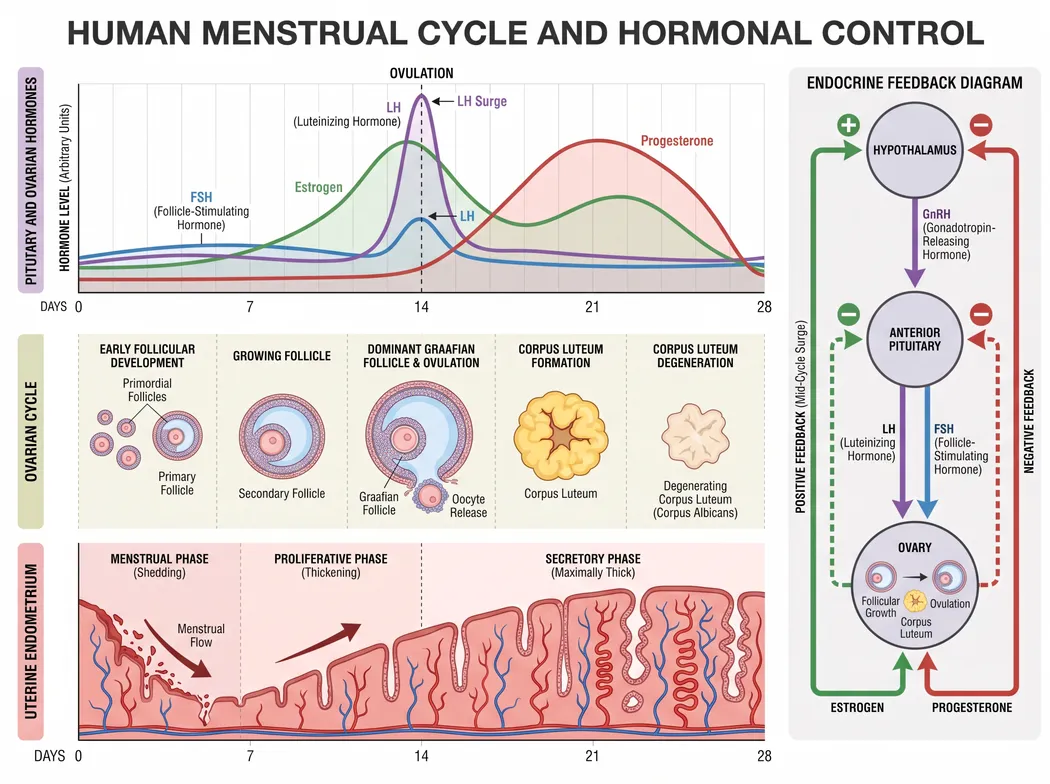
The menstrual cycle has four main phases that occur in sequence. Although a 28-day cycle is often used as an example, cycle length and the timing of each phase can vary between individuals.
Phase
Days (typical)
Key event
Menstrual
1 to 5
Uterine lining sheds
Follicular
1 to 13
Follicles mature, oestrogen rises
Ovulation
Around day 14
Egg is released
Luteal
15 to 28
Progesterone peaks, cycle resets
Menstrual Phase (Day 1-5)
Day 1 is the official start of your cycle, marked by the first day of bleeding. This happens because the egg from the previous cycle was not fertilised. With no pregnancy, oestrogen and progesterone levels fall sharply, and the uterine lining breaks down and leaves the body as menstrual blood.
Bleeding typically lasts 3 to 7 days. Flow is usually heaviest in the first 2 days, then lightens.
Common symptoms during this phase include:
Cramping in the lower abdomen or back
Bloating and a feeling of heaviness in the pelvis
Fatigue, sometimes significant on days 1 and 2
Headaches or mild nausea in some people
Cramping happens because the uterus contracts to help push out the lining. Over-the-counter pain relief and a heat pad can help. If cramps are severe enough to interrupt daily life, speak to a doctor.
Follicular Phase (Day 1-13)
The follicular phase overlaps with menstruation and continues after bleeding stops. While you are having your period, the brain's pituitary gland is already releasing follicle-stimulating hormone (FSH). FSH signals the ovaries to develop a group of small fluid-filled sacs called follicles, each containing an immature egg.
Over the next few days, one follicle becomes dominant and the others fade. This leading follicle produces increasing amounts of oestrogen, which does two important things: it thickens the uterine lining to create a nourishing environment for a potential embryo, and it signals the brain to eventually trigger ovulation.
By the end of the follicular phase, most people notice:
More energy and a more positive mood (rising oestrogen has this effect)
Clearer skin compared to the week before a period
Cervical mucus that begins to increase and become more slippery
The length of the follicular phase is the main reason cycle lengths vary between people. If you have a 35-day cycle rather than a 28-day one, your follicular phase is simply longer.
Ovulation (Day 14)
Ovulation is the pivotal event of the ovulation cycle chart. A sharp surge in luteinising hormone (LH) triggers the dominant follicle to rupture and release a mature egg into the fallopian tube. On a 28-day cycle this typically happens around day 14, but on longer or shorter cycles it shifts accordingly.
The egg lives for just 12 to 24 hours after release. Sperm can survive in the reproductive tract for up to 5 days, so the fertile window is generally the 5 days before ovulation plus the day of ovulation itself.
Signs that ovulation is approaching or happening:
A slight rise in basal body temperature (measurable with a thermometer taken first thing in the morning)
Clear, stretchy cervical mucus that resembles raw egg white
A mild one-sided pelvic ache called mittelschmerz in some people
A positive result on an LH ovulation predictor kit
Luteal Phase (Day 15-28)
After the egg is released, the ruptured follicle transforms into a temporary gland called the corpus luteum. It produces progesterone, which peaks around days 19 to 22. Progesterone keeps the uterine lining thick and receptive, ready for a fertilised egg to implant.
If fertilisation does not happen, the corpus luteum breaks down after about 12 to 14 days. Progesterone and oestrogen fall again, and the lining begins to shed, starting your next cycle.
The hormonal drop in the second half of the luteal phase is what drives premenstrual syndrome (PMS). Symptoms may include:
Breast tenderness or swelling
Bloating and weight gain from fluid retention
Mood changes, irritability, or low mood
Trouble sleeping or increased fatigue
Food cravings, particularly for carbohydrates or sweets
The luteal phase is fairly fixed at 12 to 14 days in most people. If it is consistently shorter, it can sometimes affect fertility, so mention this to a gynaecologist if you are trying to conceive.
Hormones Driving the Cycle
The hormone changes during menstrual cycle follow a predictable rise-and-fall pattern. Four hormones work in sequence:
FSH (follicle-stimulating hormone): FSH rises at the beginning of the cycle and stimulates the growth and development of ovarian follicles.
Oestrogen: Oestrogen levels generally rise during the follicular phase, reaching a peak shortly before ovulation. Levels then briefly fall and may rise again during the luteal phase.
LH (luteinising hormone): A sharp mid-cycle surge in LH triggers ovulation, leading to the release of an egg from the ovary.
Progesterone: Progesterone rises after ovulation and is the dominant hormone during the luteal phase. It typically peaks during the middle of this phase and falls if pregnancy does not occur.
The follicular and luteal phase are governed largely by oestrogen and progesterone respectively. Together, these hormones also affect mood, energy, sleep, and skin across the cycle, which is why tracking them by phase can help you plan activity, rest, and nutrition around your cycle.
When to See a Doctor: Irregular Cycles and Red Flags
Cycle variation of a few days each month is normal. However, some patterns warrant medical attention. This section is not a diagnostic tool. Use it to recognise when professional evaluation is appropriate.
Seek advice from a doctor if you notice:
Cycles consistently shorter than 21 days or longer than 35 days
Periods that have become suddenly much heavier or last longer than 7 days
Bleeding between periods or after sex
Severe pain that is not controlled by standard pain relief
No period for 3 or more months (when not pregnant)
Signs of very heavy bleeding such as soaking through a pad or tampon every hour for 2 or more hours
These symptoms can be linked to conditions including polycystic ovary syndrome (PCOS), thyroid disorders, fibroids, endometriosis, or other hormonal imbalances, all of which respond well to early diagnosis and treatment.
Who should not self-manage without professional guidance:
Anyone with a known bleeding disorder, those on medications that affect hormones, anyone under 16 with cycle irregularities, and anyone experiencing symptoms that significantly affect daily life should see a gynaecologist rather than relying on cycle-tracking apps alone.
Report adverse events or unexpected symptoms related to any hormonal treatment to your healthcare provider or the relevant regulatory authority.
Conclusion
Understanding the menstrual cycle can make it easier to recognise normal changes in your body and identify symptoms that may need attention. The cycle has four phases—menstrual, follicular, ovulation, and luteal—with hormones such as FSH, oestrogen, LH, and progesterone coordinating changes in the ovaries and uterus. Although a 28-day cycle is commonly used as an example, the timing of each phase can vary between individuals. Tracking your periods, symptoms, cervical mucus, and cycle length can help you understand your pattern and may also be useful when discussing menstrual or fertility concerns with a healthcare professional.
FAQS
How many days is a normal menstrual cycle?
A normal menstrual cycle is typically 21 to 35 days from the first day of one period to the first day of the next. The widely quoted average menstrual cycle length is 28 days, but most healthy cycles fall somewhere within that broader range.
What are the signs of ovulation?
The most reliable signs include clear, stretchy cervical mucus, a rise in basal body temperature, a positive LH test, and sometimes a mild one-sided pelvic ache. These signals cluster around the middle of your cycle, usually a day or two before the egg is released.
Can menstrual cycle length vary every month?
Yes, some variation from month to month is normal. Stress, illness, significant weight changes, travel, or disrupted sleep can all shift the length of the follicular phase, making one cycle shorter or longer than usual.
What causes irregular periods?
Common causes include hormonal imbalances such as PCOS or thyroid dysfunction, significant stress, rapid weight gain or loss, excessive exercise, and certain medications. Persistent irregularity lasting more than 2 to 3 cycles deserves a medical review.
How is the fertile window calculated?
Count back 14 days from the expected start of your next period to estimate ovulation day. The fertile window covers the 5 days before that estimated ovulation day plus the day itself. On a 28-day cycle this puts the window roughly from day 9 to day 14.