logo
0

Milia on Newborns: Causes, Differences & Care Guide

Understand milia on newborn skin — why it appears, how long it lasts, and how to tell it apart from other rashes. Expert-reviewed guidance.

article image

Dr.Yusuf

Tiny white dots on your baby's nose or cheeks can send a new parent straight to the search bar at 2 a.m. Milia on newborn skin is one of the most common reasons parents worry, yet it is almost always harmless and clears up without any treatment. Understanding what you are looking at, why it appears, and how to tell it apart from other rashes can spare you a lot of anxiety.

What Is Milia on Newborn Skin?

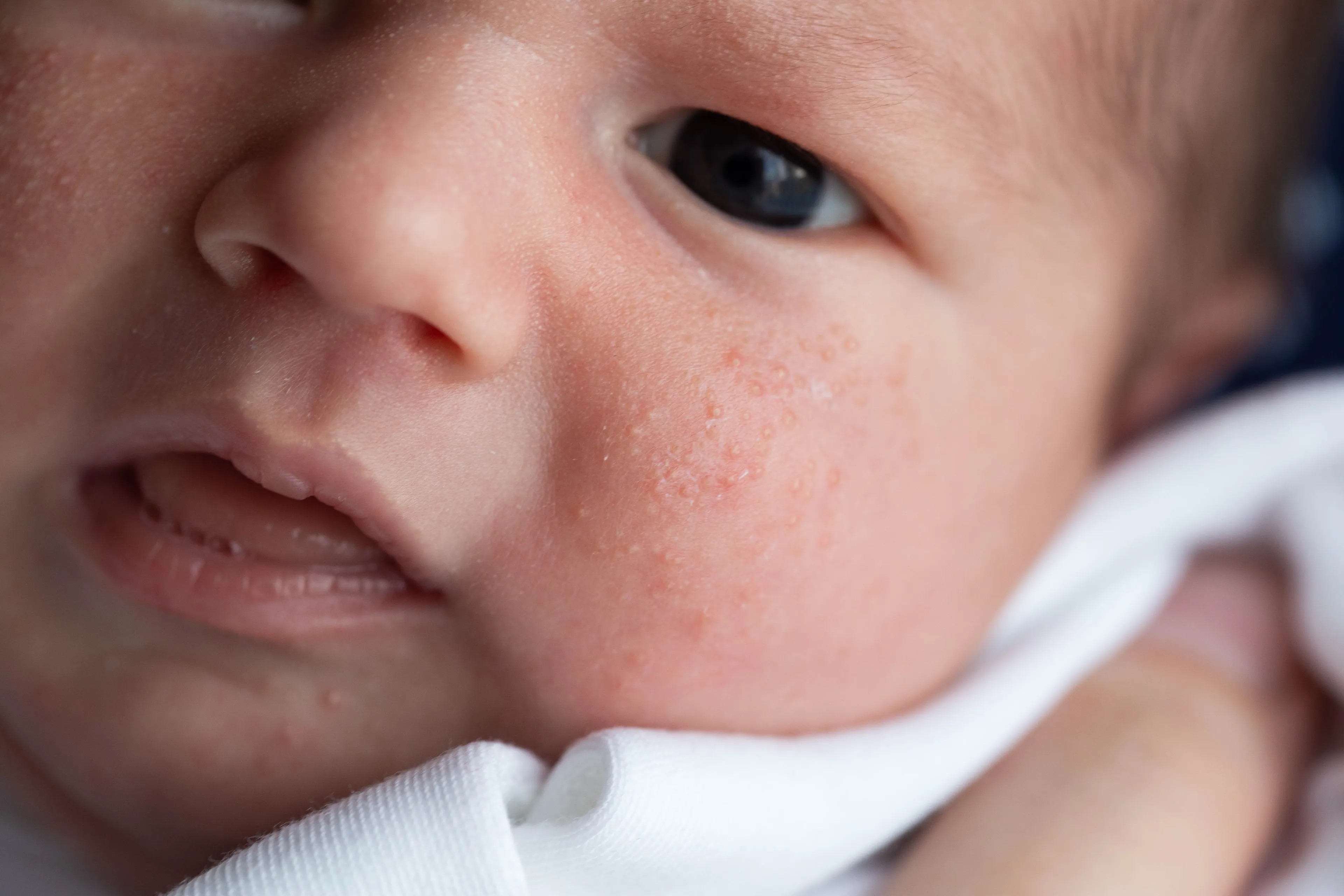
Milia are small, white or yellowish cysts that form when keratin, a protein found naturally in skin, gets trapped just beneath the surface. They appear as firm, pearl-like bumps, usually between 1 and 2 mm wide, and they do not blush or blister when pressed.

In newborns, milia most commonly show up on:

  • The nose, cheeks, and chin
  • The forehead and upper lip
  • Occasionally the gums or palate (called Epstein pearls when inside the mouth)

Around 40 to 50 per cent of newborns develop milia in the first weeks of life, making it one of the most frequent newborn skin conditions a paediatrician sees. Despite how they look, they are not infected, not painful, and not a sign that anything went wrong during pregnancy or delivery.

Why Milia Happens: Causes and Risk Factors

Newborn milia causes come down to simple biology. A baby's skin glands and pores are still maturing at birth. Keratin produced by skin cells cannot always shed or drain properly through these immature ducts, so it collects in a small pocket just under the surface, forming a cyst.

A few points worth knowing:

  • Milia have no connection to hygiene. A perfectly clean baby develops them as often as any other.
  • Maternal diet during pregnancy does not cause them.
  • They are not contagious and cannot spread from one baby to another.
  • There is no known genetic risk factor; they happen across all ethnicities and birth weights.

Premature babies may develop milia slightly later, simply because their skin matures on a different timeline.

Natural Course: How Long Does Newborn Milia Last?

This is the part most parents find most reassuring. Milia on newborns are self-resolving. As the skin matures and the pores learn to do their job, the trapped keratin works its way out on its own.

Most cases clear within 2 to 4 weeks. Some persist for up to 3 months, which is still within the normal range. How long milia last on a newborn depends mostly on how mature the skin was at birth and how quickly the ducts develop, not on anything the parent does or does not do.

The single most important instruction: do not try to pop, squeeze, or scrub them away. The skin over a newborn's cyst is delicate, and breaking it open risks introducing bacteria, causing scarring, or turning a harmless bump into an infected sore.

Gentle face washes with plain warm water are fine for routine cleaning. No special product is needed.

Milia vs Other Newborn Skin Conditions

White bumps on a baby's face are not always milia. Four conditions are commonly confused.

ConditionAppearanceLocationTimingResolves
MiliaFirm white or yellow cysts, no rednessNose, cheeks, foreheadBirth onward2 to 12 weeks
Baby acneRed pimples, some with white centresCheeks, forehead, chin2 to 6 weeks of age1 to 3 months
Heat rash (miliaria)Tiny red or clear blisters, may itchSkin folds, neck, backAny age in heatDays, with cooling
Erythema toxicumRed blotchy patches with white/yellow centresTrunk, face, limbsDay 1 to 4 of life1 to 2 weeks

Milia vs baby acne is the comparison parents most often need. The key difference is inflammation. Baby acne causes red, irritated pimples that can look angry and may come and go depending on heat or saliva contact. Milia are calm, white, and perfectly round, with no surrounding redness. Baby acne also tends to appear slightly later, usually after the second week of life, whereas milia are often present from birth.

If you are unsure which condition you are looking at, a photo sent through your clinic's patient portal or a quick walk-in appointment with a paediatrician will give you a clear answer.

Contraindications and When Home Care Is Not Enough?

Certain things parents try out of well-meaning instinct can actually cause harm.

Do not do any of the following:

  • Squeeze or lance the bumps. This risks infection and scarring.
  • Apply adult acne creams, salicylic acid, benzoyl peroxide, or retinoids. These are far too harsh for newborn skin.
  • Scrub the skin with a washcloth or exfoliating pad.
  • Use oily lotions or thick creams over the affected area, as these can clog pores further.
  • Apply breast milk directly to milia as a treatment. While breast milk has some soothing properties, there is no evidence it speeds resolution of milia.

Report adverse events to your healthcare provider or the relevant regulatory authority if your baby reacts unexpectedly to any product applied to the skin.

For general newborn skin and body care, including how to handle the delicate umbilical cord area, Apollo's guide to newborn belly button care offers practical, parent-friendly advice.

When to See a Paediatrician?

Milia rarely require a doctor visit, but certain signs suggest something else is going on:

  • The bumps are spreading rapidly or covering large areas
  • Redness, swelling, or pus develops around any bump
    Your baby has a fever alongside the skin changes
  • The rash is present on the eyelids and seems to affect vision or causes tearing
  • No improvement after 3 months

These red flags point away from simple milia and toward conditions that need proper assessment and possibly treatment.

Conclusion

Milia on newborn skin is a completely harmless, self-resolving condition affecting roughly half of all infants due to immature skin pores trapping keratin. Parents can easily distinguish milia from baby acne or heat rash by its calm, firm white appearance without surrounding red inflammation. The most important management strategy is patience—avoid popping, scrubbing, or applying adult acne products, and clean the skin gently using plain warm water. If the bumps spread rapidly, become red and inflamed, or are accompanied by a fever, consult your paediatrician promptly to rule out an underlying infection.

FAQS

Is milia contagious?

No. Milia are cysts formed by trapped skin protein, not an infection. They cannot pass from one person to another through touch or shared surfaces.

Can adults get milia too?

Yes. Adults can develop milia, often after skin trauma, sun damage, or as a reaction to heavy skincare products. Adult milia may persist longer and sometimes need professional removal.

Should I use any cream on newborn milia?

No cream is needed or recommended. Plain warm water for gentle cleaning is enough. Most milia treatment for babies amounts to watchful waiting, nothing more.
Does breastfeeding cause milia?

No. Newborn milia causes are internal related to immature skin ducts, and maternal diet or feeding method has no bearing on whether they develop.

Is milia a sign of an allergy?

No. Milia are not an allergic reaction and are not linked to food or environmental triggers. If a rash appears suddenly after introducing something new to your baby's environment, consult a paediatrician, as that is more likely a different condition.

Apollo 247 Floating Action Button