Discover what’s inside Nestlé CERELAC®, including key nutrients, sugar content and ingredients. Explore CERELAC® stages by age and texture to choose a suitable option for your baby.
Dr. Vasantha Sree
Once your baby turns six months old, complementary feeding becomes an important part of their daily routine. Alongside breastmilk and home-cooked foods, many parents consider Nestlé CERELAC® as one of the early feeding options. And naturally, one of the first questions that comes up is a simple one: what exactly is inside it, and which version is right for your baby right now? This article walks you through both, using information from Nestlé’s official sources Nestlé CERELAC | FamilyNes so you can feel confident about what you are offering your little one as they take their first steps into solid food.
What’s really inside Nestlé CERELAC®?
Nestlé CERELAC® is made from three very familiar ingredients: grains, milk, and fruits or vegetables. The grains may include wheat, rice, oats, ragi, barley and corn, which together give your baby the energy they need to grow and stay active. While milk solids are added as a source of protein and calcium, they also bring a gentle natural sweetness from lactose. Fruit or vegetable juice concentrates are used to add taste and a little natural sweetness, and the specific varieties depend on the variant you choose. Because the recipe changes from one variant to another, the ingredient list and nutrition panel will not be identical across the range. That is why it is always worth turning the pack over and reading the details on the specific one you pick up. This must be done especially when you are trying a new variant for the first time or introducing an ingredient your baby has not had before.
What CERELAC® doesn’t contain?
Nestlé CERELAC® has no preservatives, no added colours and no flavours, in line with India’s food regulations for infant nutrition. If you are wondering what makes a cereal stay fresh for twelve months without any preservatives, the answer lies in how it is made. Nestlé manages this by carefully controlling moisture, heat and oxygen. The raw materials are screened for safety before the product is created, the cereal is heat-treated and then dried to a point where bacteria growth is prevented, and the air inside the pack is replaced with food-grade nitrogen so the contents stay fresh and do not turn rancid. Each packet contains a QR code that provides test results from independent, NABL-certified laboratories as evidence. You as a parent, can scan the QR code and download the report for yourself
The 15 key nutrients in Nestlé CERELAC®
Nestlé CERELAC® is a source of 15 key nutrients, chosen to support your baby during a stage when they are growing and developing quickly. Rather than thinking about each nutrient in isolation, it helps to see how they group together to support different parts of your baby’s development:
Brain and cognitive development: Supported by Iron, Omega-3 (ALA) and Vitamin B1
Bone and muscle growth: Supported by Protein, Calcium, Vitamin D and Phosphorus
Immune function and a reduced risk of infections: Supported by Vitamins A, C and Zinc
Further, CERELAC® is designed to be one part of a varied diet, working alongside breastmilk and the home foods you are introducing, rather than the only thing on your baby’s plate. You will not need to track these nutrients yourself, as they are built into the recipe and provided in a normal serving.
The role of alpha-amylase in CERELAC®
One ingredient in CERELAC® that often goes unnoticed is alpha-amylase, a natural enzyme that helps break down complex carbohydrates into simpler forms. This makes the food easier for a baby's still-developing digestive system to handle hence making Cerelac a suitable first food for a tummy that is only beginning to adjust to solid foods at 6 months of age. As always, before introducing any new food, it is best to speak to your baby's paediatrician. They know your child and can advise whether your baby is ready and what is likely to suit them.
Does Nestlé CERELAC® cause constipation in 6–24-month-old babies?
No, Nestlé CERELAC® is not known to cause constipation.
CERELAC’s ingredient list mentions an ingredient called alpha amylase. This is an enzyme which breaks down the complex carbohydrates in cereal grains into simpler ones. Infact, examples of amylase rich foods are sprouted grains, banana which are good for digestion of babies.
That said, every baby's digestion responds a little differently to new foods, especially during the early months of complementary feeding. Constipation around this stage is fairly common and is often tied to broader changes happening at the same time — a baby moving from an almost entirely liquid diet to one that includes solids for the first time, changes in how much water they're getting, or simply trying several new foods in close succession, which makes it harder to isolate any one cause.
If you do notice constipation after introducing CERELAC®, or any new food, for that matter, it's worth speaking to your paediatrician to understand what might be behind it, rather than assuming it's necessarily linked to the cereal itself. Sometimes it's about hydration, sometimes it's about the broader mix of foods being introduced, and a paediatrician is best placed to help you figure out which it is, given how many variables tend to be changing at once during this stage of feeding.
Does Nestlé CERELAC® have too much sugar?
No, CERELAC does not have too much sugar or artificial sweeteners. As per Nestlé, the level of added sugars in Nestlé CERELAC® is well below the prescribed level set by CODEX and FSSAI both. In fact, in Dec 2024, Union Health Minister J. P. Nadda told the Parliament that the added sugar in Nestle baby products was in compliance with Indian and global standards.
For those who prefer to avoid added refined sugar altogether, Nestlé CERELAC also offers many "No Refined Sugar" variants. In these, the sweetness comes only from milk solids, cereals and fruit or vegetable concentrates, with no artificial sweeteners.
Whether you choose a standard variant or a No Refined Sugar one comes down to your own preference and your paediatrician advice. Both fall within the same age-based stage system, so your choice does not involve trading away nutritional suitability.
Now, Sugar is something many parents have started monitoring closely, so it is worth understanding how it appears on any pack.
Total sugars declared on the pack includes added sugar and naturally occurring sugars. Added sugar refers to sugar added during processing like refined sugar, jaggery etc. Naturally occurring sugars are present naturally in the ingredients such as lactose in milk, the fruit sugars (fructose) found in juice concentrates and natural sugar found in cereal grains.
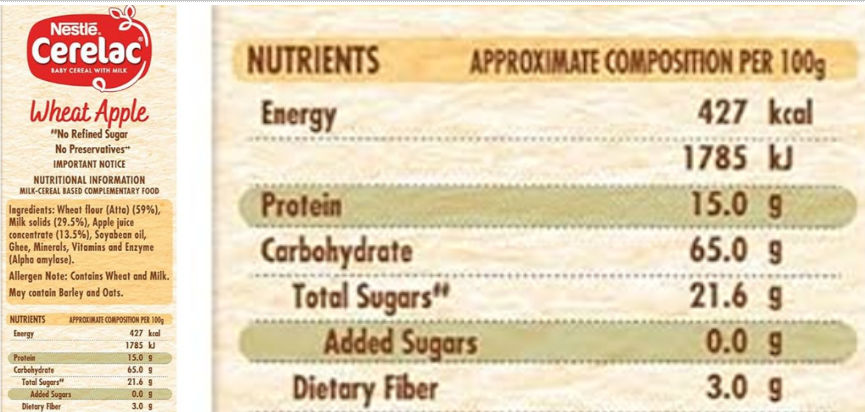
Let’s understand this with an example, if you look at the Nutrition information table of Cerelac Wheat Apple No refined Sugar variant you will see declarations per 100gm but what we need to understand is the sugars per serve because the recommended serve size is 33gm
Total Sugars 7.2g per serve
Added Sugars 0.0 g per serve
Like we mentioned above, this total sugar comes naturally from sources like Milk, Fruit and Vegetables juice concentrates, cereal grains etc. To help you understand this 7.2g total sugar, a medium banana has about 14-15g of total sugar and a medium apple has about 16g of total sugar.
Which stage is right for your baby?
The different stages of Nestlé CERELAC® are based on two important things: your baby’s age and the kind of texture they are ready for. As babies grow, they move from smooth foods that are easy to swallow towards thicker, more textured foods that help them learn to chew. The age printed on the pack is your simplest guide because it lines up the right nutrition with the right texture for wherever your baby happens to be in their eating solid foods journey.
This gradual change in texture is about more than taste. Moving from a smooth purée to something with a little more texture gently encourages the mouth and jaw that your baby will eventually use for proper chewing and, later, for eating the same meals as the rest of the family. Each stage is a small step up from the one before, which is why it usually makes sense to let your baby settle comfortably at one stage before reaching for the next.
Here’s how the stages progress:
Nestlé CERELAC® Stage 1
Age: 6–24 months
Texture: Smooth and soft, ideal for babies who are just starting solids
Variants available: Wheat Apple, Rice, Wheat, Wheat Apple Carrot, Ragi Apple
Nestlé CERELAC® Stage 2
Age: 8–24 months
Texture: Slightly thicker, with more taste variety to help babies accept new flavours
Variants available: Wheat Apple Cherry, Khichdi with Vegetables & Ghee, Rice Vegetables
Nestlé CERELAC® Stage 3
Age: 10–24 months
Texture: Thick texture that supports chewing skills
Within a stage, choosing between variants usually comes down to your baby’s taste preference and what your family prefers. If you are introducing one new ingredient at a time, you might begin with the simpler recipes before moving on to those that combine several fruits, vegetables or grains. If you are ever unsure whether your baby is ready to move up a stage, your paediatrician can help you judge the right moment, since babies reach these milestones at their own pace.
Is Nestlé CERELAC® good or bad for babies ?
The honest answer is that this is not really a question of being good or bad but rather your choice. What makes Nestlé CERELAC® good is that it is made from three very familiar ingredients: grains, milk, and fruits or vegetables. Nestlé CERELAC® does not have too much sugar and has no preservatives, no added colours and no flavours. In addition, Nestlé CERELAC® is a source of 15 key nutrients, that support your baby during a stage when they are growing and developing quickly:
• Brain and cognitive development: Supported by Iron, Omega-3 (ALA) and Vit.B1 • Bone and muscle growth: Supported by Protein, Calcium, Vitamin D and Phosphorus • Immune function and a reduced risk of infections: Supported by Vitamins A, C and Zinc
Nestlé CERELAC® offers consistency, with fortified nutrition and rigorous safety testing in every serving.
But CERELAC® is designed to be a part of a varied diet with 1-2 serves a day only, working alongside breastmilk and the home foods you are introducing, rather than the only thing on your baby’s plate.
Hence you should evaluate which complementary feeding option best meets your baby's nutritional needs and stage of development basis your choice and your paediatrician's advice. And as always, do speak to your paediatrician before introducing any new foods to your baby.
How to prepare and store it?
Getting the preparation right matters just as much as choosing the right pack, because good hygiene and the right consistency are important for your baby. Start by washing your hands well and making sure the bowl and spoon are properly clean. Boil the drinking water, let it cool until lukewarm, then pour the measured amount into your baby’s bowl, add the cereal, and stir until smooth. Then feed it to your baby straight away with a clean spoon.
As a guide, Nestlé suggests mixing 33 g (about 4 level scoops) with 100 ml of water for a baby of 6 to 12 months and 50 g (about 6 level scoops) with 150 ml of water for a child of 12 to 24 months. But always check the feeding recommendation on the pack of the specific variant you buy, as they may vary slightly. Offering up to two bowls a day can help meet your baby’s needs alongside home foods and breastmilk. It is worth sticking to the recommended serving size because using too little cereal waters down the nutrition, while using too much makes the feed too concentrated. Anything your baby does not finish is best thrown away rather than kept for later, and it is not a good idea to store cereal you have already mixed. Once the pack is open, close it tightly and keep it in a cool, dry place.