logo
0

Newborn with Temperature: Normal Range vs Fever Signs

Learn normal newborn temperature ranges, how to measure accurately, causes of fever, and critical red flags requiring urgent paediatric evaluation.

article image

Dr.Bhanu Prakash

A newborn with temperature changes that seem too high or too low can send any new parent into a spiral of worry. Understanding what is truly normal for your baby, what counts as a fever, and when to seek immediate care can make all the difference in those first anxious weeks at home. The sections below walk through everything you need to know, from reading a thermometer correctly to recognising signs that need emergency attention.

What Is a Normal Temperature Range for Newborns?

Newborns have immature thermoregulation, meaning their bodies cannot regulate heat as efficiently as older children or adults. Their normal temperature range overlaps with older age groups, but they are far more vulnerable to swings in either direction. The method you use to measure temperature also affects the number you see.

Rectal temperature is the gold standard for babies under three months. A normal rectal reading falls between 36.6°C and 37.9°C (97.9°F to 100.2°F).

Axillary (underarm) temperature is easier to take but slightly less accurate. A normal axillary range is 36.5°C to 37.4°C (97.7°F to 99.3°F).

Any rectal reading at or above 38.0°C (100.4°F) is considered a fever in a newborn. Because underarm readings can run 0.5°C to 1°C lower than core temperature, always confirm a high axillary result with the rectal method before making any decisions.

How to Correctly Measure a Newborn's Temperature

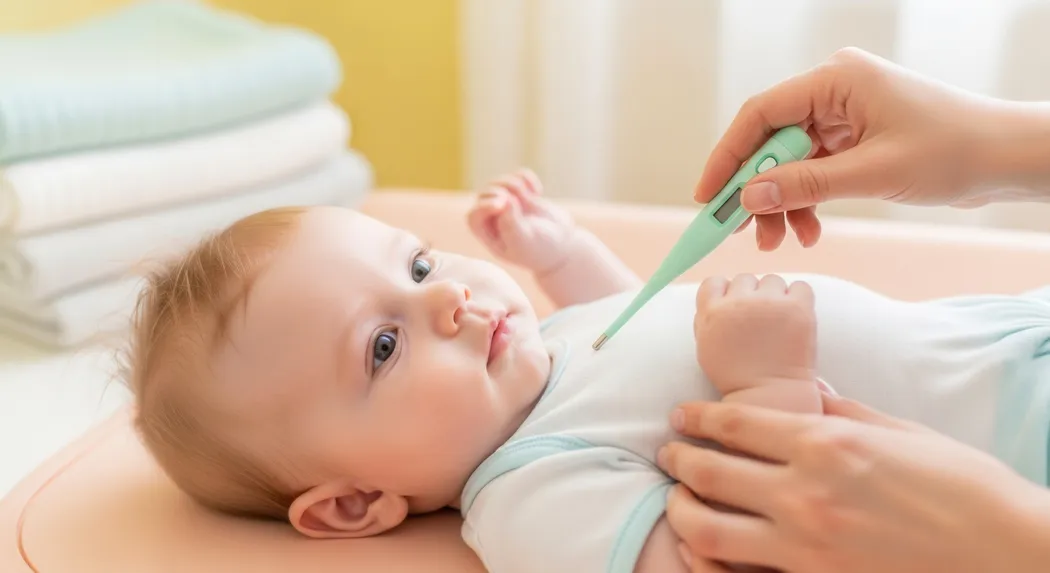
Knowing the newborn temperature range is only useful if the reading is accurate. A poorly done measurement can either falsely alarm you or miss a real fever. Here is how to check baby temperature reliably at each common site.

Rectal Method (Most Accurate)

  • Use a digital rectal thermometer, not a glass or mercury one.
  • Apply a small amount of petroleum jelly to the tip.
  • Lay your baby face-down across your lap, or on their back with legs raised.
  • Insert the tip about 1.25 cm (half an inch) into the rectum. Never force it.
  • Hold it gently in place until it beeps, then read the result.

Axillary Method (Convenient, Less Precise)

  • Place the tip in the centre of the dry armpit.
  • Hold the arm snugly against the body and wait for the beep.
  • If the reading is above 37.4°C, confirm with a rectal measurement.

Temporal Artery (Forehead) Thermometers

Temporal scanners are quick, but they can miss fever in very young babies, especially if the forehead is sweaty or the scan is inconsistent. They are more reliable for infants over three months.

Avoid oral and tympanic (ear) thermometers for newborns entirely. Ear canals at this age are too small and curved for a reliable reading.

Causes of Temperature Variation in Newborns

A newborn with a temperature that reads high is not automatically sick. Because their thermoregulatory system is still maturing, newborns cannot shiver effectively to warm up or sweat efficiently to cool down. Environmental factors move their core temperature surprisingly fast.

Common non-illness causes include:

  • Excessive Clothing: Too many clothing layers or a thick swaddle, which can push temperature above normal within minutes.
  • Room Temperature: A hot or cold room directly shifting core temperature.
  • Warm Baths and Contact: A warm bath or prolonged skin-to-skin contact briefly raising surface readings.
  • Feeding and Crying: Vigorous feeding or sustained crying temporarily increasing body temperature.

If you notice a high reading, first remove a layer of clothing, move the baby to a comfortable room, and wait ten to fifteen minutes before measuring again. A temperature that drops with these simple steps is usually environmental. One that stays elevated or climbs higher points to a possible infection and needs medical attention.

Warning Signs: When Newborn Fever Is an Emergency

Fever in a newborn under 3 months is treated as a medical emergency until a doctor says otherwise. This is not the age to wait and observe at home.

A newborn with a temperature at or above 38.0°C (100.4°F) rectally needs to be seen by a doctor immediately, regardless of how the baby otherwise appears.

Go to a hospital emergency department right away if your baby:

  • Is under 3 months old with a rectal reading of 38.0°C (100.4°F) or higher.
  • Is under 28 days old with a rectal reading of 38.0°C (100.4°F) or higher, or an unusually low temperature below 36.0°C (96.8°F).
  • Is difficult to wake, unusually limp, or floppy.
  • Has fast, noisy, or laboured breathing.
  • Has skin that looks mottled, pale, or blue-tinged around the lips.
  • Refuses two or more feeds in a row.
  • Has a bulging fontanelle (the soft spot on the head).
  • Has a high-pitched or inconsolable cry unlike their usual cry.

Why does age matter so much? Newborns have immature immune systems and cannot localise infections the way older children can. A fever can be the only visible sign of serious bacterial illness such as sepsis or meningitis. Doctors investigate any fever in a newborn under 3 months aggressively, often including blood tests, urine tests, and sometimes a lumbar puncture, to rule out life-threatening causes.

When these newborn fever symptoms appear alongside the red flags above, do not drive to a clinic. Go directly to the nearest hospital emergency department.

Contraindications and Precautions for Fever Management

Never give any fever-reducing medicine to a newborn without explicit guidance from a paediatrician. Paracetamol (acetaminophen) dosing in very young infants is strictly weight-based and age-restricted, and the wrong dose causes serious harm. Standard adult or older-child formulations are not safe for newborns.
Do not:

  • Give aspirin to any child. It carries the risk of a rare but dangerous condition called Reye's syndrome.
  • Use cold baths or ice packs to bring down fever. Rapid cooling is dangerous for a newborn.
  • Apply alcohol rubs. Alcohol is absorbed through a newborn's thin skin and can cause poisoning.
  • Do not give herbal remedies or any over-the-counter preparation without a doctor's specific approval.

While arranging care, you can:

  • Remove excess clothing layers.
  • Keep the room at a comfortable temperature.
  • Offer breast milk or formula to prevent dehydration.
  • Monitor closely and head to the nearest hospital without delay.

As you care for your new baby, you may also find it helpful to read this newborn umbilical cord and belly button care guide for other common newborn care questions.

Report adverse events to your healthcare provider or the relevant regulatory authority.

Conclusion

Monitoring a newborn's temperature requires careful observation and accurate measurement techniques. While an infant's immature thermoregulation means that room conditions or excess clothing can easily cause mild temperature fluctuations, a true fever is a different matter. A confirmed rectal reading of 38.0°C (100.4°F) or higher in an infant under three months should never be managed at home it is a paediatric medical emergency that requires prompt hospital evaluation to rule out serious systemic infections. Always confirm elevated armpit readings with a digital rectal thermometer, never administer fever-reducing medications without direct medical guidance, and take your baby to the nearest emergency department without delay if you notice lethargy, poor feeding, or abnormal breathing.

FAQS

What is considered a fever in a newborn?

A rectal temperature of 38.0°C (100.4°F) or higher is considered a fever in a newborn. Any reading at this level in a baby under three months requires immediate medical evaluation.

Is 99°F normal for a newborn?

A reading of 99°F (37.2°C) falls within the normal axillary range for most newborns and is not considered a fever. If you measured it rectally and the baby seems unwell, recheck and call your paediatrician.

Can teething cause fever in newborns?

Teething does not typically begin before four to six months, so it should not be a cause of fever in the true newborn period. Any fever in the first three months needs medical evaluation regardless of possible explanations.

How long can a newborn fever last?

A fever in a newborn that lasts more than a few hours warrants urgent medical attention; do not wait for it to resolve on its own. Duration matters less than getting assessed quickly, because the underlying cause must be identified and treated promptly.

Should I wake my newborn to check temperature at night?

If your baby seems to be sleeping and feeding normally with no other concerns, you do not need to wake them solely to check temperature. However, if they feel unusually hot or cold, are hard to rouse, or have other worrying signs, check the temperature immediately and seek care if it is elevated.

Apollo 247 Floating Action Button