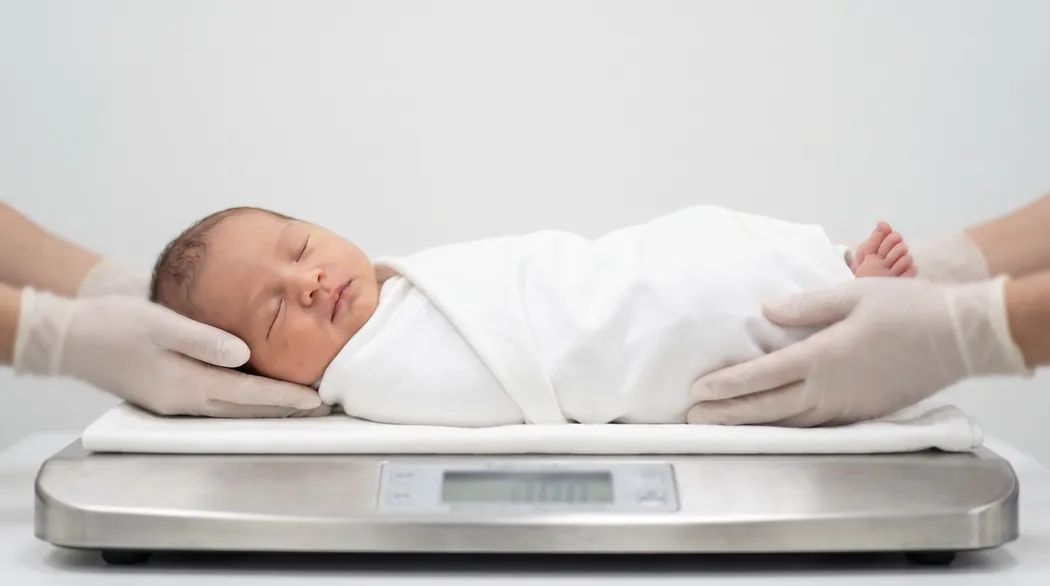
Learn how much weight a newborn typically gains each month, expected growth patterns, factors affecting weight gain, and when to consult a paediatrician.
Dr. Abdul Kalam
Tracking how much weight a newborn should gain in a month is one of the first things new parents find themselves watching closely, and for good reason. Weight gain is one of the clearest signals that your baby is feeding well, digesting properly, and growing as expected. Understanding what is normal, what is not, and when to act can ease unnecessary worry or, just as importantly, help you catch a real problem early.
Expected Weight Gain in the First Month
Most newborns gain roughly 150 to 200 grams per week during the first month, adding up to about 600 to 900 grams over the full four weeks. By the one-month mark, a baby is typically back to their birth weight and meaningfully above it.
Here is something that surprises many new parents: it is completely normal for a newborn to lose weight in the first few days after birth. Babies are born with extra fluid that gets shed in the first week. Most lose up to 7 to 10 percent of their birth weight in the first three to five days. The key expectation is that they regain this by around day 10 to 14.
If your baby was born weighing 3 kg, a drop to roughly 2.7 to 2.8 kg in the first few days is not alarming. Steady gain from that point onward is the goal.
Weekly Weight Gain Chart by Age
The table below gives a general sense of expected weekly gains across the first three months. These are ranges, not rigid targets.
Age
Expected Weight Gain
Week 1 (Day 3 to 7)
May lose up to 7 to 10% of birth weight
Week 2
Regaining lost weight; back to birth weight by Day 10 to 14
Weeks 3 to 4
150 to 200 g per week
Month 2 (Weeks 5 to 8)
150 to 200 g per week
Month 3 (Weeks 9 to 12)
100 to 200 g per week
The average weight gain for newborns per week sits around 150 to 200 grams through the first two months, then may ease toward 100 to 150 grams in month three as growth naturally slows.
Breastfed babies sometimes gain more slowly in the first few weeks compared to formula-fed babies, then catch up fully. This is a recognized pattern, not a sign of inadequate feeding, provided the baby feeds frequently, produces enough wet diapers, and is alert when awake.
Weight is one piece of the picture. Paediatricians look at several other markers during the first month as part of assessing baby growth milestones in the first month.
Length typically increases by about 2.5 to 4 cm in the first month.
Head circumference grows by approximately 1 to 1.5 cm per month in early infancy.
Wet diapers are a reliable feeding gauge: expect at least 6 wet diapers a day after the first week.
A well-fed baby feeds 8 to 12 times in 24 hours, latches actively, and seems settled after feeds.
These signs of healthy weight gain in babies go together. A newborn who is gaining steadily, producing enough wet diapers, sleeping in short bursts, and waking to feed is almost certainly thriving.
Knowing the red flags matters as much as knowing the averages. Watch for the following if you are concerned about a newborn not gaining weight:
Persistent sleepiness or difficulty waking for feeds.
Fewer than 6 wet diapers per day after the first week.
Dry mouth, a sunken fontanelle (the soft spot on the head), or skin that does not spring back when gently pinched, all signs of dehydration.
Feeds that are very short, or where the baby falls asleep at the breast or bottle within minutes without feeding actively.
A growth curve that has flattened or dropped over two or more consecutive weigh-ins on the newborn weight gain chart.
Not regaining birth weight by two weeks of age.
A newborn not gaining weight as expected is not always an emergency, but it does need prompt attention. The cause can be as straightforward as a latch issue or feed frequency, or it may point to something that needs investigation.
When to Consult a Paediatrician?
Clear triggers help parents know when to reach out rather than waiting to see a paediatrician about baby weight.
Contact your paediatrician promptly if:
Your baby has not regained birth weight by 14 days.
Total weight gain is less than 500 grams in the first month.
Your baby drops more than one major growth percentile band between visits on the newborn weight gain chart.
You notice any dehydration signs listed above.
Feeding sessions are consistently painful, or you suspect a latch or tongue-tie issue.
Your instinct tells you something is off, even if you cannot name exactly what.
Paediatricians would rather reassure you than have you wait too long. Regular scheduled visits in the first month, typically around Day 3 to 5, Day 10 to 14, and the one-month mark, are designed to catch weight and feeding concerns before they become serious.
Contraindications and Precautions for Feeding Supplements or Fortifiers
Before considering supplements or fortifiers, parents should understand that these products are not suitable for every newborn and should only be used when recommended by a paediatrician. Important situations that may require careful assessment include:
Metabolic conditions: Conditions such as phenylketonuria (PKU) or galactosemia may require specific dietary restrictions and specialised feeding plans.
Cow's milk protein allergy or lactose intolerance: Standard dairy-based fortifiers may not be appropriate for babies with certain milk-related conditions.
Kidney or liver conditions: These conditions may affect how the baby's body processes and handles additional nutrients.
Feeding intolerance: Fortification should generally be considered only after the baby's feeding tolerance has been assessed and established.
Medical need: Premature babies, very-low-birth-weight infants, or babies with specific medical conditions may sometimes require additional calories or nutrients, but this should be prescribed and monitored by a healthcare professional.
A paediatrician will review your baby's full clinical picture before recommending any addition to feeds. Self-medicating a newborn with supplements carries real risk and should be avoided.
Conclusion
Newborn weight gain can vary from baby to baby, so growth should be assessed over time rather than against a single number. Babies commonly lose some weight during the first few days after birth and usually regain their birth weight by around 10 to 14 days. After that, steady weight gain, adequate wet nappies, effective feeding, and appropriate growth in length and head circumference provide a broader picture of healthy development. If your baby is not regaining birth weight, has fewer wet nappies, is difficult to wake for feeds, or shows signs of dehydration, contact a paediatrician promptly. Avoid starting supplements or feed fortifiers without professional guidance, as some babies may require specialised feeding based on their individual needs.
FAQS
How much weight should a newborn gain in a week?
Most newborns gain around 150 to 200 grams per week from the end of the second week through the first two months. After that, the pace may ease slightly to around 100 to 150 grams per week as growth naturally slows.
Is 1 kg weight gain in a month normal for a newborn?
Gaining 1 kg in a single month is on the higher end of the typical range but is generally not a cause for concern in an otherwise healthy baby. Your paediatrician will plot the gain on a growth chart to confirm the trajectory looks appropriate for your baby's size.
Why is my newborn not gaining weight fast enough?
Common reasons include infrequent feeding, a poor latch reducing milk transfer, low milk supply, or the baby tiring quickly during feeds. Less often, an underlying medical condition may be involved, which is why persistent poor gain always warrants a paediatrician assessment.
Does breastfeeding affect newborn weight gain speed?
Breastfed babies may gain weight slightly more slowly in the early weeks compared to formula-fed babies, which is a well-recognized pattern. Provided feeding frequency, wet diaper count, and alertness are all on track, this difference is not a reason to switch or supplement without advice.
What weight gain is considered too fast for a newborn?
Consistently gaining well above 250 to 300 grams per week over several weeks may be worth discussing with your paediatrician, particularly if the baby appears uncomfortable or is being overfed. A single week of faster gain is rarely a concern on its own.