logo
0

Newborn Weight Gain in a Month: Expert Norms & Charts

Wondering how much weight a newborn should gain in a month? Get pediatrician-reviewed norms, growth chart tips, and red flags to watch for.

article image

Dr.Bhanu Prakash

Knowing how much weight a newborn should gain in a month is one of the first health milestones new parents track, and with good reason. Weight gain is the clearest early signal that a baby is feeding well, digesting properly, and growing as expected. If you have been hovering over the scale after every feed and wondering whether the numbers look right, this guide explains what is normal, what to watch, and when to call your pediatrician.

Normal Weight Gain Range for Newborns in the First Month

Most newborns lose a small amount of weight in the first few days after birth. This is completely expected as the baby sheds extra fluid and adjusts to life outside the womb. Healthy newborns typically regain their birth weight by 10 to 14 days of age.

After that initial dip and recovery, the general benchmark for average weight gain for infants per week in the first month is:

  • Around 150 to 200 grams per week
  • Roughly 700 to 900 grams over the full first month

So if a baby is born at 3 kg, reaching around 3.7 to 3.9 kg by the one-month check can be reassuring, provided the baby is feeding well and following an appropriate growth trajectory. Rather than relying on a fixed 150 to 200 g per week target, doctors assess weight gain using age- and sex-specific growth charts and the baby's individual pattern of growth. ICMR-NIN provides WHO-based weight-for-age reference values, while IAP provides paediatric growth charts for monitoring growth over time.

Is 500g weight gain in a month normal for a newborn? It falls below the typical range. Some healthy babies do gain a little less, but 500g in the first month is worth a conversation with your pediatrician. It does not automatically mean something is wrong, but it does call for a closer look at feeding frequency, latch, and milk intake.

How Doctors Track Growth: Charts and Percentiles

Paediatricians do not rely on a single weigh-in. They plot your baby's weight on a newborn weight gain chart across multiple visits to evaluate the trend, not just one day's number.

In India, most paediatricians use the WHO Child Growth Standards. These charts compare weight-for-age across a wide range of healthy children from birth to five years. Weight is expressed as a percentile: a baby at the 50th percentile weighs more than 50% of children of the same age and sex.

A few things to keep in mind:

  • There is no single "correct" percentile. A baby consistently tracking at the 15th percentile can be perfectly healthy.
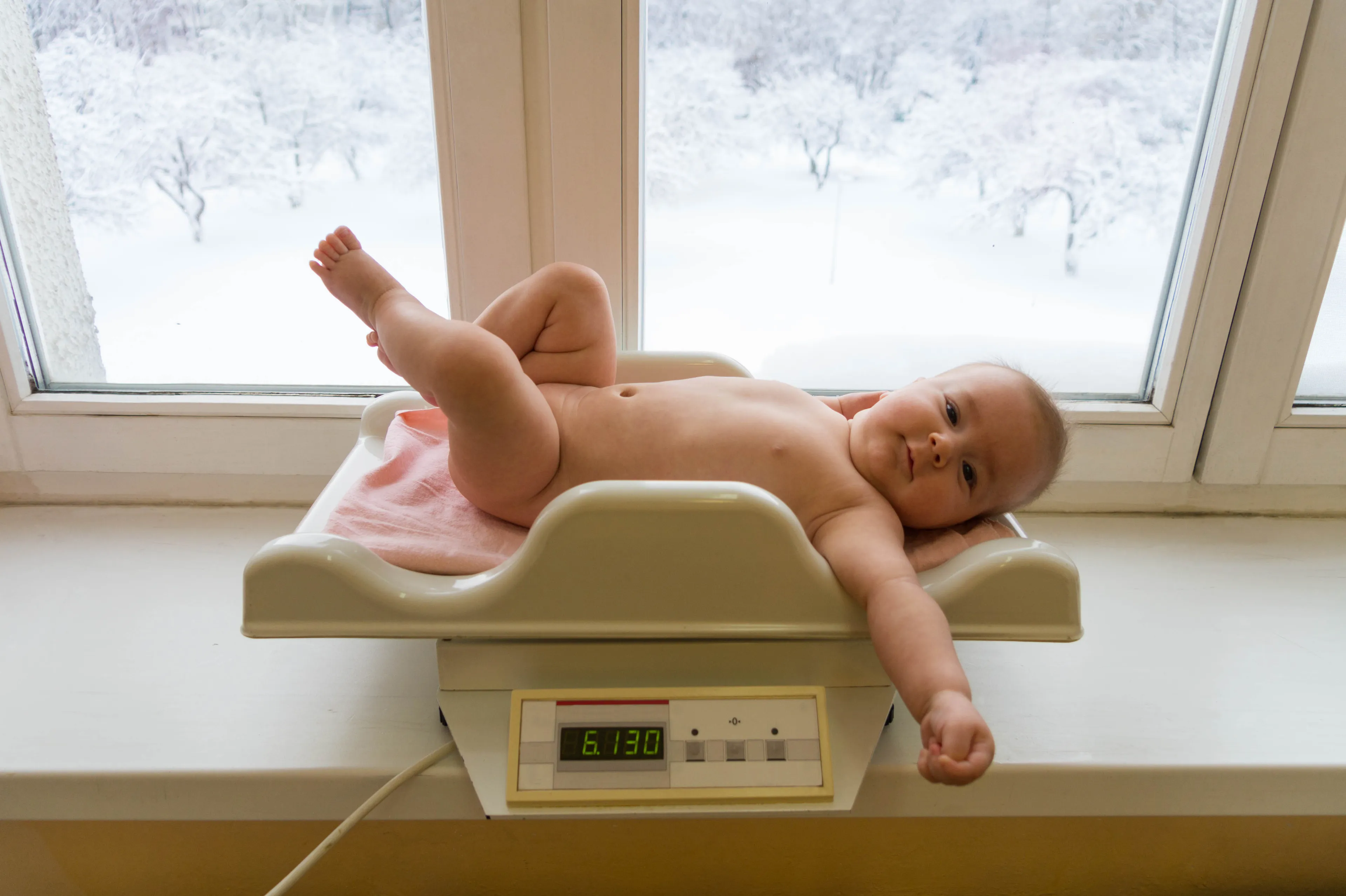
  • What matters most is that your baby follows a consistent curve rather than dropping sharply across percentile lines between visits.
  • A fall across two or more major percentile lines over time is what typically prompts closer investigation.
  • Bring your baby's health booklet or red card to every visit so the doctor can compare measurements across time. That pattern is the most useful data you can offer.

Why the Trend Matters More Than Any Single Number?

A one-off weigh-in on a different scale, at a different time of day, or just after a feed can vary by 100 to 200 grams. The trajectory across three or four data points is far more meaningful than any individual reading. Parents who understand this tend to feel much less anxious after a single slow week.

Factors That Affect Newborn Weight Gain

Not every baby gains weight at exactly the same pace. Several things naturally influence how quickly the scale moves.

Breastfed vs Formula Fed Weight Gain

Breastfed and formula-fed babies often follow slightly different growth curves, and both are normal. Formula-fed infants tend to gain a little faster in the early weeks because formula volume is easy to measure and its composition is consistent feed to feed.

Breastfed babies may gain more slowly at first, but this rarely means milk is insufficient. Frequent, effective nursing, typically 8 to 12 feeds in 24 hours, is usually enough. Audible swallowing, visible breast softening after feeds, and adequate wet diapers are more useful real-time signals than the scale alone. If you are worried about supply or latch, a lactation consultant can assess both quickly.

Other Factors That Play a Role

  • Birth weight shapes the starting point. A smaller baby may have more ground to cover early on, while a larger baby may pace differently.
  • Premature babies follow adjusted growth charts based on their corrected age, not their actual birth date, so standard charts do not apply without adjustment.
  • Jaundice or illness in the first two weeks can temporarily dampen feeding drive.
  • Latch difficulties or maternal milk supply concerns can reduce intake for breastfed babies and are usually addressable with the right support.

Signs of Poor Weight Gain in Newborns

Watching your baby's behaviour and daily output is just as important as clinic weigh-ins. Signs of poor weight gain in newborns to watch for include:

  • Fewer than six wet diapers per day after the first week of life
  • Dark or concentrated urine rather than pale yellow
  • Very infrequent stools in a breastfed newborn during the early weeks
  • Excessive sleepiness or real difficulty waking the baby for feeds
  • Prolonged crying that feeds do not settle
  • No return to birth weight by 14 days of age
  • No visible progress across two or more clinic visits on the newborn weight gain chart

These are signals to bring to your pediatrician, not a checklist for self-diagnosis. Keeping a simple notebook of feeding times, wet diaper counts, and sleep stretches for the first few weeks gives your doctor concrete information to act on.

General newborn care during this period also includes small but important practical tasks. If you are new to caring for a baby, reading up on newborn belly button care basics can help you feel more confident managing the cord stump during these first weeks at home.

Contraindications and When to Seek Medical Help

When parents wonder when to worry about baby weight gain, the answer usually comes down to specific warning signs rather than a slow week alone. Most cases of slow weight gain have a straightforward feeding explanation a paediatrician or lactation consultant can resolve.

However, some situations need prompt medical attention. Contact your paediatrician urgently if your baby shows:

  • Continued weight loss beyond 10 days with no sign of recovery
  • A loss of more than 10% of birth weight at any point
  • Signs of dehydration: sunken fontanelle (the soft spot on the head), dry mouth, no tears when crying, or very little urine output
  • Fever in a baby under three months old
  • Persistent vomiting after every feed
  • Worsening jaundice after the first two weeks

Do not attempt to address weight or feeding concerns at home by adding water, sugar water, or other supplements to a newborn's diet. This is dangerous and can cause serious harm. Normal weight gain for a 1 month old baby is best supported through frequent, demand-led feeding and professional guidance, not home adjustments.

Conclusion

Understanding how much weight a newborn should gain in a month is about looking at the overall growth pattern rather than focusing on a single number on the scale. Most babies lose some weight in the first few days and gradually regain their birth weight before continuing to gain steadily. Feeding effectiveness, wet diaper output, alertness, and the baby's position on an appropriate growth chart provide a more complete picture of healthy growth than a fixed monthly target alone.

If your baby is not regaining birth weight, continues to lose weight, has fewer wet diapers, feeds poorly, is unusually difficult to wake, or shows signs of dehydration, seek paediatric advice promptly. Do not give water, sugar water, or other supplements without medical guidance. Regular growth monitoring and early support for feeding or latch difficulties can help identify concerns and ensure your newborn receives appropriate nutrition during these important first weeks.

FAQS

How much weight should a newborn gain in the first month?

Most newborns gain around 150 to 200 grams per week, adding roughly 700 to 900 grams over the full first month. After an initial dip in the first few days, a baby who is back to birth weight by two weeks and gaining steadily after that is generally on track.

Is it normal for a newborn to lose weight after birth?

Yes, a weight loss of up to about 7 to 10% of birth weight in the first few days is considered normal as the baby loses extra fluid. Most babies regain this weight and surpass their birth weight by around 10 to 14 days.

How often should I weigh my newborn?

Your pediatrician will typically check weight at the first visit a few days after discharge, then at the two-week and one-month checks. Weighing at home more than once or twice a week is rarely helpful and can increase parental anxiety, since normal daily fluctuations can look alarming out of context.

What if my baby gains weight too fast?

Rapid weight gain is less commonly a concern in newborns than slow gain, but if your baby seems uncomfortable, is vomiting frequently, or is gaining far above the expected range, mention it at your next visit. Your pediatrician can assess whether feeding volumes or technique need any adjustment.

Does slow weight gain always mean a health problem?

Not always. A single slow week, a minor illness, or a temporary dip in feeding frequency can all cause a brief plateau. What matters is the overall trend across several visits. Persistent slow gain, especially when combined with signs of poor weight gain in newborns such as few wet diapers or lethargy, does need a pediatric evaluation.

Apollo 247 Floating Action Button