logo
0

Ovulation Guide: Menstrual Cycle & Fertile Window Explained

Learn how ovulation works, when it occurs, how to estimate your fertile window, common ovulation signs and the best ways to track ovulation.

article image

Dr.Nallapu Siri

Ovulation is the event your entire reproductive cycle revolves around. Once a month, a mature egg is released from one of your ovaries, and the roughly 24 hours it stays viable is when conception becomes possible. For anyone trying to conceive, or simply wanting to understand their own body, knowing when and how ovulation happens can make a real difference. This guide covers the science behind it, how to track it using your last menstrual period, and the signs worth watching for.

What Is Ovulation?

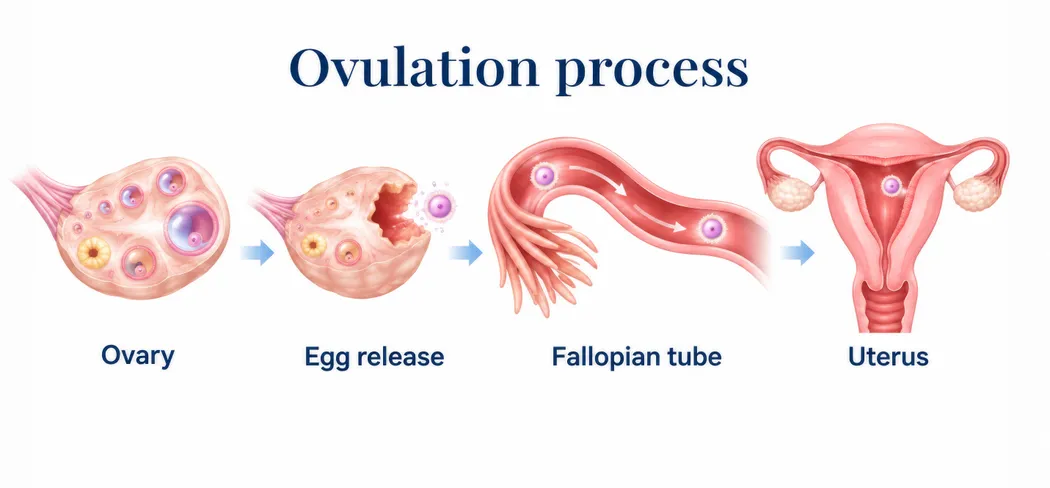
Ovulation is the release of a mature egg (oocyte) from a follicle in the ovary. The egg then travels down the fallopian tube toward the uterus, where it may be fertilised by sperm.

The trigger is a sharp rise in luteinizing hormone (LH), called the LH surge. This surge typically occurs 24 to 36 hours before the egg is released. After the follicle ruptures, the empty follicle transforms into a structure called the corpus luteum, which produces progesterone to prepare the uterine lining for a possible pregnancy. If fertilisation does not occur, progesterone drops, the corpus luteum breaks down, and menstruation begins.

Understanding the Menstrual Cycle Phases

A typical menstrual cycle runs about 28 days, though anywhere from 21 to 35 days is considered normal. There are three distinct menstrual cycle phases.

Follicular Phase

This begins on the first day of your period and runs until ovulation. Follicle-stimulating hormone (FSH) prompts several follicles in the ovary to grow, and usually one becomes dominant. As it grows, it produces estrogen, which thickens the uterine lining. This phase varies considerably in length, which is why total cycle length differs from person to person.

Ovulation Phase

Midway through the cycle, rising estrogen triggers the LH surge, and the dominant follicle releases its egg. Ovulation itself lasts only 24 to 48 hours. It is the shortest phase but the most consequential for fertility.

Luteal Phase

After ovulation, the corpus luteum releases progesterone. If no pregnancy occurs, this phase lasts about 14 days before progesterone drops and the next period begins. Unlike the follicular phase, the luteal phase is fairly consistent in length across most women.

How to Track Ovulation Using Your Last Menstrual Period (LMP)?

The most accessible way to estimate ovulation is to count from the first day of your last menstrual period (LMP). Using this as a last menstrual period calculator works like this:

  • Note the date your last period started. This is Day 1.
  • Subtract 14 days from your total cycle length.
  • The result is your estimated ovulation day.

For a 28-day cycle, ovulation typically falls around Day 14. For a 32-day cycle, it falls around Day 18. This method helps you figure out how to calculate your ovulation date without any special equipment.

Keep in mind that this approach assumes a consistent cycle and a standard 14-day luteal phase, which is not true for everyone. Stress, illness, travel, and weight changes can all shift ovulation earlier or later.

Using Ovulation Predictor Kits (OPKs)

Ovulation predictor kits detect the LH surge in urine, usually 24 to 36 hours before ovulation. They are widely available at pharmacies and are more reliable than calendar counting alone. A positive result means ovulation is likely approaching. OPKs are a tracking tool, not a diagnostic test for fertility problems.

Logging your cycles over several months in an app or on paper gives you a clearer picture of your personal pattern.

Signs and Symptoms of Ovulation

Some women notice clear ovulation symptoms; others feel nothing at all. Common signs of ovulation include:

  • Cervical mucus becomes clear, slippery, and stretchy, similar to raw egg whites. This is one of the most reliable physical indicators.
  • A mild, one-sided pelvic ache or twinge, known as mittelschmerz, can occur as the follicle ruptures. It usually lasts a few minutes to a few hours.
  • A slight rise in basal body temperature (BBT) of about 0.2 to 0.5 degrees Celsius occurs after ovulation. Tracking BBT every morning before getting up over several cycles helps reveal a pattern, though the rise confirms ovulation has already happened rather than predicting it.
  • Breast tenderness or mild bloating in the days around ovulation.
  • Heightened sense of smell or increased libido, reported by some women around the time of the LH surge.

Noting these ovulation symptoms in a journal or app over a few months builds a more reliable picture.

The Fertile Window and Chances of Conception

The fertile window spans about 6 days: the five days before ovulation and the day of ovulation itself. Sperm can survive in the female reproductive tract for up to 5 days, so having unprotected sex in the days before the egg is released can still result in conception.

Peak fertility falls on the one to two days just before ovulation and on the day itself. Ovulation and pregnancy chances are highest during this narrow window. After the egg is released, it survives for only 12 to 24 hours. If it is not fertilised in that time, it disintegrates, and the cycle moves toward menstruation.

Days Relative to Ovulation

Approximate Conception Likelihood

5 days before

Low to moderate

3 days before

Moderate

1 to 2 days before

Highest

Day of ovulation

High

Day after ovulation

Very low

A common question is how many days after a period ovulation occurs. For a 28-day cycle, it is around Day 14; for a shorter 21-day cycle, it may be as early as Day 7; and for a 35-day cycle, it could be around Day 21. Cycle length determines the answer for each person.

When to See a Doctor About Irregular Ovulation?

Irregular or absent ovulation is more common than many people realise. Conditions that can disrupt it include:

  • Polycystic ovary syndrome (PCOS), which affects hormone levels and follicle development.
  • Thyroid disorders, both underactive and overactive, which interfere with reproductive hormones.
  • Elevated prolactin levels, sometimes caused by a small pituitary gland tumour or certain medications.
  • Significant weight changes, intense exercise, or chronic stress.
  • Anovulation, where no egg is released at all, can cause irregular or missed periods.

If your cycles are consistently shorter than 21 days or longer than 35 days, if you have no period for three months or more, or if you have been trying to conceive for 12 months without success (or 6 months if you are over 35), speak with a gynaecologist. These are situations for proper medical evaluation, not self-diagnosis or self-treatment.

Contraindications and Precautions

Ovulation tracking methods, including apps, calendar calculations, BBT charting, and OPKs, are tools for awareness, not medical diagnostics. They cannot confirm fertility or rule out reproductive conditions.

People with PCOS may have multiple LH surges that do not lead to ovulation, which can produce false-positive OPK results. In such cases, professional guidance is essential before concluding home testing.

Fertility medications, including drugs that stimulate ovulation, carry real risks such as ovarian hyperstimulation syndrome (OHSS) and multiple pregnancy. These should never be used without a prescription and close medical supervision. Do not self-medicate with fertility drugs based on cycle tracking results alone.

Report any unexpected symptoms related to hormonal treatments or supplements to your healthcare provider or the relevant regulatory authority.

Conclusion

Ovulation is a key part of the menstrual cycle and determines when pregnancy is most likely to occur. While cycle dates, cervical mucus, basal body temperature and ovulation predictor kits can help identify the fertile window, none can predict the exact day of ovulation with complete accuracy. The fertile window generally includes the five days before ovulation and the day of ovulation itself. If your periods are consistently irregular or absent, or you have been trying to conceive without success, speak with a qualified healthcare professional for personalised evaluation and advice.

FAQS

How long does ovulation last?

The actual moment of egg release lasts only a few minutes, but the egg remains viable for 12 to 24 hours afterwards. The broader fertile window around it spans approximately 6 days.

Can you feel pain during ovulation?

Yes, some women experience mittelschmerz, a mild one-sided cramp or twinge in the lower abdomen. It is usually brief and harmless, but persistent or severe pain should be evaluated by a doctor.

How accurate are ovulation predictor kits?

OPKs are generally reliable at detecting the LH surge, but they confirm the hormone rise, not that ovulation actually occurred. In women with PCOS, multiple false-positive surges are possible, so results should be interpreted alongside other signs.

Can you get pregnant right after your period?

It is unlikely but possible, especially with shorter cycles. Sperm can survive up to 5 days, so if ovulation occurs early in your cycle, sperm from sex shortly after your period could potentially reach a newly released egg.

What happens if you don't ovulate?

Without ovulation, there is no egg available to be fertilised, so pregnancy cannot occur naturally that cycle. Consistently not ovulating (anovulation) can also cause irregular or absent periods and warrants a medical assessment to identify and treat the underlying cause.

Apollo 247 Floating Action Button