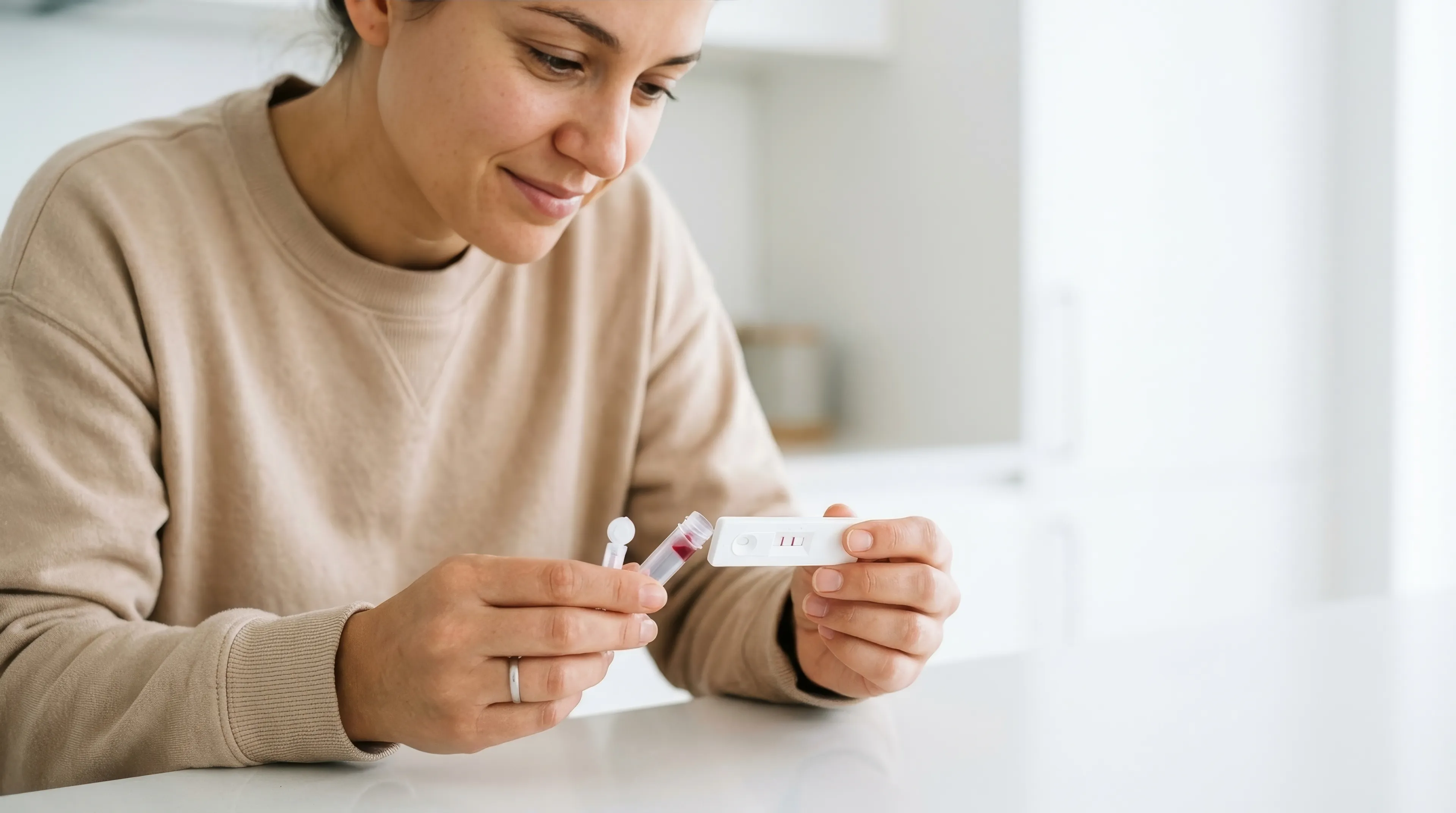
Positive Pregnancy Test with Blood: hCG Test Meaning
Positive Pregnancy Test with Blood: hCG Test Meaning
Bleeding with a positive pregnancy test? Learn what quantitative beta hCG levels mean, doubling trends, implantation spotting, and when to seek emergency care.
A positive pregnancy test with blood work is often the clearest way to confirm what a home test suggests, especially when spotting or irregular bleeding makes you question the result. Understanding what HCG blood tests actually measure, how they compare to home urine tests, and what the numbers mean can help you feel less anxious and make faster, better decisions with your doctor.
Why Bleeding Doesn't Rule Out a Positive Pregnancy Test
Seeing blood when you already have a positive result can feel alarming, but bleeding in early pregnancy is more common than most people realise, and it does not automatically mean something has gone wrong.
Implantation bleeding is one of the most frequent causes. This happens when the fertilised egg attaches to the uterine lining, usually around 6 to 12 days after conception. The bleeding is typically light, pinkish or brown, and lasts only a day or two. It can coincide with the time you would expect a period, which is why many women are unsure whether they are pregnant at all.
Other causes of early spotting include:
Cervical hyperaemia and sensitivity: Increased vascularity of the cervix in early pregnancy, which may bleed lightly following intercourse or an internal pelvic examination.
Subchorionic haematoma: A small, localized bleed between the uterine wall and the gestational membranes that often resolves spontaneously under clinical observation.
First-trimester hormonal shifts: Natural fluctuations in progesterone levels that cause mild breakthrough spotting before the placenta fully matures.
The limitation of any home urine test is that it only tells you HCG is present or absent. It cannot tell you whether the pregnancy is progressing, where it is located, or why you are bleeding. A blood test to confirm pregnancy resolves that ambiguity by giving a measurable number.
Home Urine Test vs Blood Test: Accuracy Compared
Home pregnancy tests work by detecting HCG in urine once levels cross a sensitivity threshold, usually 20 to 25 mIU/mL for most branded tests. At that concentration, a good-quality test can be over 99% accurate when used correctly, on or after the day a period is missed.
The accuracy drops considerably when tests are used too early, when urine is diluted (testing later in the day rather than with first-morning urine), or when the test is read outside the recommended time window. A faint line that disappears, or one that appears after 10 minutes, is not a reliable positive.
Common reasons for a false negative on a home test:
Premature testing: Testing before the blastocyst is fully implanted and urinary hCG reaches the kit's detection threshold (20 to 25 mIU/mL).
Specimen dilution: Drinking large quantities of water before testing, which lowers the concentration of hCG in the urine sample.
Evaporation line confusion: Misreading faint evaporation lines that appear outside the manufacturer's recommended reaction time window.
Early chemical loss: A transient implantation where hCG levels rose briefly and then rapidly declined.
A quantitative HCG test (blood-based) is more sensitive. It can detect HCG from as low as 1 to 5 mIU/mL, which is typically around 8 to 11 days after conception, before a urine test would show anything. If your home test is positive but you are bleeding, or if you received a negative home result but your period has not arrived, a blood test gives you a definitive answer.
Understanding HCG Blood Test Levels by Week
There are two types of HCG blood tests. A qualitative test simply confirms whether HCG is detected, giving a yes or no result. A quantitative HCG test, also called a beta-HCG test, measures the exact amount of HCG in your blood, reported in mIU/mL.
The quantitative version is far more informative. It lets your doctor track whether levels are rising at the expected rate, which matters both for confirming a healthy intrauterine pregnancy and for ruling out complications like an ectopic pregnancy.
HCG levels vary considerably between individuals, so a single number is less useful than the trend over 48 to 72 hours. That said, general reference ranges for early pregnancy are as follows:
Weeks Since Last Menstrual Period
Approximate HCG Range (mIU/mL)
3 to 4 weeks
5 to 50
4 to 5 weeks
5 to 426
5 to 6 weeks
18 to 7,340
6 to 7 weeks
1,080 to 56,500
7 to 8 weeks
7,650 to 229,000
8 to 12 weeks
25,700 to 288,000
These are approximate ranges used for general guidance. Your laboratory may use slightly different reference intervals, and your doctor will interpret your result in the context of your clinical picture, not the number alone.
In a healthy early pregnancy, HCG typically doubles roughly every 48 to 72 hours in the first trimester. Levels that plateau or fall during this period, or that rise more slowly than expected, may prompt further investigation.
When to Get a Blood Test After a Positive Home Test
If your home test is positive and you have no bleeding or pain, most doctors recommend scheduling a blood test within the first week of a missed period to confirm and establish a baseline HCG level.
If you are bleeding or have any doubt about the result, do not wait. Book an appointment promptly so your doctor can order a blood test to confirm pregnancy and, if needed, an ultrasound.
Your doctor may order a repeat beta HCG normal range check 48 hours after the first test. This serial measurement is standard practice when:
Unexplained vaginal bleeding: Assessing whether active bleeding correlates with normal doubling kinetics or an impending loss.
Low baseline hCG: Evaluating low initial hormone levels to distinguish delayed ovulation from impaired trophoblastic growth.
Suspected ectopic pregnancy: Identifying an abnormal, slow rate of rise (less than 49–53% over 48 hours) characteristic of ectopic implantation.
Recurrent pregnancy loss: Providing close hormonal surveillance for individuals with a history of recurrent miscarriages.
A single HCG value rarely tells the whole story. The trend is what matters.
Contraindications and Situations Needing Immediate Medical Attention
Spotting in early pregnancy is often harmless, but some types of bleeding are medical emergencies. Seek immediate care if you experience any of the following:
Heavy bleeding: Bleeding heavily enough to soak through a menstrual pad in an hour or less.
Acute unilateral pain: Sharp, intense, or worsening pain localized to one side of the lower abdomen or pelvis.
Shoulder-tip pain: Referred pain to the shoulder tip, which is a classic symptom of internal bleeding irritating the diaphragm from a ruptured ectopic pregnancy.
Signs of severe blood loss or shock: Fainting, severe dizziness, pale skin, or feeling faint alongside active bleeding.
Passing tissue or clots: Expelling distinct fleshy tissue or large dark blood clots from the vagina.
An ectopic pregnancy occurs when the fertilised egg implants outside the uterus, most often in a fallopian tube. It will produce a positive pregnancy test with blood results showing rising HCG, but it cannot result in a viable pregnancy and is life-threatening if the tube ruptures. A quantitative HCG test combined with an early ultrasound is the standard way to detect this.
Molar pregnancy is another rare condition where abnormal tissue forms instead of a normal embryo. HCG levels in a molar pregnancy can be extremely high. Both situations require urgent medical intervention.
Report adverse events or unexpected symptoms to your healthcare provider or the relevant regulatory authority.
If you are on any medication that might affect hormone levels, inform your doctor before testing. Certain fertility medications containing HCG can cause a false positive on both urine and blood tests.
Conclusion
Experiencing spotting or bleeding alongside a positive pregnancy test is understandably stressful, but it does not automatically indicate pregnancy loss. Benign causes like implantation bleeding, cervical sensitivity, or harmless subchorionic haematomas are frequent in early gestation. However, because a standard urine test only offers a yes-or-no result, a quantitative serum beta-hCG blood test is essential to measure exact hormone concentrations and track their doubling rate over 48 to 72 hours. While rising hormone trends provide reassurance, any bleeding accompanied by red flags such as sharp one-sided pelvic pain, shoulder-tip pain, dizziness, or passing clots demands immediate emergency assessment to exclude life-threatening conditions like a ruptured ectopic pregnancy. Always review your serial blood test values directly with your gynaecologist alongside an early pelvic ultrasound scan for an accurate, safe diagnosis.
FAQS
Can a blood test be positive and a urine test negative?
Yes. Blood tests detect HCG at much lower concentrations (as low as 1 to 5 mIU/mL) compared to most home urine tests (20 to 25 mIU/mL), so a blood test can be positive in very early pregnancy before a home test would register anything. If this happens, your doctor will likely repeat the blood test in 48 hours to confirm the trend.
How soon can a blood test detect pregnancy?
A quantitative HCG blood test can detect pregnancy as early as 8 to 11 days after conception, roughly 3 to 4 days before a missed period. Urine tests are generally reliable from the first day of a missed period onward.
Is an HCG blood test 100% accurate?
No test is 100% accurate, but a quantitative HCG blood test is considered highly reliable. False positives are rare and are usually linked to fertility treatments that contain HCG, certain medical conditions, or laboratory error. Serial testing over 48 to 72 hours further improves confidence in the result.
What HCG level confirms pregnancy?
Any detectable HCG level above the laboratory's threshold (generally 5 mIU/mL or higher) is considered a positive result. The level alone does not confirm a healthy pregnancy; the rising trend over serial tests, alongside an ultrasound at the right stage, gives a more complete picture.
Can stress cause a false positive blood pregnancy test?
No. Stress does not raise HCG levels. HCG is produced only by placental tissue (or in rare cases by certain tumours), so a positive blood result is not caused by stress, illness, or emotional factors. If you receive an unexpected positive, discuss it with your doctor to rule out any underlying causes.