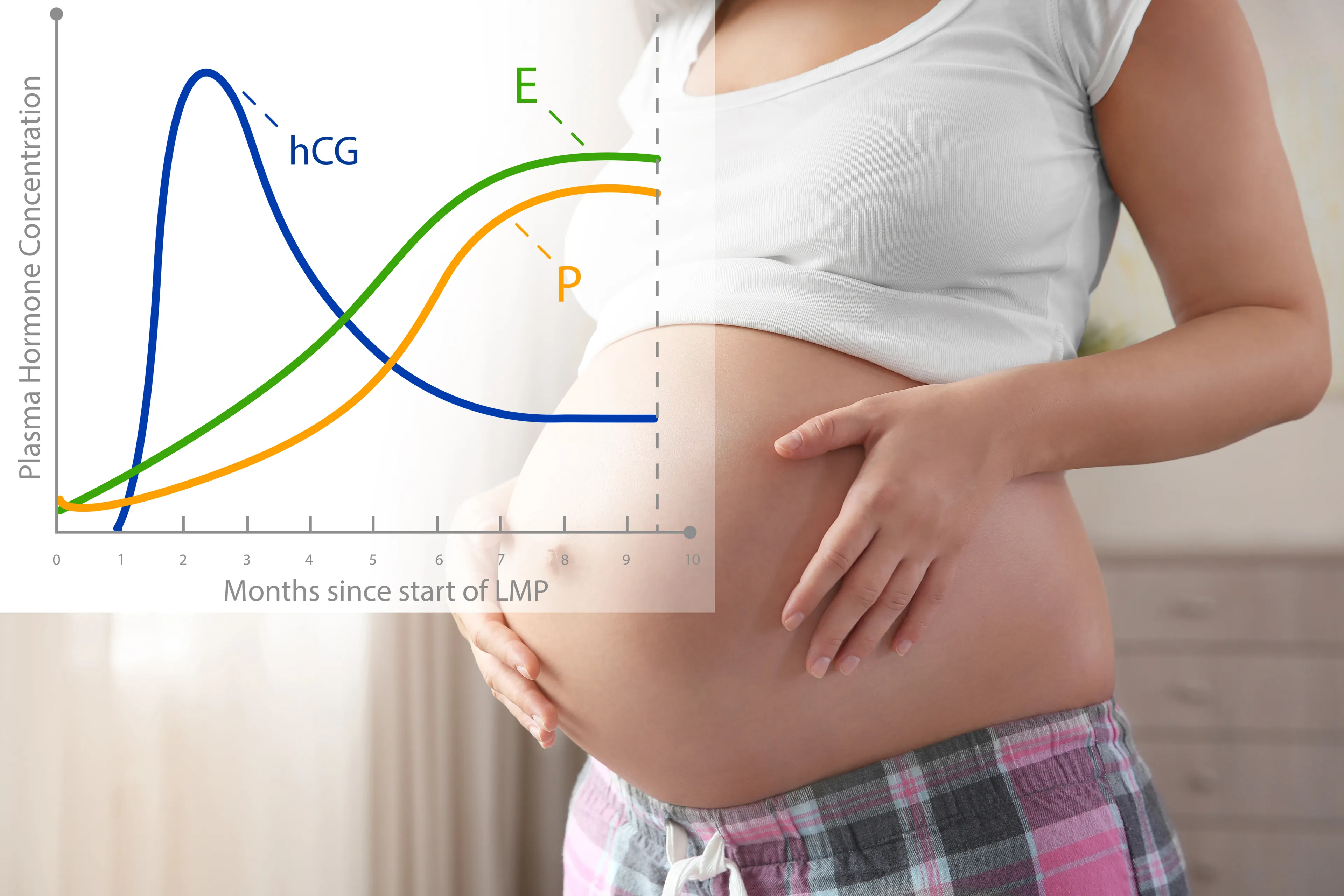
Pregnancy Hormone hCG Levels: Normal Range by Week
Understand hCG levels in pregnancy, normal ranges by week, what high or low levels mean, and when to consult your doctor. Doctor-reviewed guide.
Dr.Rohini priyanaka
Pregnancy Hormone hCG Levels: Normal Ranges by Week
Understanding pregnancy hormone hCG levels can feel overwhelming when you are staring at a blood test result and trying to make sense of numbers. Human chorionic gonadotropin, or hCG, is the hormone that confirms a pregnancy exists and helps track how it is progressing in the early weeks. Knowing what the numbers mean, and where they typically fall at each stage, can help you have a more informed conversation with your doctor.
What Is hCG and Why Is It Tested in Pregnancy?
hCG is produced by cells that eventually form the placenta, starting shortly after a fertilised egg implants in the uterus. It is the hormone that home pregnancy tests detect, and its presence in blood or urine is one of the earliest signs of pregnancy.
Doctors order a beta hCG test pregnancy investigation for several reasons:
To confirm a pregnancy is present.
To estimate how far along the pregnancy is when the last menstrual period is unclear.
To monitor pregnancies with a higher risk of complications.
To investigate symptoms like bleeding or pelvic pain in early pregnancy.
A single value rarely tells the whole story. Serial measurements over 48 to 72 hours are usually far more informative.
Normal hCG Levels by Week of Pregnancy (Chart)
The table below shows typical hCG ranges measured from the last menstrual period (LMP). These are broad reference ranges, and there is enormous variation between individuals. A healthy pregnancy can fall anywhere within, or occasionally just outside, these ranges.
Weeks from LMP
Typical hCG Range (mIU/mL)
3 weeks
5 to 50
4 weeks
10 to 750
5 weeks
200 to 7,200
6 weeks
160 to 32,000
7 to 8 weeks
3,700 to 100,000
9 to 12 weeks
25,000 to 290,000
13 to 16 weeks
13,000 to 254,000
17 to 24 weeks
4,060 to 165,400
25 to 40 weeks
3,640 to 117,000
A few important points about reading this hCG levels by week chart:
Significant range overlap: Ranges overlap significantly between weeks. A level of 500 mIU/mL could be normal at 4 weeks but low at 7 weeks.
Laboratory-specific variations: Different laboratories use slightly different reference ranges. Always interpret your result using your own lab's values.
Broad individual variance: At 5 weeks pregnant, many women have levels between 200 and 7,200 mIU/mL. A result outside this range is not automatically a problem without additional context.
The normal hCG range in early pregnancy is widest during the first trimester, which is exactly why a single snapshot rarely gives a complete picture.
In a healthy early pregnancy, hCG levels typically double every 48 to 72 hours up until about 8 to 11 weeks of gestation. This hCG doubling time is something doctors track closely with serial blood tests.
After roughly 10 to 11 weeks, doubling slows considerably. Levels usually plateau and then gradually decline through the second trimester, which is entirely normal.
What to keep in mind:
Expected 48-hour increase: A rise of at least 53 to 66 percent over 48 hours is generally considered reassuring in very early pregnancy, though some healthy pregnancies rise more slowly.
Ultrasound threshold above 6,000 mIU/mL: Doubling time becomes less meaningful once levels exceed approximately 6,000 mIU/mL. At that point, an ultrasound provides much more useful information.
Need for ongoing monitoring: A slower-than-expected rise is a reason for further monitoring, not immediate alarm.
What High or Low hCG Levels Could Mean
When hCG Is Higher Than Expected
Levels significantly above the typical range for a given week can be associated with:
A multiple pregnancy (twins or more), since more placental tissue produces more hCG.
A molar pregnancy, where abnormal placental tissue grows without a viable embryo.
Less commonly, certain chromosomal conditions.
When hCG Is Lower Than Expected
What does low hCG mean? A level below the expected range, or one that rises more slowly than anticipated, can suggest:
A pregnancy that is earlier than estimated based on dates.
An ectopic pregnancy, where the embryo implants outside the uterus.
A pregnancy that may not be progressing (threatened or missed miscarriage).
A single low value does not diagnose a miscarriage or ectopic pregnancy. Doctors always interpret hCG levels in pregnancy alongside symptoms, ultrasound findings, and clinical history before drawing any conclusions.
Contraindications and Cautions for hCG-Related Products
hCG is also used as an injectable medication in certain fertility treatments, prescribed to trigger ovulation or support the luteal phase. If you are using hCG as part of fertility care, your doctor will have discussed the specific protocol with you.
hCG injections are generally not suitable for people with:
Hormone-sensitive cancers (such as certain breast, ovarian, or prostate cancers).
Precocious puberty (early puberty in children).
Uncontrolled thyroid or adrenal disorders.
A known allergy to hCG preparations or any of their components.
Active thromboembolic conditions, in some protocols.
This is not a complete list. Always discuss your full medical history with your gynaecologist or reproductive endocrinologist before starting any hCG-based treatment. Report adverse events related to hCG injections or any medication to your healthcare provider or the relevant regulatory authority.
When to Consult Your Doctor About hCG Results
A number above or below the chart is not automatically a cause for panic, but certain situations need prompt medical attention. Contact your doctor the same day, or go to an emergency department, if you experience:
Heavy vaginal bleeding, or bleeding with clots.
Severe or one-sided pelvic or abdominal pain.
Shoulder tip pain, dizziness, or fainting (possible signs of internal bleeding from an ectopic pregnancy).
An hCG level that is falling when it should be rising, confirmed by serial tests.
Do not try to interpret your pregnancy hormone hCG levels alone. Numbers only make sense alongside a clinical examination and, where appropriate, an ultrasound scan. Once your pregnancy is confirmed and progressing well, your care team will guide you through the rest of the journey, including important milestones covered in resources like this newborn care guide after delivery.
Conclusion
Human chorionic gonadotropin (hCG) serves as a vital biochemical indicator for confirming early pregnancy and monitoring gestational progression. While normal weekly reference ranges vary significantly across individuals and laboratories, tracking appropriate doubling times over 48 to 72 hours offers reassuring clinical insight. A single numerical value should never be interpreted in isolation, as definitive assessment relies on serial blood measurements evaluated alongside clinical symptoms and pelvic ultrasound imaging. Unexpectedly high or low levels require careful medical investigation to distinguish harmless timing variations from conditions like multiple pregnancy or ectopic gestation. Always discuss laboratory findings directly with your obstetrician or gynaecologist to ensure accurate clinical interpretation and informed prenatal care.
FAQS
What is a good hCG level at 4 weeks pregnant?
At 4 weeks from the last menstrual period, hCG levels typically fall somewhere between 10 and 750 mIU/mL. Because the range is so wide, what matters more is whether the level rises appropriately over the next 48 to 72 hours.
Can hCG levels indicate twins?
Higher-than-average hCG for a given week can be a clue that a multiple pregnancy is present, but it is not a reliable way to confirm twins. An ultrasound, usually around 6 to 8 weeks, is the only definitive way to identify a multiple pregnancy.
Does a low hCG level always mean miscarriage?
No. A low level may simply mean the pregnancy is earlier than the dates suggest, or that ovulation occurred later than expected. Serial measurements and an ultrasound together give a much clearer picture than a single low result.
How is hCG level tested: blood or urine?
Both methods are used. A urine test (home pregnancy test) detects hCG qualitatively and is usually the first step. A blood test, called a beta hCG test, measures the exact level in mIU/mL and is used when precise monitoring is needed.
When does hCG peak during pregnancy?
hCG typically peaks between 8 and 11 weeks of pregnancy, often reaching levels of 25,000 to 290,000 mIU/mL or higher. After this peak, levels gradually decline and stabilise through the second and third trimesters.