logo
0

Pregnancy Symptoms Before Missing a Period

Learn about early pregnancy symptoms before a missed period, including implantation-related changes, breast tenderness, fatigue, nausea, cramping and when to take a pregnancy test.

article image

Dr.Kamran

Knowing whether you might be pregnant before your period is even late can feel like solving a puzzle with very few pieces. Pregnancy symptoms before missing a period are real for some women, but they are also easy to confuse with pre-menstrual changes. Understanding what your body may be signalling, and what it probably is not, helps you make calmer, more informed decisions.

Can You Have Pregnancy Symptoms Before a Missed Period?

Yes, some women notice early signs of pregnancy before a missed period, but it depends on timing and individual sensitivity.

After a sperm fertilises an egg, the fertilised egg travels to the uterus and implants in the lining, usually around 6 to 10 days after ovulation. Once implantation happens, the placenta begins producing human chorionic gonadotropin (hCG), the hormone that drives pregnancy symptoms and shows up on a pregnancy test. hCG levels roughly double every 48 to 72 hours in early pregnancy, so in the very first days after implantation they are still quite low.

This means some women feel nothing at all before their missed period, while others notice subtle changes. Both experiences are completely normal. Symptoms are not a reliable measure of whether a pregnancy is healthy or progressing well.

Early Physical Signs of Pregnancy

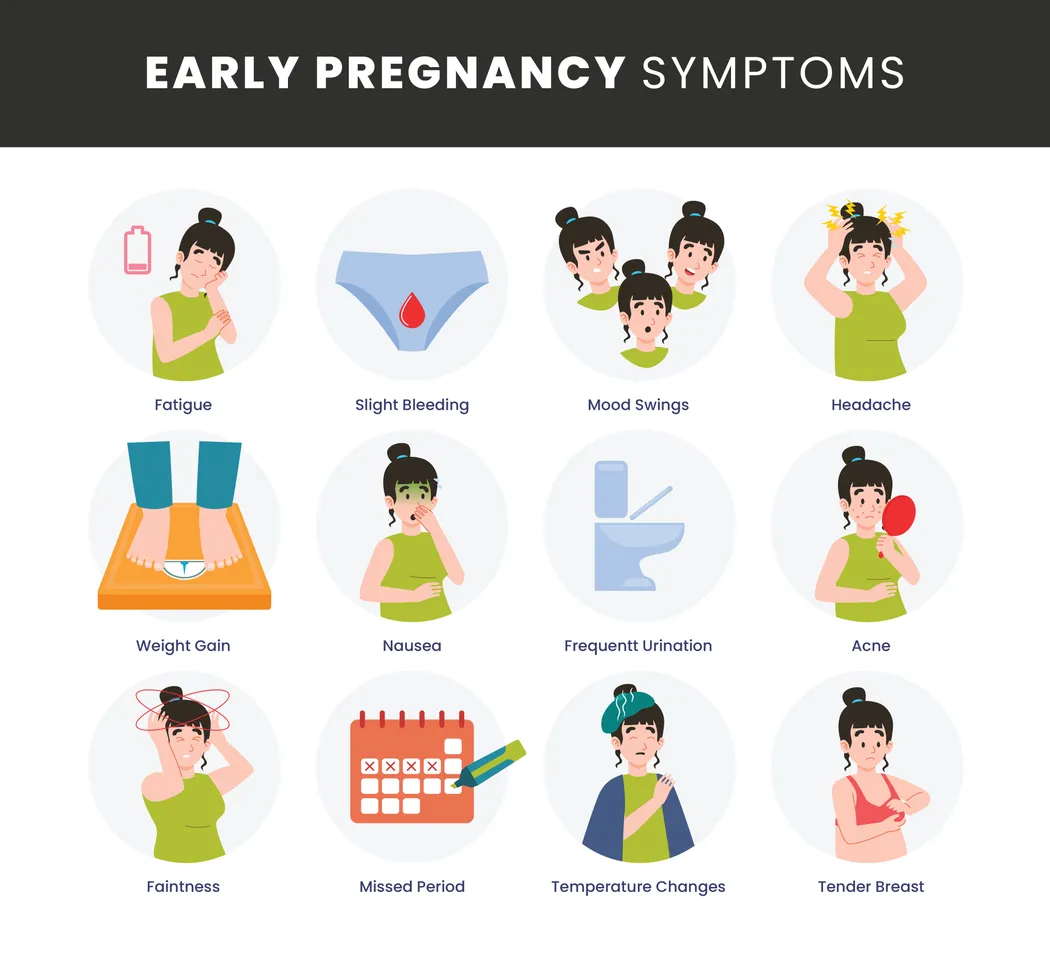
The following signs can appear as early as one to two weeks after conception, though not every woman experiences all of them. These are considered early pregnancy symptoms in week 1 to week 2 after a possible conception.

  • Fatigue is often the first thing women notice. Surging progesterone makes your body work harder, and even simple tasks can feel draining.
  • Breast tenderness or heaviness is driven by rising oestrogen and progesterone. The sensation is similar to pre-menstrual breast soreness but often described as more intense.
  • Nausea, sometimes called morning sickness, can appear before a missed period, though it is more common from week 6 onward. It does not always happen in the morning.
  • Mild cramping as the fertilised egg implants can feel like faint period cramps. These implantation symptoms are usually short-lived, lasting a day or two.
  • Bloating and a feeling of fullness in the lower abdomen are common because progesterone slows digestion.
  • Mood swings and heightened emotions mirror what progesterone does to your nervous system.
  • Frequent urination can begin surprisingly early, because hCG increases blood flow to the kidneys and your body starts producing more fluid.
  • A heightened sense of smell or sudden food aversions is one of the more distinctive early pregnancy symptoms, and it can show up before a period is even late.

None of these symptoms alone confirms pregnancy. They overlap heavily with PMS, stress, illness, and hormonal fluctuation.

Implantation Bleeding vs Period: How to Tell the Difference

One of the most confusing early signs of pregnancy before a missed period is light spotting. This is called implantation bleeding, and it occurs when the fertilised egg burrows into the uterine lining.

The table below outlines the key differences.


Feature
Implantation BleedingRegular Period
ColourLight pink or brownBright red to dark red
FlowVery light spotting, no clotsRanges from light to heavy, may include clots
DurationA few hours to 1 to 2 daysTypically 3 to 7 days
Timing6 to 12 days after ovulationAround 14 days after ovulation
CrampingMild or absentOften moderate to strong

If you notice a very small amount of pink or brown discharge around 10 days after ovulation and it stops within a day, it could be implantation bleeding. If the flow increases and follows your usual period pattern, it is more likely your period. When you are unsure, or the bleeding is heavier than expected, contact your doctor.

When to Take a Home Pregnancy Test?

Most home pregnancy tests are designed to detect hCG in urine from the first day of your missed period. Testing at this point gives you the most reliable result because hCG levels are high enough to trigger a clear positive.

Testing earlier, such as 5 days before your expected period, is possible with some sensitive tests marketed as "early result" tests, but the risk of a false negative is significant. A fertilised egg may not have implanted yet, or hCG may still be too low to detect. A negative result at that stage does not rule out pregnancy.

If you can wait until the day your period is due. If it does not arrive, test first thing in the morning when urine is most concentrated. A faint line still counts as a positive. If your period is more than a week late and you keep getting negatives, speak with a gynaecologist, because irregular cycles, stress, or other health conditions could be the cause.

As a rough guide, testing around 14 days after conception is when results become dependable, since that generally aligns with when your period would be due.

Who Should Not Self-Manage Early Pregnancy Concerns?

Early pregnancy care is generally safe to begin at home by confirming with a test and booking a doctor's appointment. However, certain symptoms should not be monitored at home without medical input:

Heavy bleeding or bleeding with significant pain is never a normal early pregnancy sign and requires immediate evaluation.
One-sided lower abdominal pain with spotting could indicate an ectopic pregnancy, which is a medical emergency.
Severe nausea leading to an inability to keep any fluids down needs clinical assessment.
If you are on any prescribed medication for a chronic condition, do not stop or change it without speaking to your doctor first, as some medicines require careful management in pregnancy.

Report any unexpected or severe symptoms to your healthcare provider or the relevant regulatory authority.

When to Consult a Doctor?

A positive home pregnancy test is your cue to book an appointment with a gynaecologist, even if you feel completely well. Early antenatal care includes confirming the pregnancy with a blood test, checking that it is in the right location, and starting folic acid if you have not already.

Seek same-day care for heavy bleeding, severe one-sided pain, or dizziness. These could point to complications that need prompt attention.

If you are already thinking ahead to life after delivery, Apollo's newborn care guide for after delivery is a helpful resource to bookmark early.

Conclusion

Some women may notice early pregnancy symptoms before their expected period, but these signs can be subtle and often overlap with premenstrual symptoms. Breast tenderness, fatigue, mild cramping, bloating, increased urination or changes in appetite may occur, but experiencing these symptoms does not confirm pregnancy. The most reliable way to determine whether you are pregnant is to take a pregnancy test at the appropriate time, as testing too early may produce a false-negative result. If your period is late and pregnancy is possible, consider repeating the test if the initial result is negative. Seek medical advice for severe abdominal pain, heavy bleeding, fainting or other unusual symptoms, particularly if pregnancy is possible.

FAQS

Can you feel pregnant one week after conception?

Some women do notice subtle changes around 7 days after conception, such as light spotting or mild fatigue, but hCG levels are very low at this point. Most symptoms that feel pregnancy-related this early are more likely linked to progesterone from ovulation than to the pregnancy itself.

What is the very first sign of pregnancy?

Implantation bleeding or spotting is often the earliest possible sign, appearing 6 to 12 days after ovulation. Fatigue and breast tenderness tend to follow shortly after as hCG begins to rise.

Can a pregnancy test be wrong before a missed period?

Yes. Testing before your missed period significantly increases the chance of a false negative because hCG may not yet be high enough to detect. A positive result before a missed period is usually reliable, but a negative result should be repeated once your period is due.

How soon can implantation symptoms start?

Implantation typically occurs 6 to 10 days after ovulation, so implantation symptoms such as mild cramping or light spotting can appear around that time. Not every woman will notice them at all.
Do early pregnancy symptoms feel like PMS?

They can feel very similar. Bloating, mood changes, breast soreness, and cramping all appear in both PMS and early pregnancy, which is why symptoms alone cannot confirm or rule out a pregnancy. A test is the only reliable way to tell.

Apollo 247 Floating Action Button