logo
0

Infant Biscuits for Teething: Safe Choices Guide

Learn how to choose safe infant biscuits for teething babies, what ingredients to avoid, how to reduce choking risks and when to seek medical advice.

article image

Dr.Mayank

Teething can be an unsettled time for babies, and you may look for something they can safely chew or gnaw on. Infant biscuits are one option, but they are not necessary for teething and can pose a choking risk if they are too hard, break into large pieces or are offered before your baby is ready for solid foods.

This guide explains when babies can start eating biscuits, what to look for on the ingredient label, how to reduce choking risks and which babies may need extra care. It also covers safer ways to introduce finger foods during the teething stage.

When Can Babies Start Eating Biscuits?

Most babies can start complementary foods at around 6 months when they show signs of developmental readiness. This does not mean that every 6-month-old is ready for every type of finger food. Your baby's ability to sit upright, control their head and neck, bring food to their mouth and swallow safely also matters.

Look for these signs before introducing an infant biscuit or other finger food:

  • Your baby can sit upright with good head and neck control.
  • Your baby can reach for food and bring it to their mouth.
  • Your baby can grasp food and attempt to feed themselves.
  • Your baby can swallow food rather than repeatedly pushing it out with their tongue.
  • Your baby shows interest in food and can manage the texture being offered.

A mature pincer grasp is not required before introducing all finger foods. Younger babies may initially pick up food using their whole hand and gradually develop more precise movements.

Check the age guidance on the specific biscuit you are considering. If your baby was born prematurely or has feeding difficulties, ask your paediatrician when and how to introduce finger foods.

What Makes an Infant Biscuit Safe and Nutritious

The ingredient list can help you choose a biscuit that fits into your baby's overall diet. Look for a product made specifically for infants and consider its ingredients, nutritional value, texture and age guidance.

Ingredients to Avoid

Some ingredients are best avoided or limited when choosing food for a baby:

  • Honey: Do not give honey to babies under 12 months because of the risk of infant botulism. This includes biscuits, rusks and other foods containing honey.
  • Added sugar: Choose foods with little or no added sugar. Babies do not need sweetened snacks as part of their diet.
  • Added salt: Babies need very little salt, so avoid products with added salt or high sodium content.
  • Hard or brittle ingredients: Avoid biscuits that can break into hard, sharp or difficult-to-manage pieces.
  • Known allergens: Check the ingredient list for foods your baby has previously reacted to. Do not avoid all common allergens simply because they have not yet been introduced, as they can be introduced from around 6 months in safe forms.
  • Unnecessary flavourings or colourings: A simple formulation can make it easier to identify ingredients if your baby develops a reaction.

What Good Infant Biscuits Contain

A suitable infant biscuit should have a texture and size that your baby can manage safely. It can also contribute useful nutrients, but it should not be relied upon as a main source of nutrition.

Look for products that:

  • Are specifically labelled for infants and your baby's age or developmental stage
  • Provide useful nutrients such as iron where applicable
  • Have little or no added sugar and salt
  • Have a texture that softens readily rather than remaining hard or brittle
  • Clearly list ingredients and allergens on the packaging

Iron becomes an important nutrient during complementary feeding, so offer a variety of iron-rich foods alongside any packaged snack. Infant biscuits should complement meals rather than replace them.

Do not assume that a biscuit is safe simply because it is labelled as a teething or infant product. Check the texture and follow the preparation and serving instructions on the pack.

Choking Hazards and Supervision Tips

Any solid food can present a choking risk if it is too hard, sticky, large or difficult for a baby to manage. Infant biscuits may soften during eating, but this does not make them completely free from choking risk.

Reduce the risk by following these steps:

  • Always supervise your baby while they are eating.
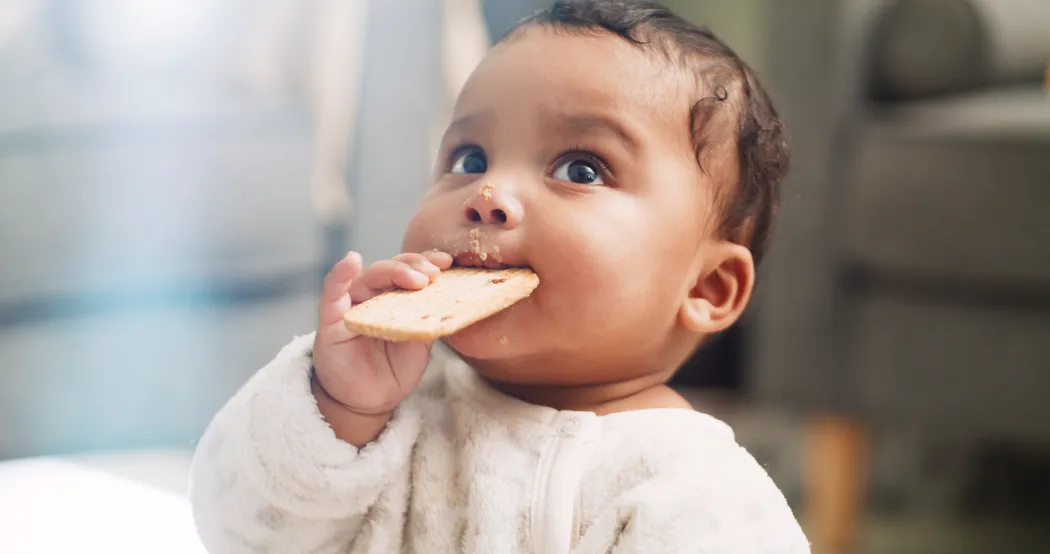
  • Keep your baby seated upright in a stable high chair or safe feeding seat.
  • Do not offer a biscuit while your baby is lying down, walking or playing.
  • Avoid feeding your baby in a moving car.
  • Follow the product's age and serving instructions.
  • Check the biscuit's texture before offering it. Do not give it if it remains hard or breaks into sharp or difficult-to-manage pieces.
  • Stay close throughout the meal so you can respond if your baby has difficulty.

Gagging can be noisy and may involve coughing, retching or bringing food forward in the mouth. Choking can prevent a baby from breathing, crying or making sounds. Learn infant choking first aid before introducing finger foods.

Rather than relying on a home "dissolve test" as proof that a biscuit is safe, assess the product according to its instructions, texture and your baby's developmental abilities. Even a biscuit that softens readily can become a choking hazard if a large piece breaks off.

How to Choose the Right Biscuit for Your Baby

Use the following points when comparing infant biscuits in a shop or online. The aim is to consider safety as well as nutritional value.

What to Look For

What to Avoid

Product labelled for your baby's age or developmental stage

Products intended for older children or adults

Texture that softens readily when eaten

Hard or brittle biscuits that can splinter

Little or no added sugar

Added sugar, glucose syrup or other sweeteners

Little or no added salt

Products with added salt or high sodium content

Useful nutrients such as iron, where provided

Treating the biscuit as a main source of nutrition

Clear ingredient and allergen information

Ingredients your baby has previously reacted to

No honey for babies under 12 months

Honey-containing biscuits or rusks for babies under 12 months

Rusk for babies is another traditional choice for some families. If you choose a rusk, check that it is specifically intended for babies and review the ingredient list, age guidance and texture. Adult rusks may contain added sugar or salt and may be harder to chew safely.

When to Consult a Paediatrician

Most babies can gradually learn to manage different textures as their feeding skills develop. Speak with your paediatrician if you are concerned about how your baby is eating or whether they are ready for a particular food.

Consult your paediatrician if:

  • Your baby repeatedly coughs, chokes or has difficulty swallowing during meals.
  • Your baby has persistent vomiting or becomes distressed during feeding.
  • Your baby develops hives, swelling, repeated vomiting or other symptoms after eating a food.
  • Your baby has had an episode that may have been choking, even if they recovered quickly.
  • Your baby has a diagnosed feeding or swallowing difficulty.
  • You are unsure whether your baby is developmentally ready for finger foods.

If your baby develops breathing difficulty, swelling of the tongue or throat, or other signs of a severe allergic reaction, seek urgent medical attention.

If a baby-care food product appears to have caused an adverse reaction, stop offering the product and inform your healthcare professional. Suspected adverse reactions can also be reported through the appropriate pharmacovigilance reporting system or regulatory authority available in your region.

Contraindications and Precautions

Certain babies may need individual advice before eating infant biscuits, while some ingredients or textures should be avoided altogether.

  • Babies under around 6 months: Complementary foods are usually introduced at around 6 months when a baby is developmentally ready. Do not introduce biscuits solely because your baby is teething.
  • Babies with a known food allergy: Avoid foods containing an allergen that has previously caused a reaction and follow your paediatrician's advice.
  • Babies with swallowing or feeding difficulties: Your healthcare professional may recommend specific food textures or feeding techniques.
  • Babies with conditions affecting the mouth or throat: Ask your healthcare professional which textures and shapes are safe.
  • Babies under 12 months: Do not give biscuits or rusks containing honey because of the risk of infant botulism.
  • Any baby offered a hard or brittle biscuit: Avoid products that remain hard or break into pieces that your baby may struggle to manage.

If your baby was born prematurely, discuss feeding readiness with your paediatrician. Developmental skills and feeding ability should guide the introduction of finger foods.

Conclusion

Infant biscuits are not essential for teething, but they can be offered as an occasional finger food once your baby is developmentally ready and the product is suitable for their age. Choose biscuits made specifically for infants, check the ingredients and age guidance, and avoid products containing honey for babies under 12 months.

The most important consideration is safe feeding. Keep your baby upright and supervised, avoid hard or brittle textures and offer a varied diet that provides the nutrients they need. If your baby has difficulty swallowing, develops a reaction to a food or you are unsure about feeding readiness, consult your paediatrician.

FAQS

Are teething biscuits necessary for babies?

No. Teething biscuits are not medically necessary. Some babies may enjoy chewing on a suitable biscuit, but other options, such as an age-appropriate teething toy or safe soft foods, can also provide opportunities to chew. Choose products and foods according to your baby's developmental stage.

Can biscuits replace a meal for infants?

No. Infant biscuits should not replace breast milk, infant formula or nutritious complementary foods. From around 6 months, babies gradually need a varied diet that provides nutrients such as iron and zinc alongside their usual milk feeds.

How many biscuits can a baby have per day?

There is no universal number that applies to every baby. The amount depends on your baby's overall diet, appetite, nutritional needs and the type of biscuit. Offer biscuits as an occasional snack rather than setting a fixed daily amount, and continue to provide a varied range of nutritious foods.

Do teething biscuits help with teething pain?

Chewing on a suitable food may feel soothing for some babies because it provides pressure against the gums. However, teething biscuits do not treat the cause of teething discomfort. A suitable teething toy may be another option. If your baby seems very uncomfortable or has symptoms that concern you, consult your paediatrician.

Are homemade biscuits safer than store-bought for babies?

Homemade biscuits allow you to control the ingredients, but they are not automatically safer. Their texture can be difficult to judge, particularly if they become hard or brittle after baking. Whether homemade or commercially produced, avoid honey for babies under 12 months, limit added sugar and salt, choose an age-appropriate texture and supervise your baby while eating.

Apollo 247 Floating Action Button