logo
0

Saline Drops for Newborn Congestion: Safe Use Guide

Discover how to safely use saline nasal drops for newborn congestion. Learn proper dosage, bulb syringe steps, warning signs, and expert paediatric advice.

article image

Dr. Ezhilrasan

Newborns are preferential and obligate nasal breathers, meaning they breathe almost exclusively through their nasal passages for the first 3 to 6 months, so even mild nasal congestion can significantly disrupt feeding and sleeping. Saline drops newborn parents rely on are a gentle, drug-free option that loosens sticky mucus so tiny airways can clear more easily. Knowing how to use saline nasal drops for babies correctly, and when to stop, makes all the difference in those early weeks.

What Are Saline Nasal Drops and How Do They Help Newborns?

Saline nasal drops are a sterile 0.9% sodium chloride solution (isotonic normal saline), formulated to match the physiological osmolarity of human body fluids (\~308 mOsm/L, adhering to USP, British Pharmacopoeia, and WHO standards). This is why the term "normal saline nasal drops baby" refers to: no drugs, no decongestants, just salt and water in a form safe for fragile newborn tissue.

When placed in a nostril, saline:

  • Moistens dry or sticky mucus so it flows and drains more easily.
  • Gently reduces irritation in the nasal lining.
  • Prepares the nose for mucus removal with a bulb syringe if needed.

Paediatricians widely recommend saline nasal drops for babies as the first step before any other measure for nasal congestion, precisely because they carry no drug-related risks.

When to Use Saline Drops for Newborn Congestion

Newborns naturally snuffle, squeak, and sneeze to clear their noses. That is normal and usually not congestion. Reach for the drops when you notice:

  • Laboured Nasal Breathing: Consistently noisy or laboured nasal breathing that does not clear on its own.
  • Feeding Difficulties: Difficulty latching or pulling off the breast or bottle mid-feed.
  • Visible Sticky Mucus: Visible thick or sticky mucus at the nostrils.
  • Respiratory Discomfort: Restlessness or crying that seems linked to breathing discomfort.

As a newborn blocked nose home remedy, saline is appropriate for these mild signs when there is no fever or distress. If your baby's chest is heaving, nostrils are flaring, or skin between the ribs sucks inward with each breath, that is a breathing emergency and needs immediate medical attention, not drops.

How to Use Saline Drops for Infant Congestion Safely

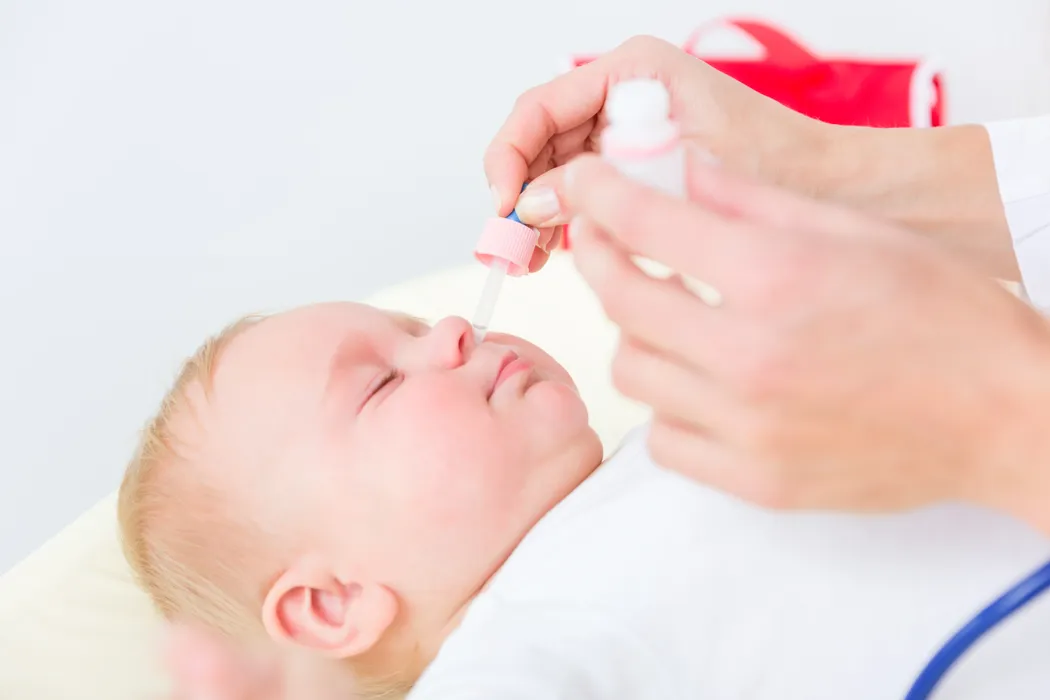
Knowing how to use saline drops for infant congestion properly is just as important as choosing the right product. Follow these steps each time:

  • Hand Hygiene: Wash your hands thoroughly before touching the dropper or your baby's face.
  • Infant Positioning: Lay your baby on their back on a firm, flat surface with the head tilted slightly back, or cradle the head in the crook of your arm.
  • Saline Instillation: Place 1 to 2 drops of saline into one nostril at a time. Wait 30 to 60 seconds to allow the solution to loosen mucus before proceeding.
  • Gentle Suctioning Technique: If using a bulb syringe, squeeze it before inserting the tip just inside the nostril, then release slowly to draw out mucus. Never push the tip deep into the nose.
  • Bilateral Application: Repeat on the other nostril.
  • Implement Sanitisation: Wipe the dropper tip clean after every use and rinse the bulb syringe with warm soapy water, then air-dry completely.

For newborn saline dosage, clinical guidelines (AAP, ICMR) and pediatric package inserts (e.g., Cipla Nasoclear, Otrivin Baby Saline) recommend 1 to 2 drops per nostril up to 3 to 4 times daily as needed. Administer drops 15 to 20 minutes before feeds to clear the airway for comfortable nursing, and avoid suctioning right after a feed to prevent vomiting.

For other early-weeks routines, the same clean-hands and sterile-supplies principle applies to newborn care basics: belly button hygiene.

Contraindications and Precautions

Saline drops are generally well tolerated, but pause and consult a doctor if:

  • Nasal Injury or Recent Surgery: There is any visible injury, bleeding, or recent surgical procedure involving the nose.
  • Known Sensitivities or Allergies: Your baby has a known sensitivity or allergy to any ingredient listed on the label.
  • Avoid Medicated Decongestants: Over-the-counter medicated drops or sprays containing alpha-adrenergic decongestants such as xylometazoline, oxymetazoline, or phenylephrine are strictly contraindicated in neonates and infants under 2 years (per FDA, EMA, and CDSCO safety advisories) due to risks of systemic absorption, severe central nervous system depression, bradycardia, and rebound mucosal swelling.
  • Avoid Homemade Saline Solutions: You are tempted to use homemade saline prepared with non-sterile water or unmeasured salt. The concentration may be wrong, and the solution can introduce infection.

Avoid using saline more often than the label recommends, since overuse can dry out the delicate nasal lining rather than soothe it.

Possible Side Effects and When to Stop Use

Normal saline nasal drops baby formulations are well tolerated by most newborns. Brief, mild reactions you may see include:

  • Reflexive Sneezing: Sneezing immediately after the drops are placed, which can actually help clear mucus.
  • Transient Fussiness: Momentary fussiness, mostly because babies dislike anything near their face.
  • Localised Nasal Redness: Slight redness at the nostril opening if drops are used very frequently.

These usually pass within seconds. Discontinue use and speak to your doctor if you notice increased congestion, any skin reaction or swelling, or worsening breathing or feeding difficulty after several days of use.

Report adverse events to your healthcare provider or the relevant regulatory authority.

When to Consult a Doctor

Baby nasal congestion relief at home works well for mild, short-lived stuffiness. Seek medical advice promptly if:

  • Neonatal Fever (<2 Months): Your newborn is under 2 months old and develops any fever, even a low one.
  • Persistent Congestion: Congestion persists beyond 3 to 5 days without improvement.
  • Feed Refusal or Dehydration: The baby is refusing feeds or producing significantly fewer wet nappies.
  • Respiratory Distress Signs: You notice wheezing, rapid breathing, or a blue tint around the lips.
  • Suspected Secondary Infection: Mucus turns thick, yellow, or green, which may point to an infection.

If adults in the household have cold symptoms, managing your own illness promptly can help protect your baby. You can find home remedies for cold relief (adult-focused reference) as a starting point for grown-up household members.

Conclusion

Because newborns are obligate nasal breathers, sterile 0.9% normal saline drops provide the safest, drug-free way to thin stubborn mucus and restore easy breathing. Simply instill 1 to 2 drops 15 to 20 minutes before feeds, limit bulb suctioning to 2 to 3 times daily to prevent tissue irritation, and strictly avoid OTC medicated decongestants. While mild stuffiness usually resolves within 7 to 10 days with home care and cool-mist humidity, contact your paediatrician immediately if your infant develops a fever, laboured breathing, or persistently refuses feeds.

FAQS

Can I use saline drops every day for my newborn?

Short-term daily use is generally considered safe during active congestion, following the dosage on the product label. If you need saline drops for newborn care every day for more than a week, check with your paediatrician to rule out an underlying cause.

Are homemade saline drops safe for babies?

Homemade solutions are not recommended for newborns. Incorrect salt concentration or non-sterile water can irritate the nasal lining or introduce infection; use a commercially prepared, sterile product instead.

What is the difference between saline drops and saline spray for infants?

Drops deliver a controlled, low-pressure amount of fluid and are preferred for newborns because sprays can create pressure that is uncomfortable and harder to control in tiny nasal passages.

Can saline drops be used alongside a humidifier?

Yes. The American Academy of Pediatrics (AAP) recommends using a cool-mist humidifier in an infant's room to maintain ambient airway hydration and prevent secretions from drying out. Warm-steam vaporizers should be strictly avoided due to accidental scalding and burn hazards. Clean the water tank daily to prevent bacterial and mold accumulation.

How long can newborn congestion last?

Nasal congestion caused by an uncomplicated viral upper respiratory infection typically peaks around days 3 to 5 and resolves within 7 to 10 days (per CDC and AAP clinical benchmarks). If congestion persists past 10 days, worsens, or is accompanied by a fever or feed refusal, consult your pediatrician immediately.

Apollo 247 Floating Action Button