logo
0

Saline Drops Newborn: Complete Usage and Safety Guide

Learn how to use saline drops safely for newborn nasal congestion, proper step-by-step application, safe dosage limits, and when to see a paediatrician.

article image

Dr. Mayank

A newborn who cannot breathe freely through their nose will struggle to feed, sleep, and settle, and watching that happen is stressful for any parent. Saline drops for newborns are one of the simplest, safest tools available to ease a blocked nose without using any medication, and knowing how to use them correctly makes all the difference.

What Are Saline Drops and How Do They Help Newborns?

Saline nasal drops are a sterile solution of sodium chloride (salt) in water, matched to a concentration that is gentle on delicate nasal tissue. There is no drug, decongestant, or preservative in a standard isotonic saline preparation, which places them in a completely different category from medicated nose drops.

When placed in a baby's nostril, the solution loosens and thins dried or sticky mucus, making it easier to drain naturally or be gently suctioned out. Newborns breathe almost exclusively through their noses, so even mild congestion can interfere with feeding and sleep. Clearing the airway with normal saline for a baby's nose restores comfort without any pharmacological effect on the body.

When to Use Saline Drops for Your Newborn?

Not every snuffle warrants saline drops. Look for these specific signs before reaching for the bottle:

  • Noisy, snuffly breathing that is louder than usual
  • Pulling away from the breast or bottle mid-feed because the baby cannot breathe and suck simultaneously
  • Visible dried mucus or crusting at the nostril opening
  • Restlessness at night that seems linked to a blocked nose

Saline nasal drops for babies work best when used before feeds and before sleep, because those are the moments when a clear airway matters most. As a newborn nasal congestion home remedy, saline is a useful first step, but there is no need to use it when breathing sounds normal. For broader ideas on managing cold symptoms naturally, see our guide on home remedies for cold relief.

Step-by-Step: How to Administer Saline Drops Safely

Proper technique prevents discomfort and gets the drops where they need to go.

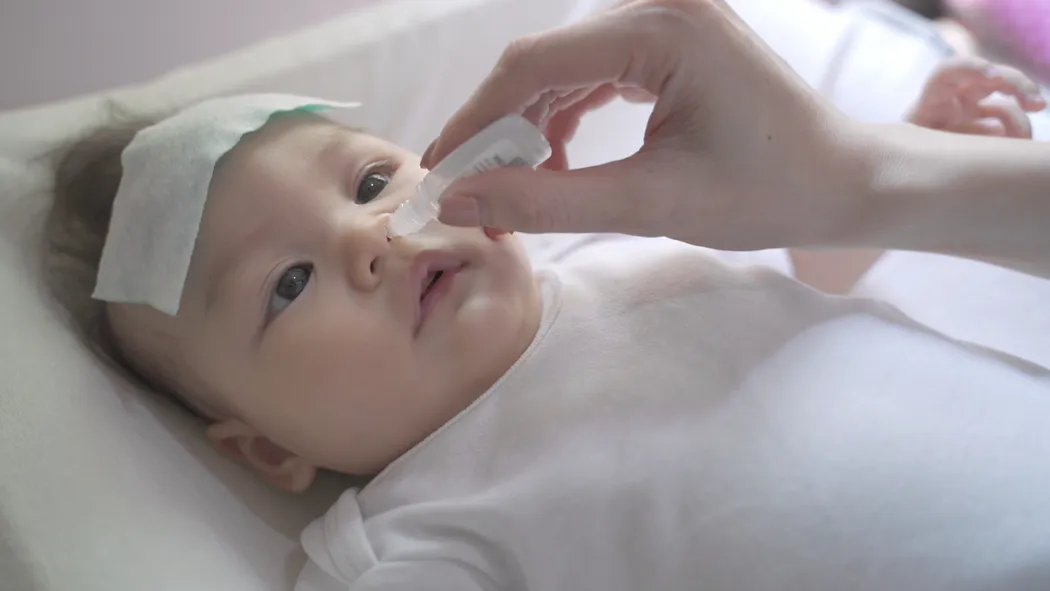
  • Position the Baby: Lay your baby on their back on a firm, flat surface and gently support the head so the nostrils point upward.
  • Tilt Head Slightly: Tilt the head back very slightly—just enough to open the nostrils without straining the neck.
  • Position Dropper Tip: Place the dropper tip right at the nostril opening without inserting it deeply.
  • Instil Drops: Instil 1 to 2 drops into one nostril, wait 20 to 30 seconds, and repeat on the other side.
  • Allow Solution to Work: Keep your baby still for approximately 30 seconds to let the saline loosen and thin the mucus.
  • Gently Suction Mucus: Squeeze a clean bulb syringe before insertion, place the tip just inside the nostril, and slowly release to draw out loosened mucus.
  • Clean and Dry Equipment: Wipe the dropper tip and rinse the bulb syringe with warm water after each use, letting both dry fully before storing.

Stay calm and steady throughout. Babies pick up on anxiety, and a tense parent makes the process harder for everyone.

How Often and How Many Drops Are Safe?

A commonly followed approach is to use saline nasal drops for babies 2 to 3 times a day, ideally before feeds or bedtime. Most paediatricians advise no more than 4 applications in 24 hours without specific guidance.

The baby saline drops dosage per nostril is typically 1 to 2 drops for a newborn. Sticking to this baby saline drops dosage matters: using more drops does not improve results and can irritate the nasal lining. Always follow the specific frequency your child's doctor advises, particularly if your baby was born prematurely or has any underlying health condition.

Contraindications and Safety Considerations

Saline drops are gentle, but they are not appropriate for every situation.

  • Do not use saline drops if the nostrils appear injured, bleeding, or inflamed beyond normal congestion.
  • Premature babies have more fragile nasal passages; check with your neonatologist before using any nasal preparation.
  • Never substitute medicated decongestant drops for saline. Over-the-counter medicated nasal drops are not approved for newborns and can cause serious side effects.
  • Using saline more than the recommended number of times per day can dry out and irritate the nasal mucosa, making congestion worse rather than better.
  • Always use a preparation specifically labelled for infants or formulated as sterile isotonic saline. Do not use hypertonic adult formulations on a newborn.

Report adverse events to your healthcare provider or the relevant regulatory authority if your baby shows any unexpected reaction after using saline drops.

Prescribing and Product Information

Saline nasal drops are available over the counter at pharmacies without a prescription. They are sold generically as isotonic normal saline for baby nose use and under several brand names; any pharmacist can point you to an appropriate infant-grade preparation.

Read the pack insert carefully before use, including the expiry date, storage instructions, and any preservative information. Once opened, most single-use vials should be discarded immediately; multi-dose bottles typically carry a short in-use shelf life noted on the label. For a broader overview of caring for your newborn day to day, see our newborn care essentials guide.

When to Consult a Doctor?

Saline drops address mild congestion only. They are not a treatment for illness. Seek medical attention promptly if you notice any of the following:

  • Fever in a baby under 3 months, even a low-grade one
  • Rapid, laboured, or noisy breathing beyond ordinary snuffling
  • Skin pulling in between the ribs or at the neck with each breath
  • Blue or pale colouring around the lips or fingertips
  • No improvement after 2 to 3 days of consistent saline use
  • Persistent refusal of feeds or unusual lethargy

These signs suggest something more than simple congestion and need a pediatrician's assessment, not a home remedy.

Conclusion

Sterile isotonic saline drops offer a safe, non-medicated way to clear nasal passages and restore comfort for feeding and sleeping newborns. By placing 1 to 2 drops per nostril two to three times daily before feeds or bedtime and suctioning with a bulb syringe, parents can manage mild nasal congestion effectively at home. Never substitute adult hypertonic solutions or medicated decongestants. If congestion persists past 3 days, or if your baby shows red-flag symptoms like fever, rapid breathing, or poor feeding, consult your paediatrician promptly.

FAQS

Can I make saline drops at home for my baby?

Homemade salt-water mixtures carry a risk of incorrect concentration and contamination, both of which can harm a newborn's delicate nasal lining. It is much safer to use a sterile, commercially prepared saline nasal drops product labelled for infant use.
How long can newborns use saline drops?

Saline drops can be used for as long as congestion persists, but if symptoms do not improve within 2 to 3 days, see a doctor rather than continuing on your own. There is no fixed maximum duration, but ongoing congestion usually has an underlying cause that needs assessment.

Do saline drops have side effects?

When used correctly and at the right frequency, side effects are rare. Overuse can dry and irritate the nasal lining, and an incorrect technique can cause brief discomfort or sneezing, which is harmless.

Can saline drops be used with breast milk instead?

Breast milk is sometimes suggested as a newborn nasal congestion home remedy, but there is limited evidence for its use in the nose, and it can introduce bacteria into the nasal passage. Sterile saline remains the recommended choice for safe newborn stuffy nose relief.

Is saline spray the same as saline drops for infants?

The solution is the same, but the delivery method differs. Drops allow precise, gentle instillation and are generally preferred for newborns; sprays can deliver a stronger jet of fluid that may be uncomfortable or overwhelming for very young babies. Always check that any nasal product is labelled as suitable for newborns before using it.

Apollo 247 Floating Action Button