logo
0

Stages of Prenatal Development: Trimester-Wise Guide

Understand the stages of prenatal development, fetal milestones, and maternal changes by trimester. Doctor-reviewed guide from Apollo Pharmacy.

article image

Dr.Yusuf

Understanding the stages of prenatal development helps expecting parents connect with what is happening inside the womb at every step. From the moment of fertilisation to the final weeks before birth, the journey involves rapid, precisely timed changes that shape a new human being. Knowing these milestones can ease anxiety, support informed conversations with your doctor, and help you make choices that protect your growing baby.

What Are the Stages of Prenatal Development?

Prenatal development is divided into three biological stages, each with a distinct name and week range:

  • Germinal stage: conception through roughly week 2. The fertilized egg divides rapidly and travels to the uterus, where it implants in the uterine lining.
  • Embryonic stage: weeks 3 through 8. Major organ systems begin forming during this period of organogenesis, and the developing organism is called an embryo.
  • Fetal stage: week 9 through birth. The organism is now called a fetus. Growth and maturation of existing structures continue until delivery.

These stages map onto the three clinical trimesters. The first trimester covers weeks 1 to 12 and includes all three biological stages. The second spans weeks 13 to 26, and the third covers weeks 27 to 40.

First Trimester: Germinal and Embryonic Development

The first trimester is the most biologically eventful stretch of pregnancy. Everything that will eventually become a person has to be established from scratch.

Key milestones by week:

  • Weeks 1 to 2 (germinal stage): Fertilisation occurs, usually in the fallopian tube. The zygote divides into a blastocyst and implants in the uterine wall around day 6 to 10.
  • Week 3: The neural tube, which will become the brain and spinal cord, begins forming.
  • Weeks 4 to 5: The heart starts beating. Limb buds appear.
  • Weeks 6 to 8: Eyes, ears, and facial features take shape. The liver, kidneys, and lungs are in early development. Fingers and toes begin to separate.
  • Weeks 9 to 12 (early fetal stage): The fetus can move, though the mother cannot yet feel it. Genitalia start to differentiate. By week 12, all major organs are present in at least a rudimentary form, and the fetus measures about 5 to 6 cm.

Because organogenesis happens entirely in the first trimester, this period is the most sensitive to harmful exposures such as infections, medications, and nutritional deficiencies.

Second Trimester: Fetal Growth Milestones

Many parents describe the second trimester as the most comfortable phase. Morning sickness tends to ease, energy often returns, and the pregnancy becomes visibly apparent.

Fetal development during weeks 13 to 26:

  • Weeks 14 to 16: Facial muscles allow the fetus to make expressions. Fine hair called lanugo covers the skin.
  • Weeks 18 to 20: Sex can often be determined by ultrasound. Most mothers feel fetal movement for the first time around this point, a sensation called quickening. First-time mothers may notice it slightly later, around weeks 20 to 22.
  • Weeks 22 to 24: Survival outside the womb becomes possible with intensive medical support, though outcomes improve considerably after week 28.
  • Week 26: The eyes begin to open. The lungs start producing surfactant, a substance critical to breathing after birth, though they are not yet fully mature.

The fetus grows from roughly 65 g at week 13 to around 900 g by week 26.

Third Trimester: Final Growth and Preparation for Birth

The final stretch of the stages of prenatal development focuses on size, strength, and readiness for life outside the womb.

  • Weeks 28 to 32: The brain grows rapidly. The fetus can hear external sounds and respond to light. Bones harden, but the skull stays flexible for birth.
  • Weeks 33 to 36: Lung maturation continues. The fetus typically settles into a head-down position. Fat deposits build up under the skin.
  • Weeks 37 to 40: A pregnancy is considered full term from week 37. The lungs are the last major organ system to fully mature, completing development close to 36 to 38 weeks. The fetus gains about 200 g per week in the final month.

By week 40, the average newborn weighs around 3 to 3.5 kg and measures about 50 cm.

Maternal Changes Alongside Fetal Development

Pregnancy changes every system in the mother's body. The table below maps the most common physical and hormonal shifts to each trimester.

TrimesterHormonal ChangesPhysical ChangesCommon Symptoms
First (weeks 1 to 12)hCG rises sharply; progesterone and estrogen surgeUterus expands; blood volume increasesNausea, fatigue, breast tenderness, frequent urination
Second (weeks 13 to 26)hCG plateaus; cortisol risesVisible baby bump; skin changes such as linea nigra and stretch marksReduced nausea, back pain, leg cramps, nasal congestion
Third (weeks 27 to 40)Relaxin softens ligaments; oxytocin primes the uterusDiaphragm displaced; pelvic pressure increasesBreathlessness, heartburn, swollen ankles, Braxton Hicks contractions

A note on Braxton Hicks contractions: these are sporadic, painless tightening sensations in the uterus that occur in the third trimester. They are the body's way of preparing for labour and are not true labour contractions. If contractions become regular, painful, or frequent before week 37, contact your doctor promptly.

Emotional shifts are normal throughout. Mood changes in the first trimester often follow hormonal spikes. Anxiety around viability is common in the second trimester. Anticipation and physical discomfort tend to dominate the third.

Factors and Conditions That Can Affect Prenatal Development

Several exposures can disrupt fetal growth at different points in pregnancy:

  • Alcohol has no established safe level during pregnancy and is associated with fetal alcohol spectrum disorders.
  • Tobacco smoking reduces oxygen supply to the fetus and is linked to preterm birth and low birth weight.
  • Uncontrolled infections such as rubella, toxoplasmosis, and cytomegalovirus can cause serious fetal harm, particularly in the first trimester.
  • Nutritional deficiencies, especially of folate, iodine, and iron, affect neural and physical development.
  • Unmanaged chronic conditions such as diabetes, hypertension, and thyroid disorders can increase the risk of complications.
  • Significant psychological stress and anxiety can influence birth outcomes, though the mechanisms are still being studied.

Early antenatal care helps identify and manage most of these risks before they cause lasting harm.

Contraindications and Safety Precautions During Pregnancy

Certain medications and substances are contraindicated during pregnancy because they cross the placenta and can harm the developing fetus. Always check with your doctor or pharmacist before taking anything, including over-the-counter products.

Substances and drug categories commonly avoided:

  • Retinoids (acne or psoriasis medications): Associated with serious birth defects if taken in the first trimester.
  • Warfarin and anticoagulants: Linked to fetal haemorrhage and skeletal abnormalities.
  • Certain antiepileptic drugs: Carry a risk of neural tube defects, particularly when taken in early pregnancy; a specialist must weigh the risks of stopping against the risks of continuing.
  • Tetracycline-class antibiotics: Can affect fetal bone and tooth development when used in the second and third trimester.
  • Non-steroidal anti-inflammatory drugs (NSAIDs): Generally avoided in the third trimester due to the risk of premature closure of the ductus arteriosus.
  • High-dose vitamin A supplements: Beyond standard prenatal formulations, excessive intake can be teratogenic.

This list is not exhaustive. Any medication change during pregnancy should be discussed with a qualified healthcare provider.

Report adverse events related to any medication or supplement taken during pregnancy to your healthcare provider or the relevant regulatory authority.

When to Consult a Doctor
 

Antenatal care is not just for complications. Scheduled visits allow your doctor to track fetal growth, screen for gestational diabetes and pre-eclampsia, confirm fetal positioning, and answer your questions at every stage.

Seek immediate medical attention if you experience:

  • Heavy bleeding or significant cramping at any point in pregnancy.
  • Severe headache, visual disturbances, or sudden swelling of the face or hands.
  • Reduced or absent fetal movement after week 28.
  • Fever above 38 degrees Celsius with no clear cause.
  • Signs of preterm labour before week 37 (regular contractions, pelvic pressure, fluid leakage).

Conclusion

Prenatal development is an extraordinarily synchronized biological sequence spanning the germinal, embryonic, and fetal stages across forty gestational weeks. The first trimester remains the most vulnerable window as rapid organogenesis establishes the rudimentary architecture of the brain, heart, and limbs, requiring rigorous avoidance of known teratogens such as retinoids, high-dose vitamin A, and unprescribed pharmaceuticals. The second and third trimesters transition from structural formation to significant somatic growth, neurosensory maturation, and pulmonary preparation with surfactant production. Consistent antenatal consultations are vital to monitor maternal cardiovascular adaptations, track fetal biometry, and identify complications like gestational hypertension or fetal growth restriction early. If you experience critical warning signs—such as bright red vaginal bleeding, severe unilateral pelvic pain, visual disturbances, or sudden cessation of fetal movements after 28 weeks—seek emergency obstetric care immediately.

FAQS

What are the 3 stages of fetal development?

The three stages are germinal (conception to week 2), embryonic (weeks 3 to 8), and fetal (week 9 to birth). Each stage has a distinct biological focus, from implantation through organogenesis to full growth and maturation.

How many weeks are in each trimester of pregnancy?

The first trimester covers weeks 1 to 12, the second trimester covers weeks 13 to 26, and the third trimester runs from week 27 to week 40, making each trimester roughly 13 weeks long.

What is the most critical stage of prenatal development?

The embryonic stage (weeks 3 to 8) is generally considered the most critical, as all major organ systems form during this window. Harmful exposures during this period carry the highest risk of structural birth defects.

When do baby's organs finish developing?

Most organs are structurally present by the end of the first trimester, but they continue maturing throughout pregnancy. The lungs are the last major system to fully mature, typically completing development between weeks 36 and 38.
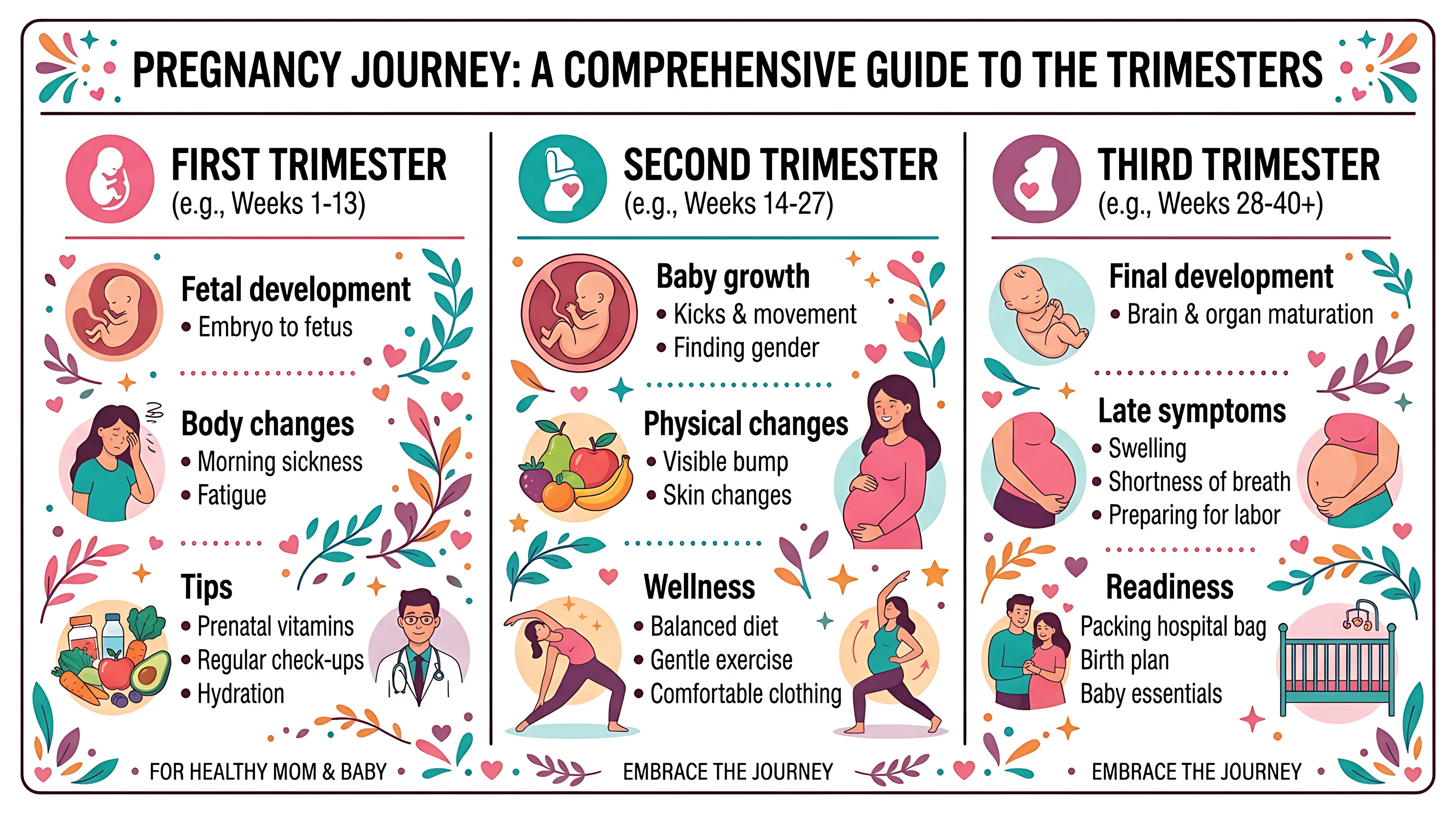
What maternal changes happen in each trimester?

The first trimester brings nausea, fatigue, and hormonal surges. The second trimester often feels more comfortable, with a visible bump and reduced nausea. The third trimester involves increasing pelvic pressure, breathlessness, heartburn, and Braxton Hicks contractions as the body prepares for labour.

Apollo 247 Floating Action Button