logo
0

Infant Vision: Developmental Milestones & Eye Care

Learn how infant vision develops from birth, including key visual milestones, normal changes, warning signs, and when your baby may need an eye check-up.

article image

Dr.Mayank

Watching your baby notice your face for the first time is one of parenthood's quiet miracles. But the vision of an infant doesn't arrive fully formed at birth. It builds gradually over the first year, shaped by the growth of the eye, retina, and brain all working together. Understanding what your baby should be seeing at each age helps you celebrate normal progress and spot early signs that something needs attention.

How Vision of an Infant Develops After Birth

Newborns can see from the moment they are born, but only in a very limited way. The world looks blurry, and their clearest focal range is roughly 20 to 30 centimetres, which is almost exactly the distance between a feeding parent's face and their eyes. Beyond that range, shapes blur quickly.

A few things are worth knowing about newborn vision stages:

  • Contrast Sensitivity: Contrast matters more than colour. Newborns are drawn to bold black-and-white patterns and the edges of faces because their cone cells, responsible for colour and fine detail, are not yet mature.
  • Light Sensitivity: Newborns are highly sensitive to light. Bright light may make them squint or turn away, which is completely normal during the first few weeks.
  • Peripheral Vision: Peripheral vision is present from birth, but central, focused vision takes several months to develop and sharpen.

The visual cortex, the part of the brain that processes what the eyes send, develops rapidly over the first year. This is why early stimulation with faces, contrasting patterns, and movement genuinely supports infant vision development.

Vision Milestones by Month (0 to 12 Months)

The table below outlines typical baby eye milestones by month. Healthy babies develop at slightly different rates, and a week or two either way is rarely cause for concern. Consistent delays across multiple milestones, however, are worth discussing with your doctor.
 

Age    What Most Babies Can Do
0 to 1 monthFixes gaze briefly on faces; tracks slow movement through about 45 degrees; prefers high-contrast patterns
2 to 3 months    Follows a moving object more smoothly; begins sustained eye contact; shows interest in colourful mobiles
4 to 6 monthsReaches toward objects, showing early depth perception; recognises familiar faces from across a room; colour vision close to an adult's
7 to 9 monthsTracks fast-moving objects; looks for a dropped toy; begins judging distances while crawling
10 to 12 monthFocuses on small objects; points at things of interest; coordinates hand-eye movements with increasing precision

The question of when do babies start seeing clearly doesn't have one single answer. Rough adult-level sharpness is typically reached somewhere between one and two years of age, as the retina and visual pathways continue maturing well beyond the first birthday.

Signs of Vision Problems in Infants

Most eye issues in babies are picked up either by parents at home or during routine well-baby visits. Knowing the red flags means you can act quickly.

  • Eye Contact and Tracking: By three months, a baby should be making consistent eye contact and following a face or toy with their eyes. If there is no reliable eye contact by this age, mention it to your paediatrician at the next visit, or sooner if you are worried.
  • Eye Crossing (Strabismus): It is common for a newborn's eyes to wander or appear slightly crossed during the first six to eight weeks. Their eye muscles are still learning to work together. Constant crossing or outward turning after four months is not normal and needs evaluation. Untreated crossed eyes can lead to amblyopia, where the brain stops using the weaker eye.
  • White Pupil Reflex (Leukocoria): A white or yellowish glow in the pupil, especially visible in flash photographs, is an urgent warning sign. It can indicate conditions including cataracts or retinoblastoma, a rare but serious eye tumour. Do not wait for a scheduled appointment. See a doctor the same day or go to an emergency department.

Other signs of eye problems in infants

  • Excessive tearing in one or both eyes beyond the first few weeks, which can suggest a blocked tear duct
  • Persistent redness or discharge that doesn't clear with gentle wiping
  • One eye that looks noticeably larger or smaller than the other
  • The baby consistently tilting or turning their head to one side when looking at things
  • Extreme sensitivity to light beyond the newborn period

Trust your instinct. If something looks off, raise it with your baby's doctor without waiting for the next scheduled visit.

When to See a Pediatric Eye Specialist?

Routine eye screening for infants follows a standard schedule, and timing matters because early treatment for most childhood eye conditions gives far better outcomes.

Recommended screening ages for a pediatric eye checkup for babies:

  • At Birth: A red reflex test checks for obvious structural abnormalities.
  • Around 6 Months: A paediatrician should assess whether both eyes are tracking together and whether the red reflex remains normal.
  • At 3 Years: A more formal visual acuity assessment becomes possible as children can begin to cooperate with chart-based testing.

Your baby should see a paediatric ophthalmologist sooner if:

  • Family History: A family history of childhood eye conditions, such as congenital cataracts or significant refractive errors in young children, may warrant earlier specialist evaluation.
  • Premature Birth: Babies born prematurely may need specialised screening for retinopathy of prematurity.
  • Warning Signs: If you or your paediatrician notice any of the warning signs listed above, your baby should be evaluated by an eye specialist.
  • Leukocoria: A white pupil reflex (leukocoria) at any age is an emergency requiring same-day medical review.

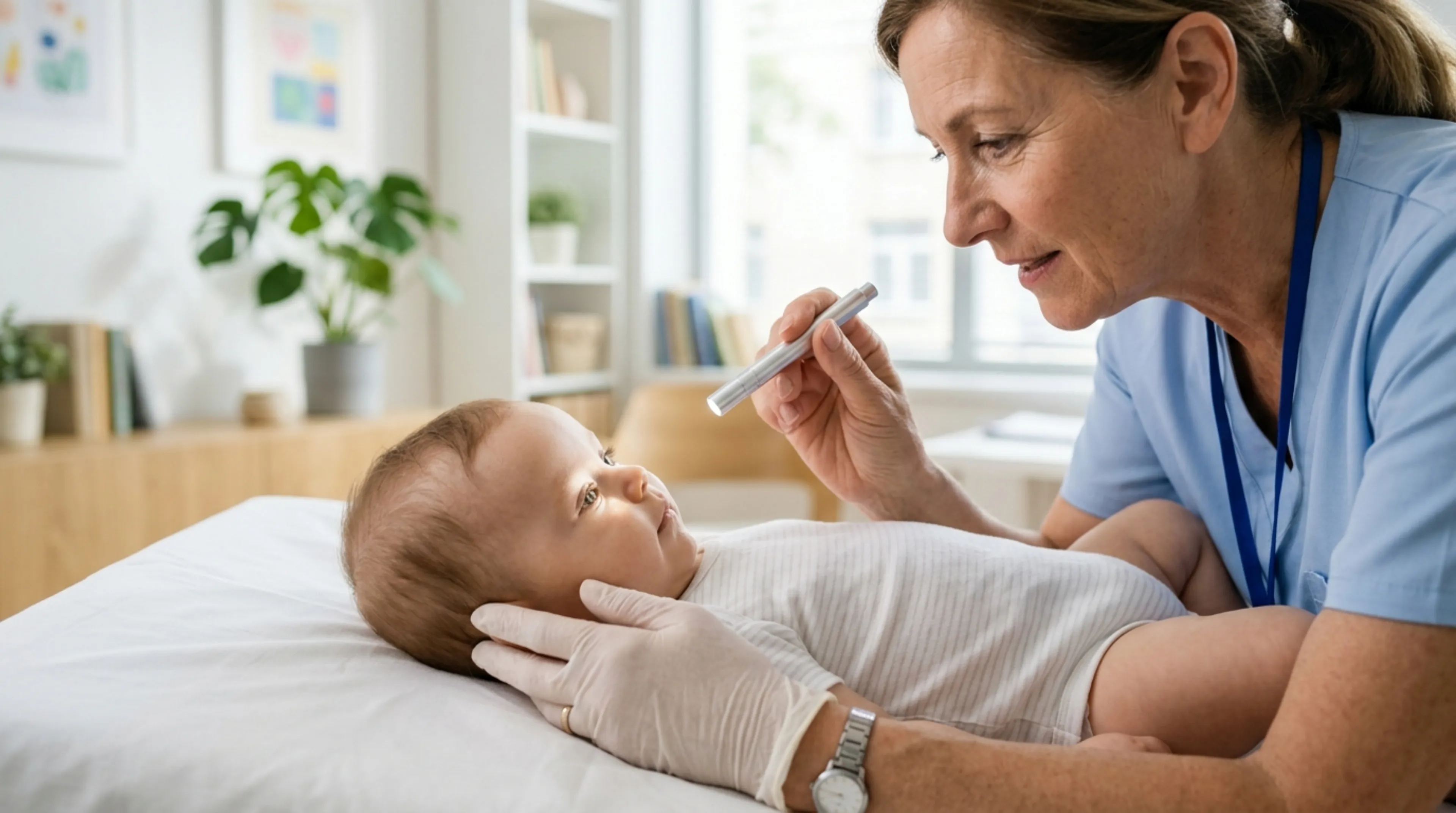
A specialist does not need your child to read letters. Paediatric ophthalmologists use light, lenses, and the baby's natural visual responses to get a clear picture of eye health at any age.

Contraindications and Precautions for Infant Eye Care Products

Never apply adult eye drops or any over-the-counter eye preparation to a baby's eyes without explicit guidance from a doctor or pharmacist. Infant eyes are sensitive and still developing, and adult formulations can cause serious irritation or harm.

Key points for safe infant eye care:

  • All eye drops and ointments for infants require a paediatrician's or ophthalmologist's prescription. This includes antibiotic drops, anti-allergy preparations, and lubricating drops.
  • Do not use drops labelled for adults or older children in infants, even if the condition appears similar.
  • Homemade remedies such as breast milk dropped into the eye or herbal preparations are not recommended as substitutes for medical treatment.
  • If your baby has a known allergy to any medication or preservative, inform the prescribing doctor before any eye preparation is used.

If your baby experiences unusual redness, swelling, increased discharge, or distress after any eye product is applied, stop using it immediately. Report adverse events to your healthcare provider or the relevant regulatory authority.

For broader guidance on looking after your newborn, including skin, cord, and general hygiene care, see newborn care basics beyond eye health.

Conclusion

Infant vision develops rapidly during the first year, progressing from limited, blurry vision in the newborn period to improved focus, colour perception, depth perception, and hand-eye coordination. Understanding typical visual milestones can help parents recognise normal development and identify signs that may need medical attention. Persistent eye crossing, poor eye contact or tracking, unusual light sensitivity, or a white pupil reflex should not be ignored. Regular eye screening and prompt evaluation of warning signs can help protect your baby's developing vision. Always consult a paediatrician or paediatric ophthalmologist if you have concerns about your baby's eyes.
FAQS

When can babies see clearly?

Babies achieve rough adult-level visual sharpness gradually, with most reaching near-normal clarity somewhere between one and two years of age. In the early weeks, vision is blurry beyond 20 to 30 centimetres, but it improves steadily month by month as the retina and brain mature.

Why do my baby's eyes look crossed sometimes?

Occasional crossing in the first six to eight weeks is normal, because the eye muscles are still developing coordination. If the crossing is constant, or if it persists beyond four months of age, have your baby evaluated by a paediatrician or paediatric ophthalmologist to rule out strabismus.

Is tummy time good for infant vision?

Yes. Tummy time encourages a baby to lift their head and track objects at varying distances, which strengthens eye-muscle coordination and supports depth perception. Even short, supervised sessions each day contribute to overall visual and motor development.

Can infants see colour at birth?

Newborns can detect some colour, but their colour vision is limited and muted. They are most responsive to high-contrast black-and-white patterns in the early weeks. By around four to six months, colour vision has developed to roughly adult levels.

What causes watery eyes in newborns?

The most common cause is a blocked nasolacrimal (tear) duct, which affects a significant number of newborns and usually resolves on its own within the first year. Persistent or worsening tearing, or tearing accompanied by redness and discharge, should be reviewed by a doctor.

Apollo 247 Floating Action Button