
0
Welcome User
Login/Sign Up

Login/Sign Up
₹18
(Inclusive of all Taxes)
₹13 with coupons & bank offers*
Get Free delivery (₹99) with
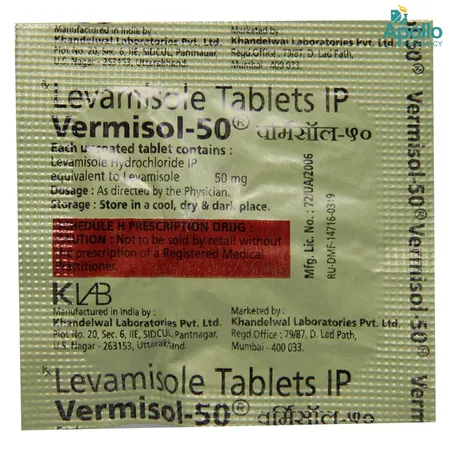
Vermisol 50 Tablet belongs to a class 'anti-parasitic', primarily used for the treatment of roundworm and hookworm infections. Roundworms are parasites that live in your intestine and cause ascariasis (an infection of the small intestine caused by Ascaris lumbricoides, which is a species of roundworm). It also causes infection in the lungs. Hookworms are parasites; they live on other living things and cause ancylostomiasis (an infection of the small intestine caused by ancylostoma, a hookworm species), and it also causes infection in the lungs and skin.
Vermisol 50 Tablet is composed of 'levamisole'. It works by suppressing the enzyme activity in the worm's muscle; this leads to paralysis and death. In this way, it kills worms and treats your infection.
You are advised to take Vermisol 50 Tablet for as long as your doctor has prescribed it for you, depending upon your medical condition. The most common side effects of a Vermisol 50 Tablet include headache, dizziness, vomiting, nausea, and abdominal pain. These side effects resolve on their own. However, if the side effects are persistent, stop the medicine and consult your doctor immediately.
Before starting Vermisol 50 Tablet inform your doctor if you are allergic to Vermisol 50 Tablet or any other medications. Inform your doctor if you are taking any prescription or nonprescription medications, herbal or dietary supplements. Use the Vermisol 50 Tablet as advised by your doctor. Tell your doctor if you are pregnant or planning to get pregnant or breastfeeding. Do not recommend the Vermisol 50 Tablet to kidney disease, liver disease and pre-existing blood disorders.
Vermisol 50 Tablet is used in the treatment of Ascariasis, Ancylostomiasis and Mixed ascariasis-hook worm infections. The detailed uses of Vermisol 50 Tablet are as follows:
Vermisol 50 Tablet is composed of 'levamisole' belonging to a class 'anti-parasitic', primarily used for treating roundworm and hookworm infections. It works by suppressing the enzyme activity in the worm's muscle; this leads to paralysis and death. In this way, it kills worms and treats your infection. Vermisol 50 Tablet is also used in the treatment of mixed ascariasis hookworm infections. It is also used in colon cancer in combination with cancer medicine to work effectively against colon cancer.
Unsafe
Vermisol 50 Tablet is not recommended with the consumption of alcohol while receiving this medicine since it may increase the risk of adverse effects such as severe headaches, nausea, vomiting, dizziness, etc.
Caution
Vermisol 50 Tablet is not recommended for use in pregnant women unless absolutely necessary. All the risks and benefits should be discussed with the doctor before taking this medicine. Your doctor may prescribe a suitable alternative based on your clinical condition.
Caution
Vermisol 50 Tablet is not recommended for use in breastfeeding women unless absolutely necessary. All the risks and benefits should be discussed with the doctor before taking this medicine. Your doctor may prescribe a suitable alternative based on your clinical condition
Caution
Use of this may cause symptoms such as dizziness, sleepiness, etc., in some patients. It is advised that you do not perform any activities such as driving a vehicle or operating machinery if you experience any of these symptoms.
Caution
Vermisol 50 Tablet should be used with caution in patients with a history of liver diseases due to the increased risk of severe adverse effects. Regular monitoring of liver function tests, appropriate dose adjustments or replacement with a suitable alternative may be required in some cases based on the clinical condition of the patient.
Caution
Vermisol 50 Tablet should be used with caution in patients with a history of kidney diseases due to the increased risk of severe adverse effects. Regular monitoring of kidney function tests, appropriate dose adjustments or replacement with a suitable alternative may be required in some cases based on the clinical condition of the patient.
Caution
Vermisol 50 Tablet should be prescribed by the advice of your doctor. Because dose adjustments were done based on the height and weight of the child.
Unsafe
This medicine is not recommended for cardiac patients due to its adverse effects.
Consult your doctor
It is unknown, whether Vermisol 50 Tablet is safe for use in geriatric patients or not. Please consult your physician.
Wash your hands with soap and water before handling food.
Teach children the importance of washing hands to prevent infection.
Wash, peel or cook all raw vegetables and fruits before eating, particularly those that have been grown in soil that has been fertilized with manure.
Take milk, papaya, nuts, oats, eggs into your regular diet.
Eat berries, fish, veggies.
Avoid oily food and spicy foods.
Have a query?
Before starting Vermisol 50 Tablet inform your doctor if you are allergic to Vermisol 50 Tablet or any other medications. Inform your doctor if you are taking any prescription or nonprescription medications, herbal or dietary supplements. Use the Vermisol 50 Tablet as advised by your doctor. Tell your doctor if you are pregnant or planning to get pregnant or breastfeeding. Do not recommend the Vermisol 50 Tablet to kidney disease, liver disease and pre-existing blood disorders. This Vermisol 50 Tablet should be used with caution in patients with a history of liver diseases, kidney diseases due to the increased risk of severe adverse effects. Vermisol 50 Tablet is also not recommended in rheumatoid arthritis. Caution should be taken while using Vermisol 50 Tablet in Sjogren's syndrome ( disorder of your immune system identified by its two most common symptoms — dry eyes and a dry mouth).
Drug-Drug Interactions: Vermisol 50 Tablet may interact with anti-helminthics (albendazole, ivermectin),anti-cancer drugs (doxifluridine, capecitibine), antiepileptic drugs (phenytoin) and anti-coagulants (heparin, warfarin).
Drug-Food Interactions: Vermisol 50 Tablet may interact with alcohol.
Drug-Disease Interactions: Vermisol 50 Tablet should be used with caution in patients with kidney problems, liver problems, rheumatoid arthritis and Sjogren's syndrome.
Login/Sign Up
Login/Sign Up
Disclaimer


