
0
Welcome User
Login/Sign Up

Login/Sign Up
₹116.5
(Inclusive of all Taxes)
₹86 with coupons & bank offers*
Get Free delivery (₹99) with
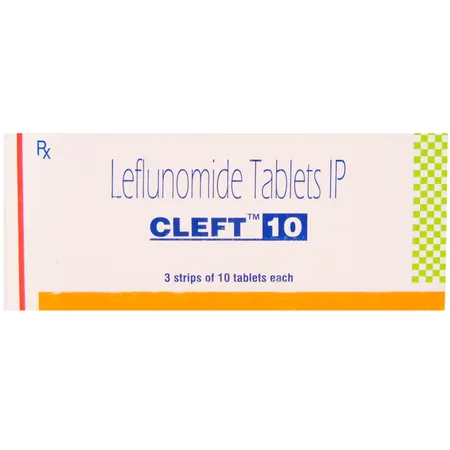
Cleft 10 Tablet is a prescription medication primarily used to treat active rheumatoid arthritis in adults. It belongs to a class of medicines known as disease-modifying antirheumatic drugs (DMARDs), which help control swelling, pain, and stiffness in your joints. By managing these chronic symptoms, this medicine helps prevent long-term joint damage and assists you in maintaining your daily physical function.
To get the most benefit, you must take Cleft 10 Tablet consistently every day, exactly as prescribed by your healthcare provider. You can take this tablet with or without food, but taking it at the same time each day will help you build a reliable routine. Making healthy adjustments, such as eating a balanced diet and doing gentle, joint-friendly exercises, can support your treatment outcomes.
While taking Cleft 10 Tablet , some people may experience mild side effects like diarrhoea, nausea, or temporary hair thinning. However, you must contact your doctor immediately if you notice serious symptoms such as yellowing of your eyes or skin, dark urine, or unusual tiredness, as these could indicate liver damage.
Do not take this if you are pregnant, planning to become pregnant, or breastfeeding, as this medicine can cause severe harm to an unborn baby. Before starting Cleft 10 Tablet , talk to your doctor if you have a history of liver disease, severe infections, kidney problems, or a weakened immune system.
This medicine can interact with certain other drugs, alcohol, and live vaccinations, which may increase your risk of liver issues or serious infections. Because of these risks, elderly individuals and people with pre-existing medical conditions should talk to their doctor or pharmacist before starting treatment to ensure it is safe for them.
Cleft 10 Tablet may be prescribed for the following inflammatory joint conditions:
Cleft 10 Tablet helps control inflammation and slow disease progression in certain autoimmune joint disorders. Its benefits may include:
To use Cleft 10 Tablet safely and effectively, follow these instructions:
Always follow your doctor's exact instructions. Do not stop taking this medication suddenly without consulting your doctor first, even if you begin to feel better.
Unsafe
You are recommended to avoid alcohol consumption while taking Cleft 10 Tablet . Alcohol intake, along with Cleft 10 Tablet , may cause liver disease.
Unsafe
It is not recommended to take Cleft 10 Tablet while you are pregnant. Cleft 10 Tablet may cause serious birth defects.
Unsafe
It is not recommended to take Cleft 10 Tablet while you are breastfeeding. Cleft 10 Tablet passes into breast milk.
Caution
Cleft 10 Tablet may cause dizziness and tiredness; do not drive or operate heavy machinery if you feel dizzy.
Consult your doctor
Please consult your doctor if you have liver impairment before taking Cleft 10 Tablet .
Consult your doctor
Please consult your doctor if you have kidney impairment before taking Cleft 10 Tablet .
Unsafe
Cleft 10 Tablet is not approved for children under the age of 18 years.
Unsafe
Avoid taking Cleft 10 Tablet if you have any cardiac problems. If prescried, caution should be exercised while taking Cleft 10 Tablet .
Consult your doctor
Please consult a doctor before giving Cleft 10 Tablet to geriatric patients.
Have a query?
The time required for Cleft 10 Tablet to start to work: Cleft 10 Tablet starts working within 4 weeks of treatment. However, it might take four to six months to feel the full effect of the drug.
The time for which the effects of Cleft 10 Tablet last: The duration of action for Cleft 10 Tablet is unknown.
Drug-Drug Interactions
Inform your doctor if you are taking any of the following medicines, as they may interact with Cleft 10 Tablet :
Drug-Food Interactions
The following food and drink interactions may affect the safety of Cleft 10 Tablet :
Drug-Disease Interactions
Inform your doctor if you have a history of the following conditions before taking Cleft 10 Tablet , as it may worsen your condition or cause complications:
Login/Sign Up
Login/Sign Up
Disclaimer


