
0
Welcome User
Login/Sign Up

Login/Sign Up
₹264.5
(Inclusive of all Taxes)
Get Free delivery (₹99) with
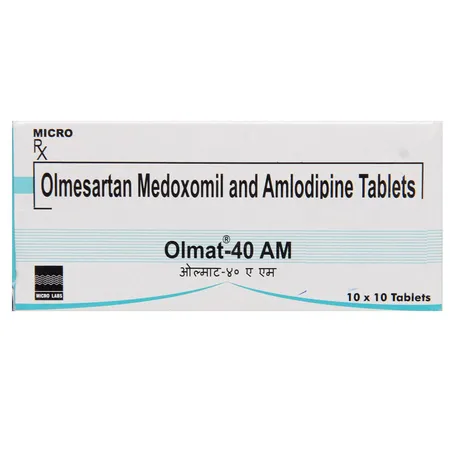
Olmat-40 AM Tablet is a prescription medication used to treat high blood pressure, also known as hypertension. By lowering elevated blood pressure, this medication helps reduce the risk of serious cardiovascular events such as strokes and heart attacks. It is designed for daily, long-term management of high blood pressure.
To achieve the best results, you should take Olmat-40 AM Tablet consistently at the same time every day, either with or without food. Combining this daily treatment with healthy lifestyle modifications, such as eating a low-salt diet and staying physically active, will greatly support your treatment goals.
While taking Olmat-40 AM Tablet , some people may experience mild side effects like ankle swelling or dizziness. However, if you develop rare but serious symptoms like severe chest pain, a rapid heartbeat, or signs of an allergic reaction, seek immediate medical attention and consult your doctor.
Before starting this medication, talk to your doctor if you have a history of kidney disease, liver damage, heart conditions, or severe dehydration. Do not take this if you are pregnant, planning to become pregnant, or breastfeeding, as it can cause severe harm to an unborn baby.
Olmat-40 AM Tablet can interact with other substances, including potassium supplements, water pills, certain pain relievers, and alcohol, which can cause unsafe drops in blood pressure or kidney issues. If you are an older adult, your doctor may want to monitor your kidney function and blood pressure closely when you begin taking this medicine.
Olmat-40 AM Tablet is prescribed to help control high blood pressure and reduce the risk of complications associated with hypertension, including:
Olmat-40 AM Tablet provides several important benefits for individuals with hypertension, including:
Take Olmat-40 AM Tablet exactly as prescribed by your doctor. Follow these step-by-step instructions for safe use:Take Olmat-40 AM Tablet exactly as prescribed by your doctor. Follow these step-by-step instructions for safe usTake Olmat-40 AM Tablet exactly as prescribed by your doctor. Follow these step-by-step instructions for safe use:
Swallow the tablet whole with a full glass of water. Do not crush, chew, or break the tablet.
You can take this medication with or without food, but try to take it at the same time every day to maintain a steady level of the medicine in your body.
Do not change your dose or stop taking this medication without consulting your healthcare provider, even if you feel completely well.
Unsafe
You are recommended not to consume alcohol along with Olmat-40 AM Tablet to avoid unpleasant side effects.
Unsafe
Olmat-40 AM Tablet is not recommended for use in pregnancy as it may harm your foetus. Please consult your doctor.
Unsafe
Olmat-40 AM Tablet is not recommended for breastfeeding mothers. It is excreted into milk in small amounts and is cleared slowly. It can accumulate in infants, especially newborns or preterm infants. Lactation might also be suppressed due to the effect of Olmat-40 AM Tablet .
Unsafe
Driving after taking Olmat-40 AM Tablet is not recommended as it may occasionally cause drowsiness or fatigue.
Caution
Olmat-40 AM Tablet to be taken with caution, especially if you have a liver disease history.
Caution
Olmat-40 AM Tablet to be taken with caution, especially if you have a history of kidney diseases. The dose may have to be adjusted by your doctor.
Unsafe
Use of Olmat-40 AM Tablet in children less than 12 years of age is not recommended, as the safety and efficacy of Olmat-40 AM Tablet in these age groups have not yet been established.
Caution
Olmat-40 AM Tablet should be used with caution in patients with heart problems. Inform your doctor about any heart-related conditions before taking Olmat-40 AM Tablet .
Caution
Olmat-40 AM Tablet should be given with caution in elderly patients due to an increased risk of side effects. It is important to inform your doctor before using it.
Have a query?
Drug-Drug Interactions
Olmat-40 AM Tablet may interact with certain medications, potentially affecting its effectiveness or increasing the risk of side effects. Inform your doctor about all medicines, supplements, and herbal products you are taking, including:
Drug-Food Interactions
Certain foods and beverages may influence the effects of Olmat-40 AM Tablet . Consider the following precautions:
Drug-Disease Interactions
Certain medical conditions may require special precautions or closer monitoring while taking Olmat-40 AM Tablet . Tell your doctor if you have any of the following:
Login/Sign Up
Login/Sign Up
Troikaa Pharmaceuticals Ltd
₹262
(₹17.47 per unit)
Mankind Pharma Pvt Ltd
₹191.5
(₹19.15 per unit)
Hbc Life Sciences Pvt Ltd
₹317.5
(₹21.17 per unit)
Disclaimer


