logo
0

Choking Prevention for Babies: Food Safety Guide

Learn how to prevent choking in babies with safe food preparation, age-appropriate textures, suitable foods and essential feeding safety tips.

article image

Dr. Mayank

Starting solid foods is an exciting milestone in your baby’s life, but it can also bring a lot of anxiety for parents and caregivers. As you transition your little one from breast milk or formula to purees and finger foods, safety is undoubtedly your top priority. Many parents worry about gagging, coughing, and the ultimate emergency: what to do if the baby is choking on food.

While it is entirely normal to feel nervous, equipping yourself with the right knowledge is the best way to build confidence. By understanding how to prepare foods safely, recognising the difference between normal gagging and true choking, and knowing how to respond in an emergency, you can protect your baby and enjoy this beautiful new stage of their development.

In this comprehensive guide, we will cover everything you need to know about choking prevention, safe food preparation, and the exact steps to take if an emergency arises.

Gagging vs. Choking: Knowing the Difference

Before diving into safety steps, it is vital to understand the difference between gagging and choking. New parents often confuse the two, which can lead to unnecessary panic or, conversely, a delayed response during a real emergency.

What is Gagging?

Gagging is a normal, healthy, and protective reflex. When a baby is learning how to chew and swallow, food can sometimes travel too far back on their tongue. The gag reflex pushes the food forward to prevent swallowing it whole.

  • What it looks like: Your baby’s face may turn slightly red, they may make retching or coughing sounds, and they might even spit up a small amount of food.
  • What to do: Stay calm and let them work it out. Gagging is actually a protective reflex that helps prevent a baby choking on food. Do not stick your fingers in your baby's mouth, as this can accidentally push the food further down their throat.

What is Choking?

Choking occurs when an object or piece of food physically blocks the airway, making it difficult or impossible for the baby to breathe. This is a life-threatening medical emergency.

  • What it looks like: The baby is silent or making very faint, high-pitched squeaking noises. They are unable to cry, cough effectively, or breathe. Their skin, lips, or fingernails may begin to turn blue or pale, and they will look panicked.
  • What to do: You must act immediately.

Step-by-Step Guide: What to Do if Baby is Choking on Food

Knowing exactly what to do if a baby is choking on food can feel overwhelming, but breaking it down into simple, memorable steps can help you stay calm and act fast. The following instructions are designed for babies under the age of one (12 months).

Note: If the baby is coughing strongly or crying, their airway is not fully blocked. Encourage them to keep coughing to clear the blockage on their own. If they cannot make sound, cry, or breathe, follow these emergency steps immediately.

Step 1: Call for Help

If you are not alone, loudly instruct someone else to call 911 (or your local emergency number) immediately while you begin first aid. If you are alone, perform 2 minutes of care (the steps below) before stopping to call 911 yourself.

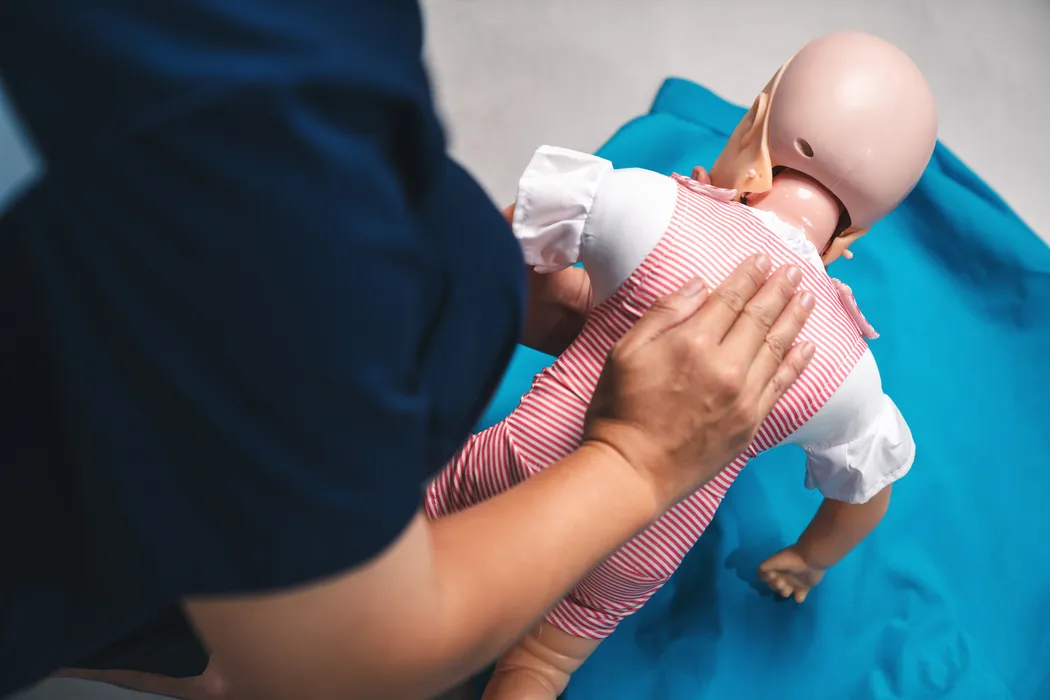
Step 2: Position the Baby for Back Blows

  • Place the baby face-down along your forearm.
  • Support the baby’s head and jaw with your hand. Be careful not to compress the soft tissues of their throat.
  • Angle the baby so that their head is lower than their chest.
  • Rest your forearm on your thigh for added support and stability.

Step 3: Deliver 5 Back Blows

  • Using the heel of your free hand, deliver 5 firm, distinct blows to the baby's back, right between their shoulder blades.
  • Each blow should be a separate, forceful attempt to dislodge the obstruction.

Step 4: Position the Baby for Chest Thrusts

  • If the food does not come out after 5 back blows, place your free hand on the back of the baby’s head, supporting their spine.
  • Carefully roll the baby over so they are now face-up along your forearm, still keeping their head lower than their chest.
  • Rest your forearm on your thigh.

Step 5: Deliver 5 Chest Thrusts

  • Locate the breastbone, right in the centre of the baby's chest (just below the nipple line).
  • Place two fingers (index and middle fingers) in the center of their chest.
  • Press down firmly and quickly, compressing the chest about 1.5 inches (about one-third to one-half the depth of the chest).
  • Deliver 5 rapid chest thrusts.

Step 6: Repeat the Cycle

  • Continue alternating between 5 back blows and 5 chest thrusts until the object is successfully spit out, or until the baby can breathe, cough, or cry.
  • This sequence is the gold standard for what to do if a baby is choking on food when they are conscious.

If the Baby Becomes Unresponsive

  • Place the Baby Safely: If the baby becomes unresponsive, gently place them on a flat, firm surface.
  • Begin Infant CPR: Start infant CPR, alternating 30 chest compressions with 2 rescue breaths.
  • Check the Mouth: Each time you open the airway to give rescue breaths, look inside the baby’s mouth. If you can clearly see the food object, carefully remove it with your finger.
  • Never Perform a Blind Finger Sweep: Do not put your finger into the baby’s mouth unless you can see the object, as this may push the food deeper.
  • Call Emergency Services: If you are alone and have not already called 911, call after 2 minutes of CPR.

High-Risk Foods and How to Prepare Them Safely

Prevention is always the best medicine. Many choking incidents can be avoided simply by identifying high-risk foods and preparing them in a way that matches your baby's developmental stage.

The shape, size, and texture of certain foods make them naturally dangerous for young children. Here is a list of high-risk foods and how to safely prepare them to prevent a scary scenario of a baby choking on food.

High-Risk FoodThe DangerHow to Prepare It Safely
Grapes & Cherry TomatoesRound, firm foods can block a baby’s airway.Cut them lengthwise into quarters. Never serve them whole.
Hot Dogs & SausagesTheir cylindrical shape can act like a plug in the windpipe.Cut them lengthwise into thin strips, then chop them into small, bite-sized pieces.
Apples & Raw CarrotsHard, crunchy textures can be difficult for babies to chew.Steam, boil or bake until soft enough to mash easily between your fingers. Alternatively, grate them finely.
Whole Nuts & SeedsSmall, hard foods can be inhaled into the airway.Avoid whole nuts and seeds. Instead, use a thin spread of smooth nut butter, diluted if necessary.
Large Chunks of MeatTough, chewy pieces can be difficult for babies to break down.Purée meat, shred it very finely or offer moist, finely ground meat.
Sticky Foods (Thick Peanut Butter)Thick, sticky foods can make swallowing and breathing difficult.Never serve spoonfuls of peanut butter. Thin it out and spread it very sparingly on soft toast.

Safe Eating Environments and Feeding Habits

How and where your baby eats is just as important as what they eat. Establishing a safe eating environment reduces distractions and ensures your baby can focus entirely on swallowing. While prevention is key, knowing what to do if baby chokes on food keeps you in control during an emergency.

  • Always Supervise: Never leave your baby unattended while they are eating, even for a few seconds. Choking is silent, so you must keep your eyes on them at all times.
  • Sit Upright: Always feed your baby while they are sitting completely upright in a secured high chair. Never feed your baby while they are reclining, lying down, walking, crawling, or running.
  • Avoid Distractions: Keep the dining area calm. Turn off televisions and tablets, and avoid giving your baby toys while they eat. Distracted chewing increases the risk of accidental inhalation.
  • No Car or Stroller Feeding: Avoid giving your baby snacks while they are in a moving vehicle or stroller. If they begin to choke, it can be extremely difficult to pull over, get them out of their seat, and administer aid in time.
  • Let Them Pace Themselves: Encourage your baby to eat slowly. Do not force-feed them or rush them through their meal.

How to Safely Introduce Solids

Whether you choose traditional purees or baby-led weaning (BLW), introducing solids should be a gradual, positive process.

Baby-Led Weaning vs. Purees

Traditional weaning starts with smooth purees, slowly introducing thicker textures over time. Baby-led weaning skips purees entirely, offering soft, baby-finger-sized pieces of whole foods from the start.

Studies show that there is no significant difference in choking rates between babies fed purees and those who follow baby-led weaning, provided the foods are prepared safely. Regardless of the method you choose, understanding the immediate steps of what to do if baby chokes on food is critical.

Signs of Readiness

Only introduce solids when your baby shows clear developmental signs of readiness, which typically occurs around 6 months of age:

  • They can sit up with little to no support and have good head control.
  • They have lost the tongue-thrust reflex (automatically pushing food out of their mouth with their tongue).
  • They show curiosity about food, reaching for your plate or watching you chew.

Conclusion

Choking prevention is an essential part of introducing solid foods to babies. Parents and caregivers can reduce the risk by preparing foods according to the baby's developmental stage, avoiding common choking hazards and always supervising meals. It is also important to understand the difference between gagging and choking and to know how to respond quickly during an emergency. Taking an infant CPR and first-aid course can provide valuable hands-on preparation and confidence for handling a choking emergency.

FAQS

What is the most common food babies choke on?

Hard, round, sticky, or highly chewable foods are the most common choking hazards. This includes whole grapes, hard candies, popcorn, hot dogs, whole nuts, and large chunks of meat or cheese. Always cut round foods into quarters and cook hard fruits and vegetables until soft.

Should I try to scoop food out of my baby's mouth if they are gagging?

No. If your baby is gagging or coughing, their natural reflexes are working to clear the food. Sticking your finger into their mouth (a blind finger sweep) can accidentally push the food further down, turning a harmless gag into a dangerous choke. Only swipe their mouth if you can clearly see the object and easily retrieve it.

How do I know if my baby is gagging or choking?

Gagging is loud and active; your baby will cough, sputter, and make noise, and their face may turn red. Choking is quiet and silent; your baby will be unable to cry, cough, or breathe, and their skin or lips may turn blue.

What should I do if my baby becomes unconscious from choking?

Gently place the baby on a hard, flat surface and begin infant CPR (30 chest compressions followed by 2 rescue breaths). Look inside their mouth before giving breaths, and remove any visible blockages. If you are alone, perform CPR for 2 minutes before calling 911.

How can I prepare myself so I know what to do if the baby is choking on food?

The best way to prepare is by taking a certified infant CPR and first-aid class through organizations like the American Red Cross or the American Heart Association. Having hands-on practice with a mannequin will give you the muscle memory and confidence needed to act quickly in an emergency.

Apollo 247 Floating Action Button