logo
0

Infant Development by Month: 0-12 Month Milestones Guide

Track infant development by month with pediatrician-reviewed milestones for motor, speech, and social growth from newborn to 12 months.
 

article image

Dr. J.T.Hema Prathima

Tracking infant development by month is one of the most reassuring and sometimes nerve-wracking parts of early parenthood. Understanding what your baby is expected to do at each stage helps you celebrate real progress, spot potential concerns early, and have more informed conversations with your pediatrician. Every baby moves at their own pace, but knowing the general pattern gives you a useful roadmap through the first remarkable year.

How Infant Development Is Tracked Month by Month

Pediatricians look at four broad domains when assessing baby milestones by month:

  • Motor skills cover both gross motor (head control, rolling, sitting, walking) and fine motor (grasping, pincer grip).
  • Cognitive development includes how your baby learns, remembers, solves simple problems, and understands cause and effect.
  • Language tracks babbling, responding to sound, and eventually saying recognizable words.
  • Social and emotional growth covers smiling, making eye contact, showing attachment, and managing feelings.

At well-baby visits, your doctor uses standardized screening tools to compare your child's progress against a broad normal range. These are not pass-or-fail tests. Healthy babies can reach the same milestone weeks apart and still be developing perfectly well. An infant growth chart month wise tracks physical measurements like weight and length separately from these developmental checks, though doctors review both together at each visit. What matters most across all four domains is a general forward momentum over time, not hitting every marker on a fixed date.

Newborn to 3 Months: Early Reflexes and Bonding

The newborn stage is dominated by survival reflexes. Your baby arrives wired for feeding, comfort, and connection.

At 1 month, a newborn can:

  • Turn toward anything that touches the cheek (rooting reflex), which helps with feeding.
  • Throw the arms wide in response to a sudden sound or sensation (Moro or startle reflex).
  • Curl the fingers tightly around anything placed in the palm.
  • Track a slow-moving face or high-contrast object with the eyes for a few seconds.
  • Recognize a parent's voice and briefly quiet to it.

Head control is minimal at birth but improves quickly. By 6 to 8 weeks, most babies begin lifting their head briefly during tummy time, a skill that underpins every motor milestone that follows.

The social smile typically appears between 6 and 8 weeks. This is different from the early reflexive smiles seen in sleep; a social smile is a deliberate response to seeing your face or hearing your voice. It is one of the most meaningful moments in early bonding.

By 3 months, many babies can hold their head steady when held upright, bat at dangling objects, and coo back and forth in an early conversational rhythm. This is also a good time to get comfortable with basic newborn care routines, including newborn belly button care in the first weeks, which is easy to overlook in the chaos of new parenthood.

4 to 6 Months: Rolling, Reaching, and Babbling

This window brings visible, exciting leaps. Babies become more physically active and start interacting with the world beyond their caregivers.

Rolling over usually begins between 4 and 5 months, typically from tummy to back first because it requires less strength. Rolling from back to tummy follows around 5 to 6 months. Some babies skip or delay rolling and still develop normally, but mention it to your doctor if it has not happened by 6 months.

Fine motor skills sharpen quickly. By 5 months, most babies can deliberately reach for and grasp objects, transfer them from hand to hand, and bring everything straight to their mouths. Close supervision becomes essential from this point on.

Babbling begins in earnest around 4 to 6 months. You will hear strings of vowel sounds ("ah," "oh") and early consonant-vowel combinations ("ba," "ma"). Babies this age also start laughing out loud, a genuine social response to tickling or playful faces.

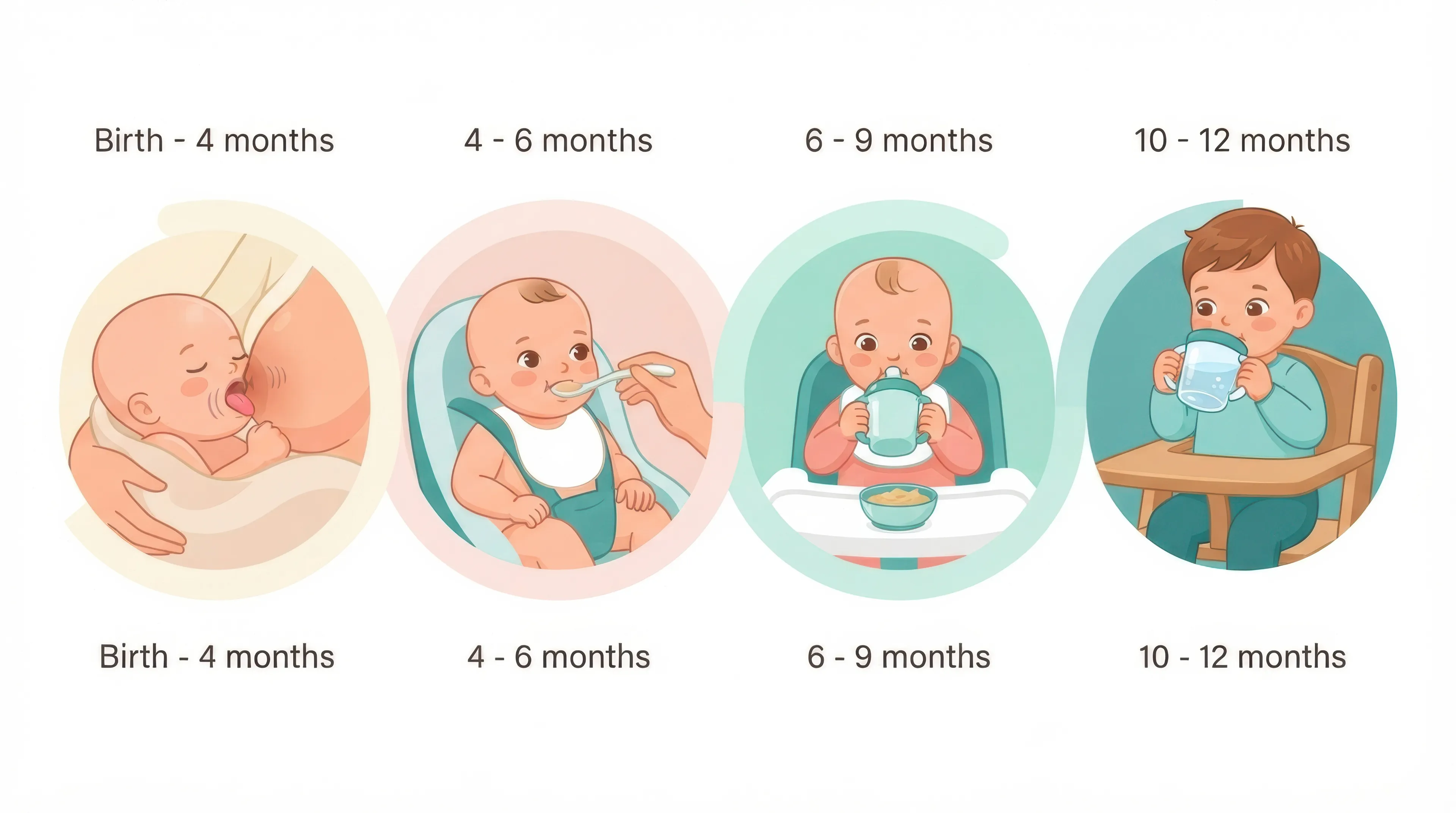
On starting solids: most guidelines suggest babies show readiness around 6 months, not earlier. Signs of readiness include sitting with minimal support, showing interest in food, and losing the tongue-thrust reflex that automatically pushes food out. Always discuss timing with your pediatrician before introducing solids; a month or two either way can matter.

7 to 9 Months: Sitting, Crawling, and Object Permanence

Between 7 and 9 months, your baby becomes genuinely mobile and mentally much more complex.

Sitting unsupported typically consolidates around 7 to 8 months. Once seated independently, babies can use both hands to explore objects rather than bracing themselves for balance.

Crawling usually begins between 7 and 10 months. Classic hands-and-knees crawling is the most common pattern, but some babies bottom-shuffle, army-crawl on their elbows, or skip crawling altogether and move straight to pulling up and walking. All of these are within the normal range. What matters is that your baby is finding a way to move around independently.

Object permanence is a key cognitive leap during these 0 to 12 months milestones. Before about 6 to 7 months, a baby believes something simply ceases to exist when it disappears from view. By 8 to 9 months, they understand that a hidden object still exists and will actively search for it. This is why peek-a-boo suddenly becomes far more exciting at this age.

Stranger anxiety and separation distress also peak during this phase. A baby who was previously happy with anyone may now cry when passed to unfamiliar relatives. This is entirely normal and a healthy sign of secure attachment, not a behavioral problem.

The pincer grasp, using the thumb and index finger to pick up small objects, begins emerging around 8 to 9 months. Keep small objects off the floor; a baby practicing this grip will pick up anything within reach.

10 to 12 Months: Standing, First Words, and Walking Cues

The final stretch of the first year brings dramatic independence.
Most babies pull themselves to a standing position using furniture between 9 and 11 months. Cruising, moving sideways along furniture while holding on, typically follows within a few weeks. These movements build the leg strength and balance needed for independent steps.

First words usually emerge between 10 and 14 months. A "word" at this stage means any consistent sound used to mean the same thing ("mama," "baba," "dada" directed meaningfully, not just as babble). By 12 months, most babies have one to three recognizable words. Pointing, either to request something or to share interest in it, also appears around this time and is an important communication milestone.

Walking independently has a wide normal range, anywhere from 9 to 18 months. A baby who is cruising confidently at 12 months is on track even if they have not yet let go. Premature infants are assessed against their corrected age, not birth date. If your baby is not pulling to stand by 12 months, raise it with your doctor.

Signs of Developmental Delay to Discuss With a Pediatrician

Baby developmental delay signs can show up in any of the four domains. The following are red flags that warrant a conversation with your pediatrician, not necessarily a diagnosis, but a prompt for closer evaluation.

Motor red flags:

  • Not lifting the head at all during tummy time by 3 months.
  • Not reaching for objects by 5 to 6 months.
  • Not sitting with support by 9 months.
  • Not pulling to stand by 12 months.

Language and cognitive red flags:

  • Not responding to their own name by 9 months.
  • No babbling by 9 months.
  • No single meaningful words by 16 months.
  • Loss of a previously acquired skill at any age (this is always worth reporting immediately).

Social red flags:

  • No social smile by 3 months.
  • Little to no eye contact by 3 to 4 months.
  • No interest in faces or familiar voices by 6 months.

Recognizing baby developmental delay signs early gives families access to early intervention services, which are most effective when started young. If something feels off, trust your instinct and speak to your doctor. These indicators are not a diagnostic tool; only a qualified professional can assess your child fully.

Contraindications and Safety Considerations

As babies grow, parents are sometimes offered supplements, teething gels, gripe water, or other products marketed around developmental stages. A few important cautions:

  • Teething gels containing benzocaine are not recommended for infants. Ask your pharmacist for alternatives that are age-appropriate.
  • Iron, vitamin D, and other supplements should only be given on a pediatrician's advice. Dosing in infants is weight-sensitive, and over-supplementation carries real risks.
  • Probiotic drops, omega-3 products, and herbal preparations are not universally safe for all infants. Certain conditions, including immune disorders or a history of premature birth, may be contraindications. Always confirm with your doctor before starting anything.
  • Baby development supplements are not regulated with the same rigor as medications. "Natural" does not mean safe for a developing infant.

Report adverse events related to any product, supplement, or medication to your healthcare provider or the relevant regulatory authority.

Conclusion

The first year of life brings remarkable changes in a baby's motor skills, communication, learning and social development. From early reflexes and the first social smile to sitting, crawling, standing and saying initial words, each milestone offers insight into how your baby is growing. However, developmental timelines are guides rather than strict deadlines, and healthy babies may reach milestones at different ages. You can support progress through responsive interaction, talking, reading, supervised tummy time and age-appropriate play. Keep track of your baby's development during routine check-ups, and discuss any concerns or loss of previously acquired skills with your paediatrician promptly. Early assessment and intervention can make a meaningful difference when additional support is needed.

FAQS

What is the average milestone chart for 0 to 12 months?

A month wise baby milestones overview: newborns reflex-feed and startle; by 3 months they smile and coo; by 6 months they roll, babble, and grasp; by 9 months they sit and may crawl; by 12 months most cruise along furniture, point, and say a word or two. These are averages, and healthy babies vary by several weeks on either side.

Is it normal for babies to develop at different rates?

Yes, there is a broad normal range for almost every milestone. Genetics, temperament, birth order, and whether a baby was premature all influence timing. The key is consistent forward progress across motor, language, cognitive, and social domains, not hitting each milestone on a specific date.

What milestones should a baby reach by 6 months?

By 6 months, most babies can roll (at least one direction), sit briefly with support, reach and grasp objects deliberately, babble consonant-vowel sounds, and recognize familiar faces. These 0 to 12 months milestones are a general guide; bring any concerns to your pediatrician at the 6-month well-baby visit.

How can parents support infant development at home?

Talk to your baby constantly, narrate daily routines, and read aloud from the earliest weeks. Regular tummy time from birth builds the strength for rolling and crawling. Simple back-and-forth play, even just copying each other's sounds, supports both language and social growth without any special equipment.

When should a baby see a pediatrician for delayed milestones?

Any time you notice a red flag, such as no social smile by 3 months, no babbling by 9 months, or loss of a skill your baby previously had, bring it up at your next appointment or call sooner if you are worried. Early review is always better than waiting.

Apollo 247 Floating Action Button