logo
0

Infant Growth Month by Month: Weight, Length & Milestones

Track infant growth month by month, including expected weight, length, developmental milestones, growth patterns, and signs that may need medical attention.

article image

Dr.Rohini priyanaka

Every parent has felt that mix of wonder and worry when watching a newborn: is my baby growing the way they should? Tracking infant growth month by month is one of the most reassuring things you can do, because it turns vague anxiety into clear, measurable information. Weight, length, and developmental milestones together paint a picture of your baby's health, and knowing what to expect each month helps you catch genuine concerns early, including knowing when to worry about baby weight gain.

How Infant Growth Is Measured and Tracked

Paediatricians use three core measurements at every well-baby visit:

  • Weight is the most sensitive early indicator of nutrition and overall health.
  • Length (height) reflects skeletal growth over time.
  • Head circumference tracks brain and skull development.

These measurements are plotted on a growth chart. In India, most paediatricians use the WHO Child Growth Standards, developed from a diverse international population of healthy, breastfed infants.

The charts produce a percentile score, a baby on the 40th percentile for weight is heavier than 40% of babies the same age and lighter than 60%. Any percentile between the 3rd and 97th is generally considered within the normal range.

What matters more than hitting a specific percentile is consistency. A baby tracking steadily along the 15th percentile is growing just fine. A baby who drops sharply from the 70th to the 20th over a few months warrants a closer look. Head circumference is measured until about 24 months, and a rapidly changing measurement can signal problems that weight alone would not reveal.

Infant Growth Month by Month: 0-12 Months Benchmarks

The table below gives general ranges used in clinical practice. Individual babies vary, so treat these as orientation points, not rigid targets. These ranges reflect baby weight gain chart by month data used in standard paediatric practice, and a baby height and weight chart India version from your paediatrician's clinic will plot your child's individual curve against locally adapted WHO standards.

AgeAverage Weight GainAverage Length GainKey Notes
BirthBaselineBaselineMost babies lose 5% to 10% of birth weight in the first few days
1 month150 to 200 g/week3 to 4 cm totalShould regain birth weight by 10 to 14 days
2 months150 to 200 g/week3 to 4 cm totalWakeful periods lengthen; feeding frequency begins to settle
3 months150 g/week2 to 3 cm totalGrowth rate starts to slow slightly
4 months100 to 150 g/week2 cm totalRolls may begin; solids are still not recommended
5 months100 g/week2 cm totalMany babies roughly double their birth weight around this time
6 months85 to 100 g/week1.5 to 2 cm totalComplementary foods can begin around 6 months
7 to 8 months70 to 85 g/week1 to 1.5 cm/monthSitting, crawling attempts; appetite may vary
9 to 10 months50 to 70 g/week1 cm/monthPulling to stand; pincer grip developing
11 to 12 months40 to 50 g/week1 cm/monthMost babies triple their birth weight by 12 months

Weight gain naturally slows as babies become more mobile. A slower gain at 9 months compared to 2 months is entirely expected and is one of the most reassuring signs of healthy infant growth.

Also keep in mind practical day-to-day care during the newborn phase, such as newborn belly button care in the first weeks, which can affect your baby's comfort and feeding cues in the early days.

Developmental Milestones by Age

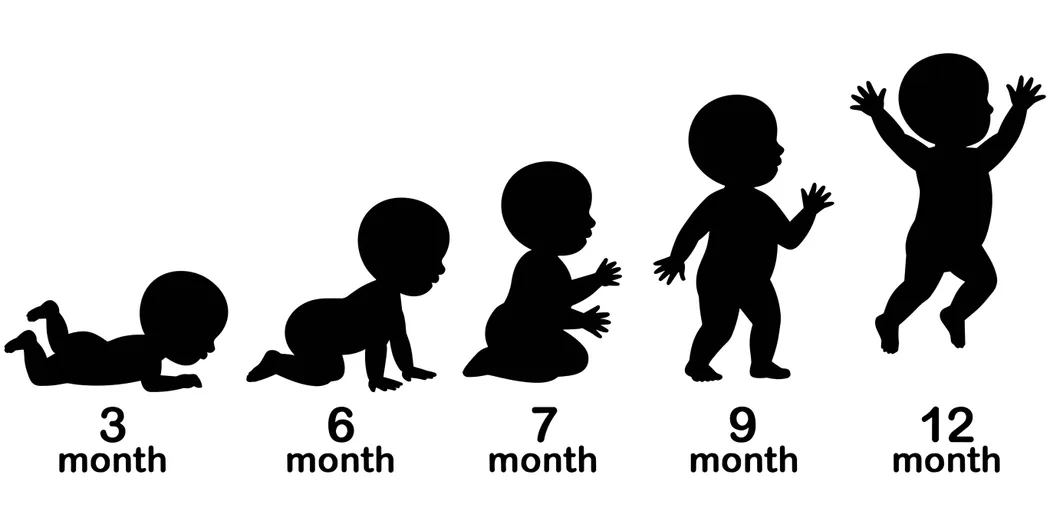
Growth is not only about weight and length. Infant developmental milestones by age cover motor skills, social responses, and early cognitive abilities. Below is a practical grouping by quarter.

0 to 3 Months

  • Lifts head briefly when placed on the tummy by 1 month; holds it steadily for several seconds by 3 months.
  • Responds to familiar voices and turns toward sound.
  • Social smiling appears around 6 to 8 weeks, an important early sign of healthy neurological development.
  • Tracks a moving face or object with the eyes.
  • Hands remain mostly fisted, but the grasp reflex is strong.

3 to 6 Months

  • Rolls from tummy to back, then back to tummy.
  • Reaches for and grasps objects; brings them to the mouth.
  • Laughs and babbles with consonant-vowel sounds ("ah", "goo").
  • Recognises familiar faces and shows clear preference for caregivers.
  • Holds head steady without support; mini push-up when on tummy.

6 to 9 Months

  • Sits independently, first briefly then with increasing stability.
  • Starts crawling or bottom-shuffling (the method varies widely).
  • Bangs objects together; explores texture and shape by mouthing.
  • Responds to their own name and shows stranger anxiety, which is a healthy attachment sign.

9 to 12 Months

  • Pulls to stand using furniture; cruises along furniture side-stepping.
  • Some babies take first independent steps; others walk at 14 to 15 months, which is still normal.
  • Pincer grip allows picking up small objects precisely.
  • Says "mama" or "dada" with meaning; may have one or two additional words.
  • Understands simple instructions such as "no" or "give me".

Red flags worth raising with your doctor: no social smile by 3 months, no babbling by 9 months, no pointing or waving by 12 months, or any loss of a skill already acquired.

Growth Spurts: What to Expect

The newborn growth spurts timeline follows a loose but recognisable pattern. Common windows occur around:

  • 1 to 3 weeks
  • 6 weeks
  • 3 months
  • 6 months

During a spurt, babies feed more frequently, often seeming hungry within an hour of a full feed. They may sleep more, or sleep more fitfully, and can be unusually fussy. This is normal and self-limiting, usually lasting 2 to 5 days. Understanding the newborn growth spurts timeline helps parents avoid unnecessary worry and resist the temptation to introduce solids too early.

For breastfeeding mothers, increased demand will boost milk supply within a day or two. Formula-feeding parents can expect a temporary increase in volume the baby wants. The extra nursing or bottle feeds are exactly the right response; there is no need to supplement to "fill the baby up" during a spurt.

When to Consult a Paediatrician About Growth Concerns?

Most variations in infant growth month by month fall within normal range, but some patterns genuinely need professional review. Knowing when to worry about baby weight gain, or about developmental progress, helps you act promptly when it matters.

Speak to your paediatrician if you notice any of the following:

  • Slow Weight Gain: Your baby has not regained birth weight by 2 weeks or is consistently gaining weight below the expected range.
  • Falling Growth Curve: Your baby's growth curve drops across two or more percentile lines.
  • Feeding Difficulties: Your baby repeatedly refuses feeds, appears to have pain during feeding, or produces fewer than 6 wet nappies per day.
  • Delayed Milestones: Significant delays, such as no head control by 4 months, no sitting by 9 months, or no words by 12 months, should be discussed with a doctor.
  • Loss of Skills: Any loss of developmental skills your baby previously had should be reported promptly.
  • Parental Concern: If you are worried about your baby's growth or weight gain, speak with your paediatrician even if you are unsure what is causing the concern.

Early review is almost always better than waiting. A paediatrician can assess whether slow gains reflect a feeding issue, an underlying condition, or simply your baby's natural curve. If symptoms persist or you remain concerned after one visit, schedule a follow-up rather than waiting.

Contraindications and Precautions

This article is for general information only and does not replace a professional paediatric assessment. Every baby is different, and growth patterns must be interpreted in the context of birth weight, gestational age, family history, and feeding method.

Please keep the following safety points in mind:

  • Avoid Unnecessary Supplements: Do not give vitamin, mineral, or herbal supplements without medical advice. If poor feeding, fatigue, or other concerns persist, consult a doctor.
  • Use Growth Charts Correctly: Do not compare your baby's measurements with a single chart value. Growth charts represent ranges and growth patterns, not pass-or-fail targets.
  • Consider Corrected Age: If your baby was born prematurely, ask your paediatrician about corrected age before using standard growth and developmental milestone charts.
  • Seek Guidance Before Changes: Do not change feeding methods, introduce solids before 6 months, or stop breastfeeding based on growth concerns alone. Discuss concerns with your paediatrician or lactation consultant.

Report adverse events to your healthcare provider or the relevant regulatory authority.

Conclusion

Infant growth varies from baby to baby, and steady progress is more important than reaching a specific weight or milestone at an exact age. Regularly tracking weight, length, and development can help parents understand their baby's growth pattern and identify concerns early. If your baby has poor weight gain, feeding difficulties, delayed milestones, or loses previously acquired skills, consult a paediatrician for appropriate guidance.

FAQS

How much should a baby weigh at 6 months?

Most babies weigh roughly 1.5 to 2 times their birth weight by 6 months, though the exact figure varies with birth weight and feeding method. Your paediatrician's growth chart will show whether your baby is following a healthy curve, which matters more than any single number.

Is it normal for babies to lose weight after birth?

Yes, a weight loss of 5% to 10% of birth weight in the first few days is expected as excess fluid is lost. Most babies regain their birth weight by 10 to 14 days; if this has not happened by 2 weeks, consult your paediatrician.

How can I tell if my baby is growing well?

The most reliable signs of healthy infant growth are consistent weight gain along a percentile curve, regular wet and dirty nappies, alertness between feeds, and meeting developmental milestones broadly on schedule. Regular well-baby visits give the clearest overall picture.

What foods support healthy infant growth?

Breast milk or formula meets all nutritional needs for the first 6 months. After 6 months, age-appropriate complementary foods, starting with soft purees and progressing to mashed family foods, support continued growth alongside continued milk feeds.

Do formula-fed and breastfed babies grow differently?

Breastfed and formula-fed babies often show slightly different growth patterns, particularly after 3 to 4 months, with breastfed babies sometimes gaining weight more slowly in the second half of infancy. Both patterns are normal; WHO growth charts are based on breastfed infants and account for this variation.

Apollo 247 Floating Action Button