logo
0

Infant Weight Chart: Tracking Your Baby's Healthy Growth

Learn how to use an infant weight chart to track your baby's growth, understand expected weight patterns, growth factors, and signs that may need paediatric evaluation.


article image

Dr. Vasantha Sree

Watching your baby grow is one of the most rewarding parts of early parenthood, but it can also bring moments of worry. An infant weight chart helps parents and paediatricians track a baby's physical development over time, providing a clear picture of overall health, nutrition, and physical development. In the first year of life, babies grow faster than at any other stage, making regular weight checks an essential part of routine pediatric care.

Tracking weight allows you to see patterns rather than isolated numbers. While it is natural to wonder how your little one compares to others, every child follows an individual timeline. Understanding how an infant weight chart works helps you focus on what truly matters: steady, healthy progress along your baby's personal growth curve.

What Is an Infant Weight Chart and Why It Matters?

An infant weight chart is a standardised medical screening tool used to record and assess a child's physical growth from birth onward. It plots a baby's weight against their age, comparing their measurements with large, healthy populations of infants.

Most paediatricians worldwide, including in India, rely on the WHO growth chart for infants. The World Health Organization developed these standards based on the Multicentre Growth Reference Study, which tracked healthy, breastfed children raised in optimal conditions across diverse geographical regions. These charts describe how children should grow under ideal nutritional and environmental conditions, setting a biological standard rather than just reflecting the average of a specific local population.

In clinical practice, this chart serves as a screening tool, not a standalone diagnostic test. A single weight measurement only tells you what your baby weighs on that particular day. When plotted across several clinical visits, the chart reveals a trend. A steady curve confirms that your baby is absorbing nutrients, gaining mass, and developing appropriately. If the curve flattens, drops, or rises unusually fast, it alerts your paediatrician to evaluate feeding practices, digestive health, or metabolic factors early.

Along with tracking growth, keeping up with newborn care essentials like umbilical cord hygiene and routine vaccinations ensures your baby stays on a healthy trajectory right from the start.

Infant Weight Chart by Month (0 to 12 Months)

The table below provides reference ranges based on international standards for boys and girls from birth to 12 months. It shows the median (50th percentile) average baby weight by age, along with the standard reference band (spanning roughly the 3rd to 97th percentiles).

Age (Month)  Boys: Average Weight (50th Percentile) Boys: Normal Range (3rd to 97th Percentile)Girls: Average Weight (50th Percentile) Girls: Normal Range (3rd to 97th Percentile)
Birth  3.3 kg  2.5 to 4.4 kg    3.2 kg 2.4 to 4.2 kg
 1 Month   4.5 kg3.4 to 5.8 kg  4.2 kg   3.2 to 5.5 kg
2 Months  5.6 kg     4.3 to 7.1 kg  5.1 kg  3.9 to 6.6 kg
3 Months   6.4 kg 5.0 to 8.0 kg   5.8 kg     4.5 to 7.5 kg
4 Months  7.0 kg   5.6 to 8.7 kg  6.4 kg    5.0 to 8.2 kg
5Months    7.5 kg 6.0 to 9.3 kg   6.9 kg     5.4 to 8.8 kg
6Months  7.9 kg    6.4 to 9.8 kg  7.3 kg   5.7 to 9.3 kg
7Months  8.3 kg  6.7 to 10.3 kg  7.6 kg  6.0 to 9.8 kg
8Months   8.6 kg   6.9 to 10.7 kg 7.9 kg   6.3 to 10.2 kg
9Months  8.9 kg   7.1 to 11.0 kg    8.2 kg 6.5 to 10.5 kg
10Months 9.2 kg   7.4 to 11.4 kg8.5 kg  6.7 to 10.9 kg
11Months  9.4 kg  7.6 to 11.7 kg    8.7 kg   6.9 to 11.2 kg
12Months 9.6 kg   7.7 to 12.0 kg   8.9 kg     7.0 to 11.5 kg

A baby weight chart by month provides a useful reference point, but slight variations above or below these figures can still be entirely healthy. A clinical evaluation always looks at weight in combination with your baby's length and head circumference to assess overall body proportion.

How to Read Percentiles on a Growth Chart?

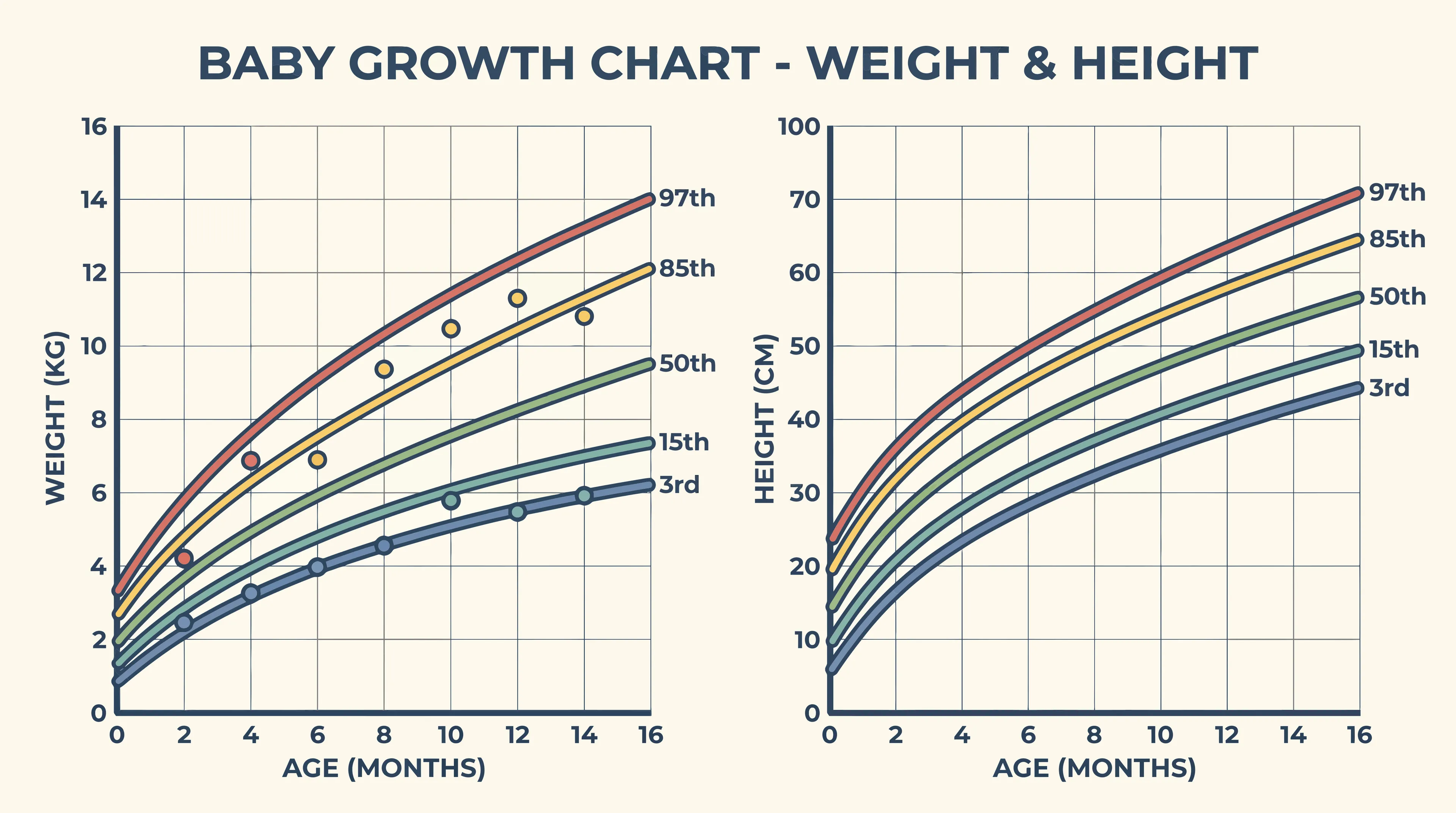
When you look at a baby growth percentile chart, you will see several curved lines running upward across the page. These lines represent percentiles, typically plotted at the 3rd, 15th, 50th, 85th, and 97th levels.

Understanding percentiles is straightforward once you know how the comparison works:

  • If your baby is on the 50th percentile, it means 50% of healthy babies of the same age and sex weigh less, and 50% weigh more. This is the statistical median.
  • If your baby sits on the 75th percentile, it means they weigh more than 75 out of 100 babies, and less than 25 out of 100 babies in the reference population.
  • If your baby tracks along the 15th percentile, they are lighter than 85 out of 100 infants, but this can represent normal, proportionate health for their individual frame.

A common misconception is that the 50th percentile is the ideal target to reach. Growth charts do not function like graded exams where higher is better. A baby on the 10th percentile can be just as healthy and energetic as a baby on the 90th percentile.

Consistency matters far more than the exact number. A baby who starts near the 25th percentile and continues to track steadily near that line over several months demonstrates healthy physical progress. Paediatricians watch for sharp shifts, such as a child suddenly dropping from the 75th percentile down to the 15th, rather than focusing solely on where the child sits on a given day.

Signs of Healthy vs Concerning Weight Gain

Parents frequently ask how much should my baby weigh at various milestones and whether their daily weight gain is adequate. While looking at an infant weight chart helps, observing daily behaviors, feeding cues, and physical indicators provides a more complete view of their well-being.

Signs of Healthy Growth

  • Steady progress along an established growth curve over several months.
  • Wetting 6 or more diapers in a 24-hour period after the first week of life, with pale, odorless urine.
  • Regular, soft bowel movements appropriate for their age and feeding source.
  • Good alertness during awake periods, strong muscle tone, and visible engagement with caregivers.
  • Meeting developmental milestones like lifting the head, rolling, and tracking objects with their eyes.
  • Contentment and relaxation after feeds, showing that their nutritional intake meets their hunger.

Red Flags for Concerning Weight Gain

  • A flat growth curve, indicating no weight gain over a period of 3 to 4 weeks in early infancy.
  • A sustained drop crossing two or more major percentile lines on a newborn weight chart.
  • Fewer than 4 wet diapers a day, or urine that appears dark amber or concentrated.
  • Extreme lethargy, weak crying, or difficulty waking up for regular feeding sessions.
  • Persistent, forceful vomiting after feedings, distinct from mild and common infant spit-up.
  • Sunken fontanelles (the soft spots on top of the head) or dry mucous membranes inside the mouth.

When asking how much should my baby weigh, keep in mind that short periods of slower weight gain can happen during minor colds or when teething begins. However, persistent stalling requires medical evaluation.

Factors That Influence Infant Weight

Infant growth is influenced by internal biological patterns and external nutritional factors. Understanding these variables prevents unnecessary anxiety when comparing your child to generic milestones.

  • Genetics: Parental height and body frame play a substantial role in determining an infant's build, bone structure, and overall growth trajectory.
  • Feeding Method: Breastfed babies often gain weight rapidly in the first 2 to 3 months and then taper to a leaner growth rate, whereas formula-fed infants may show a more uniform, heavier gain later in infancy.
  • Gestational Age: Premature babies need their age adjusted for prematurity on a newborn weight chart to reflect their biological developmental stage accurately.
  • Maternal Health During Pregnancy: Maternal nutrition, placental efficiency, gestational diabetes, and thyroid health directly influence birth weight and early postnatal growth patterns.
  • Acute Illnesses: Common infant infections like gastroenteritis, viral bronchiolitis, or ear infections can cause temporary pauses in weight gain or brief weight loss.
  • Caloric Efficiency and Metabolism: Natural variations in basal metabolic rates and daily activity levels influence how effectively an infant converts milk calories into body mass.

When to Consult a Paediatrician?

Regular well-child visits are scheduled to catch growth issues before they lead to developmental setbacks. However, certain clear trigger points warrant an earlier consultation with your healthcare provider.

Schedule an appointment if:

  • Your baby has not regained their birth weight by 14 days of life.
  • The growth curve shows zero weight gain over an entire month during the first 6 months.
  • There is an unexplained, sudden drop across two major percentile curves on the growth chart.
  • Your baby frequently falls asleep within 2 to 3 minutes of starting a feed and refuses to wake up for more milk.
  • You notice signs of chronic dehydration, such as dry lips, no tears during crying, or sunken eyes.
  • You feel persistent anxiety about whether your baby is receiving enough milk or formula.

Always consult a certified paediatrician rather than attempting self-diagnosis, home remedies, or unverified feeding regimens.

Contraindications and Precautions

Standard growth charts are designed for healthy, full-term infants. Applying standard WHO charts to all infants without clinical adjustment can lead to incorrect conclusions and inappropriate feeding interventions.

Important Precautions:

  • Premature Infants: Babies born before 37 weeks of gestation should not be evaluated against standard full-term charts without using corrected gestational age or specialised premature infant growth charts (such as Fenton growth charts).
  • Underlying Medical Conditions: Infants diagnosed with congenital heart disease, metabolic disorders, renal conditions, or chromosomal variations (such as Down syndrome) require condition-specific growth curves monitored by specialists.
  • No Unsupervised Dietary Changes: Never dilute formula, switch to animal milks, introduce solid foods prematurely before 4 to 6 months, or use infant supplements without direct instruction from a paediatrician.
  • Avoid Unregulated Growth Tonics: Do not administer over-the-counter appetite stimulants, digestive drops, or herbal concoctions to alter baby weight.

Prescribing Information and Safety Note: This guide is intended for educational purposes and should not replace clinical judgment or professional pediatric advice.

Adverse Event Reporting: Report adverse events to your healthcare provider or the relevant regulatory authority.

Medical Review Note: Reviewed by a qualified pediatric specialist to ensure clinical accuracy and alignment with current pediatric growth monitoring guidelines.

Conclusion of Baby Growth Tracking

Tracking your baby's weight offers clear insight into their nutritional health and physical milestones throughout the first year. Rather than aiming for a specific number on the scale, focus on consistent, steady gains along your baby's individual percentile line. Routine well-baby visits, responsive feeding, and close observation of wet diapers and activity levels remain the most reliable ways to ensure your infant continues to thrive.

FAQS

What is a healthy weight for a newborn baby?

A full-term newborn typically weighs between 2.5 kg and 4.4 kg at birth, with the median average sitting around 3.2 to 3.3 kg. Birth weight depends on gestational age, maternal health, and genetics, and your doctor will check that it aligns proportionally with baby length.

How much weight should a baby gain each month?

During the first 3 months, healthy infants typically gain roughly 150 to 200 grams per week, totaling around 600 to 800 grams per month. Between 4 and 6 months, this rate usually moderates to about 400 to 600 grams monthly, slowing further as solid foods are introduced.

Is it normal for babies to lose weight after birth?

Yes, it is entirely normal for newborns to shed 5% to 10% of their birth weight within the first 3 to 5 days of life as excess fluid is eliminated. Most healthy infants regain their initial birth weight by 10 to 14 days after birth with steady feeding.

What if my baby is not following the growth chart?

If your baby's weight veers significantly from their typical curve, a paediatrician will assess their latch, feeding volume, stool frequency, and overall physical milestones. Temporary dips can occur after mild illnesses and are usually resolved with simple feeding adjustments.

Are WHO growth charts different from CDC charts?

Yes, the WHO charts reflect how healthy children grow under optimal conditions worldwide, using breastfed infants as the physiological baseline. The CDC charts historically described how a specific sample of children grew in the United States, which included a larger proportion of formula-fed infants.

Apollo 247 Floating Action Button