
0
Welcome User
Login/Sign Up

Login/Sign Up
₹148.5
(Inclusive of all Taxes)
Get Free delivery (₹99) with
Zio Cal D3 Tablet is used to treat and prevent nutritional deficiencies. A nutritional deficiency occurs when the body does not absorb or get enough nutrients from food. Vitamins and minerals are necessary for body development and the prevention of diseases.
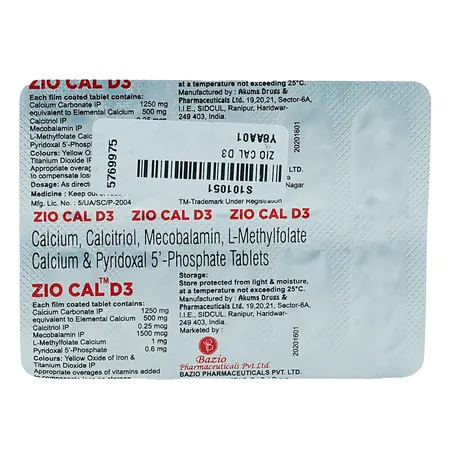
Zio Cal D3 Tablet is a combination of five supplements: Elemental Calcium, Calcitriol, Methylcobalamin, Pyridoxal-5-Phosphate, and L-Methylfolate calcium. Elemental Calcium makes the bones stronger by increasing their density. It helps in treating and preventing low calcium levels. Calcitriol is a form of vitamin D which helps in the absorption of calcium from the stomach. Methylcobalamin helps in the proper functioning of the brain and nerves and the production of red blood cells. Pyridoxal-5-phosphate helps regulate essential metabolic functions. L-Methylfolate calcium helps in producing and maintaining new blood cells. Together, Zio Cal D3 Tablet helps in treating nutritional deficiencies.
You are advised to take Zio Cal D3 Tablet for as long as your doctor has suggested it for you, depending on your medical condition. In some cases, you may experience certain common side effects, such as stomach pain, constipation, loss of appetite, nausea, and vomiting. Most of these side effects do not require medical attention and will resolve gradually over time. However, you are advised to talk to your doctor if you experience these side effects persistently.
Inform your doctor if you are taking any other medicines and herbal products before starting Zio Cal D3 Tablet . If you are known to be allergic to Zio Cal D3 Tablet or its inactive components, please talk to your doctor. Consult your doctor before taking Zio Cal D3 Tablet if you are pregnant or breastfeeding. Zio Cal D3 Tablet should not be given to children unless advised by a doctor. Avoid consuming alcohol along with Zio Cal D3 Tablet .
Zio Cal D3 Tablet is used in the management and treatment of nutritional deficiencies. The detailed uses of Zio Cal D3 Tablet are as follows:
Zio Cal D3 Tablet is a combination of five supplements: Elemental Calcium, Calcitriol, Methylcobalamin, Pyridoxal-5-Phosphate, and L-Methylfolate calcium. Zio Cal D3 Tablet is used to treat and prevent nutritional deficiencies. Elemental Calcium makes the bones stronger by increasing their density. It helps in treating and preventing low calcium levels. Calcitriol is a form of vitamin D which helps in the absorption of calcium from the stomach. Methylcobalamin helps in the proper functioning of the brain and nerves and the production of red blood cells. Pyridoxal-5-phosphate helps regulate essential metabolic functions. L-Methylfolate calcium helps in producing and maintaining new blood cells. Together, Zio Cal D3 Tablet helps in treating and preventing nutritional deficiencies.
Caution
Avoid consumption of alcohol while taking Zio Cal D3 Tablet .
Caution
Please consult your doctor before taking Zio Cal D3 Tablet if you are pregnant or if you have any concerns regarding this; your doctor will recommend only if the benefits outweigh the risks.
Caution
Consult your doctor before taking Zio Cal D3 Tablet , your doctor will decide whether Zio Cal D3 Tablet can be taken by breastfeeding mothers or not.
Caution
It is unknown whether Zio Cal D3 Tablet affects your ability to drive. Drive or operate machinery only if you are alert.
Caution
Limited data is available regarding the usage of Zio Cal D3 Tablet in patients with liver impairment. Please consult your doctor before taking Zio Cal D3 Tablet if you have a liver impairment or any concerns regarding this.
Caution
Limited data is available regarding the usage of Zio Cal D3 Tablet in patients with kidney impairment. Please consult your doctor before taking Zio Cal D3 Tablet if you have kidney impairment or any concerns regarding this.
Caution
Limited data is available regarding the usage of Zio Cal D3 Tablet in children, so please consult a doctor.
Consult your doctor
Please inform your doctor if you have a history of heart disease before taking Zio Cal D3 Tablet . Your doctor will recommend it only if the benefits outweigh the risks.
Consult your doctor
Zio Cal D3 Tablet should be given to elderly patients only if recommended by a doctor. If you have any concerns, please consult your doctor.
Try Vitamin B complex food sources like milk, cheese, eggs, liver and kidney, chicken, red meat, tuna, mackerel, and salmon, shellfish, oysters, clams, dark green vegetables, such as spinach and kale, beets, avocados, potatoes, whole grains, cereals, kidney beans, black beans, and chickpea.
Try folate-rich food sources like broccoli, Brussels sprouts, leafy green vegetables, cabbage, kale, spring greens, spinach, peas, chickpeas, kidney beans, liver (avoid this during pregnancy), and breakfast cereals fortified with folic acid.
Sprinkle sunflower seeds over your food, vegetables and salads.
Include fruits like citrus, banana, and watermelon in your diet.
Avoid smoking and alcohol consumption.
Exercise regularly and maintain a healthy lifestyle. Avoid excess fatty foods.
Have a query?
Do not take Zio Cal D3 Tablet if you are allergic to any of its contents. Inform your doctor before taking Zio Cal D3 Tablet if you have anaemia, infections, low potassium levels in blood, kidney or liver problems. Do not take Zio Cal D3 Tablet if you are pregnant or breastfeeding unless recommended by the doctor. Zio Cal D3 Tablet should be given to children only if advised by the doctor. Avoid consuming alcohol while being treated with Zio Cal D3 Tablet .
Drug-Drug Interactions: Zio Cal D3 Tablet may have interaction with a pain killer (aspirin), supplement (iron, ergocalciferol, cholecalciferol), hormone (levothyroxine), antacid (cimetidine, omeprazole, lansoprazole), anti-diabetic (metformin), antibiotic (chloramphenicol), anti-convulsant (phenobarbital, phenytoin), anti-neoplastic (altretamine), and anti-Parkinson medication (levodopa).
Drug-Food Interactions: No interactions found/established.
Drug-Disease Interactions: Zio Cal D3 Tablet may have interactions with malabsorption, low potassium levels in the blood, electrolyte imbalance, dialysis, hypercalcemia, kidney and liver problems.
Login/Sign Up
Login/Sign Up
Disclaimer


