logo
0

Baby Milestones: A Month-by-Month Guide to Growth

Track baby milestones month by month, from newborn reflexes to first steps, words, social skills, developmental delays, and ways to support growth.

article image

Dr. Mayank

Watching your baby grow across the first twelve months is one of parenthood's most absorbing experiences. Baby milestones give you a structured way to understand what your child is learning and when to expect each new skill. They are not a pass-or-fail checklist but a broad map covering physical, cognitive, and social development from the day your baby arrives to their first birthday.

What Are Developmental Milestones and Why They Matter?

Developmental milestones are skills or behaviours that most babies achieve within a certain age window. Paediatricians group them into four domains:

  • Physical (gross motor): large muscle skills like rolling, sitting, and walking
  • Physical (fine motor): hand and finger control such as grasping and the pincer grip
  • Cognitive: thinking, memory, problem-solving, and early language
  • Social and emotional: smiling, recognising caregivers, and responding to others

The word "typical" matters here. Every baby develops at their own pace, and the ranges can be wide. Reaching a milestone a few weeks later than average is usually normal. These benchmarks help you have informed conversations with your paediatrician rather than replacing a professional assessment.

Newborn to 3 Months: Early Milestones

The newborn period looks quiet from the outside but is neurologically intense. These first weeks are full of reflexes and rapid sensory tuning.

Month 1

  • Startles to sudden sounds (Moro reflex)
  • Turns head toward a familiar voice
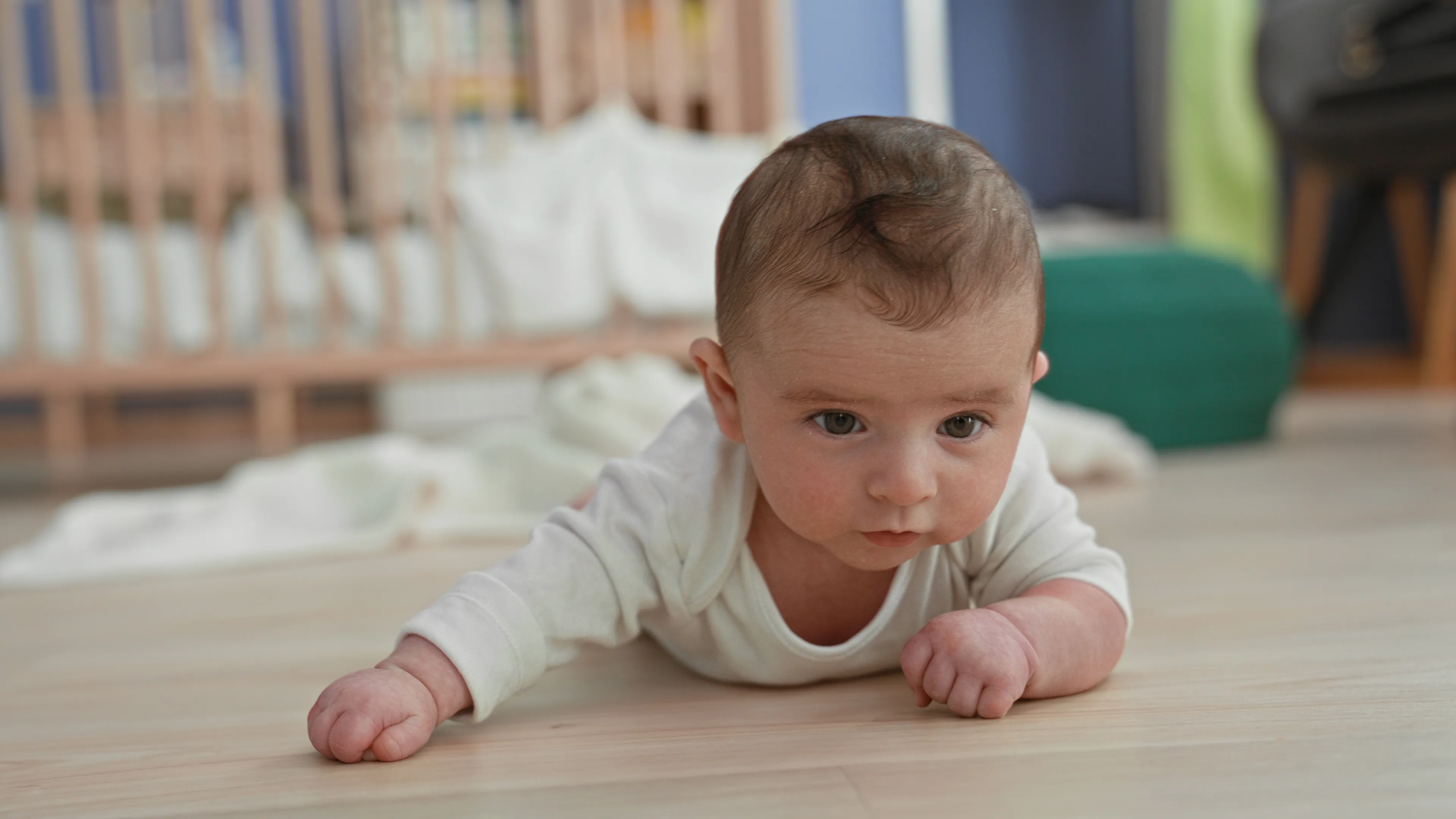
  • Briefly lifts chin during tummy time.
  • Focuses on faces held about 20 to 30 cm away

Month 2

  • Tracks a moving object with the eyes
  • Holds head up for short periods during tummy time
  • Begins cooing with soft vowel-like sounds
  • Responds to your voice with small body movements

Month 3

  • Produces the first real social smile in response to your face or voice
  • Holds head steady with less wobble
  • Swipes at dangling objects intentionally
  • Recognises the primary caregiver's face and voice distinctly

These newborn milestones confirm the nervous system is wiring itself correctly. Tummy time, gentle talking, and skin-to-skin contact actively support this phase.

4 to 6 Months: Rolling, Babbling and Recognition

This quarter brings some of the most visible leaps in infant developmental milestones. Babies become far more interactive and start making deliberate movements.

Month 4

  • Rolls from tummy to back (the easier direction first)
  • Reaches for and grasps objects with both hands
  • Laughs out loud
  • Shows excitement at familiar faces and routines

Month 5

  • Begins rolling in both directions
  • Passes an object from one hand to the other
  • Babbles simple consonant-vowel sounds like "ba" and "ma"
  • Recognises their own name when called

Month 6

  • Sits briefly with support or by leaning on hands
  • Transfers objects purposefully and mouths them to explore texture.
  • Babbling becomes more rhythmic and conversational in tone.
  • May show early signs of teething such as drooling and gum sensitivity, which can briefly affect sleep without necessarily changing developmental progress

Rolling over typically appears between 4 and 6 months. Many babies roll from tummy to back around 4 months and roll both ways by 5 to 6 months, but the range is wide.

7 to 9 Months: Sitting, Crawling and Stranger Anxiety

The 7-to-9-month window is when babies grow dramatically more mobile and emotionally aware. Social and cognitive milestones accelerate noticeably here.

Month 7

  • Sits unsupported for several seconds, then longer stretches
  • May begin belly-crawling or shuffling
  • Explores objects by banging, shaking, and dropping them
  • Begins to understand cause and effect (drops spoon, looks for it)

Month 8

  • Many babies crawl on hands and knees; some skip this and move straight to pulling up.
  • Object permanence emerges: baby searches for a toy hidden under a cloth.
  • Responds to "no" and simple phrases in context
  • Shows clear preference for familiar caregivers

Month 9

  • Pulls to a stand using furniture
  • Pincer grasp develops, picking up small pieces of food with thumb and forefinger.
  • Stranger anxiety peaks: baby cries or clings when unfamiliar people approach
  • Imitates sounds, clapping, and simple gestures.

Stranger anxiety, though stressful for families, is a healthy social and cognitive milestone. It confirms your baby has formed secure attachments and can distinguish familiar from unfamiliar people.

Most babies start crawling between 7 and 10 months, but some walk without ever crawling in the classic sense. Both patterns are generally normal.

10 to 12 Months: First Words and First Steps

These months bridge infancy and toddlerhood. Motor confidence and early language come together quickly.

Month 10

  • Cruises along furniture, shifting weight side to side.
  • Uses gestures: waves bye-bye, points at objects of interest
  • Understands several common words (ball, cup, mama, dada)
  • Imitates actions like banging a spoon

Month 11

  • Stands independently for a few seconds
  • Says one or two words with meaning, typically "mama" or "dada" directed at the right person
  • Tries to repeat words after hearing them
  • Shows strong preferences for certain foods, toys, or people

Month 12

  • Many babies take first independent steps around this time, though 9 to 15 months is the normal range.
  • Uses 1 to 3 words consistently with meaning
  • Follows simple one-step instructions ("give me the cup")
  • Points to request things or share interest

Tracking baby milestones by month through this baby growth chart for the first year shows how dramatically skills compound. Month 12 is less an endpoint than a launch pad for toddler development.

Signs of Developmental Delay: When to Consult a Paediatrician?

The following signs warrant a prompt conversation with your paediatrician. They are not a diagnosis but a prompt to seek professional assessment.

AgeRed-flag sign
2 monthsDoes not respond to loud sounds or follow objects with eyes
4 monthsDoes not smile at people or hold head steady
6 months Does not laugh, squeal, or reach for objects
9 monthsDoes not babble, bear weight on legs, or sit with support
12 monthsDoes not use any words, point, or wave

Signs of developmental delay in babies can appear across any domain: physical (not rolling or sitting by expected ages), cognitive (no object permanence by 9 months), or social (no eye contact, no response to name by 12 months).

Do not self-diagnose based on an article. Early intervention works best when it starts early, and your paediatrician is the right first step.

Supporting Healthy Development: Nutrition and Care Basics

A baby's brain and body grow fastest in the first year. What supports that growth is simpler than many products suggest.

  • Exclusive breastfeeding for the first 6 months provides balanced nutrition for most infants; after 6 months, appropriate complementary foods are added gradually.
  • Responsive caregiving, talking, singing, and making eye contact build neural pathways as effectively as any toy.
  • Safe, supervised tummy time from the first weeks strengthens the neck, shoulder, and core muscles needed for rolling, sitting, and crawling.
  • Adequate sleep matters: newborns need 14 to 17 hours a day, and the amount gradually decreases through the first year.

On supplements: iron, vitamin D, and other micronutrients are sometimes recommended for specific situations, such as exclusively breastfed babies in low-sunlight environments or premature infants. Any supplement must be prescribed or approved by a paediatrician based on your baby's individual needs. Do not give supplements based on general advice. Report adverse events to your healthcare provider or the relevant regulatory authority.

Conclusion

Baby milestones provide a helpful guide to how children typically develop during their first year, but every baby progresses at their own pace. From head control, rolling, and sitting to babbling, gestures, and first steps, developmental skills emerge across physical, cognitive, language, and social areas. Parents can support healthy development through responsive interaction, tummy time, appropriate nutrition, and adequate sleep. If your baby misses several expected milestones, shows a developmental red flag, or loses a skill they previously had, speak with a paediatrician for an individual assessment.

FAQs

What is the average age for a baby to walk?

Most babies take their first independent steps between 9 and 12 months, with 15 months considered within the typical range. If your baby is not walking by 15 months, speak with your paediatrician.

Is it normal for babies to reach milestones at different times?

Yes, there is a wide normal range for almost every milestone, and individual variation is expected. What matters is that development is progressing, even if the pace differs from another baby's.

What milestones should a 6-month-old baby have?

By 6 months, most babies sit briefly with support, roll in both directions, babble consonant-vowel sounds, recognise familiar faces, and reach for and transfer objects between hands.

How do I track my baby's milestones?

Keep a simple journal or use a trusted app to note when your baby achieves each skill, and bring this record to every pediatric check-up so your doctor can review the full picture alongside weight and growth measurements.

When should I worry about my baby not meeting milestones?

If your baby misses multiple milestones in one domain, or shows any of the red-flag signs listed in the table above, consult your paediatrician promptly rather than waiting for the next scheduled visit

Apollo 247 Floating Action Button